
Cash Transactions Continue to Dominate Housing Sector
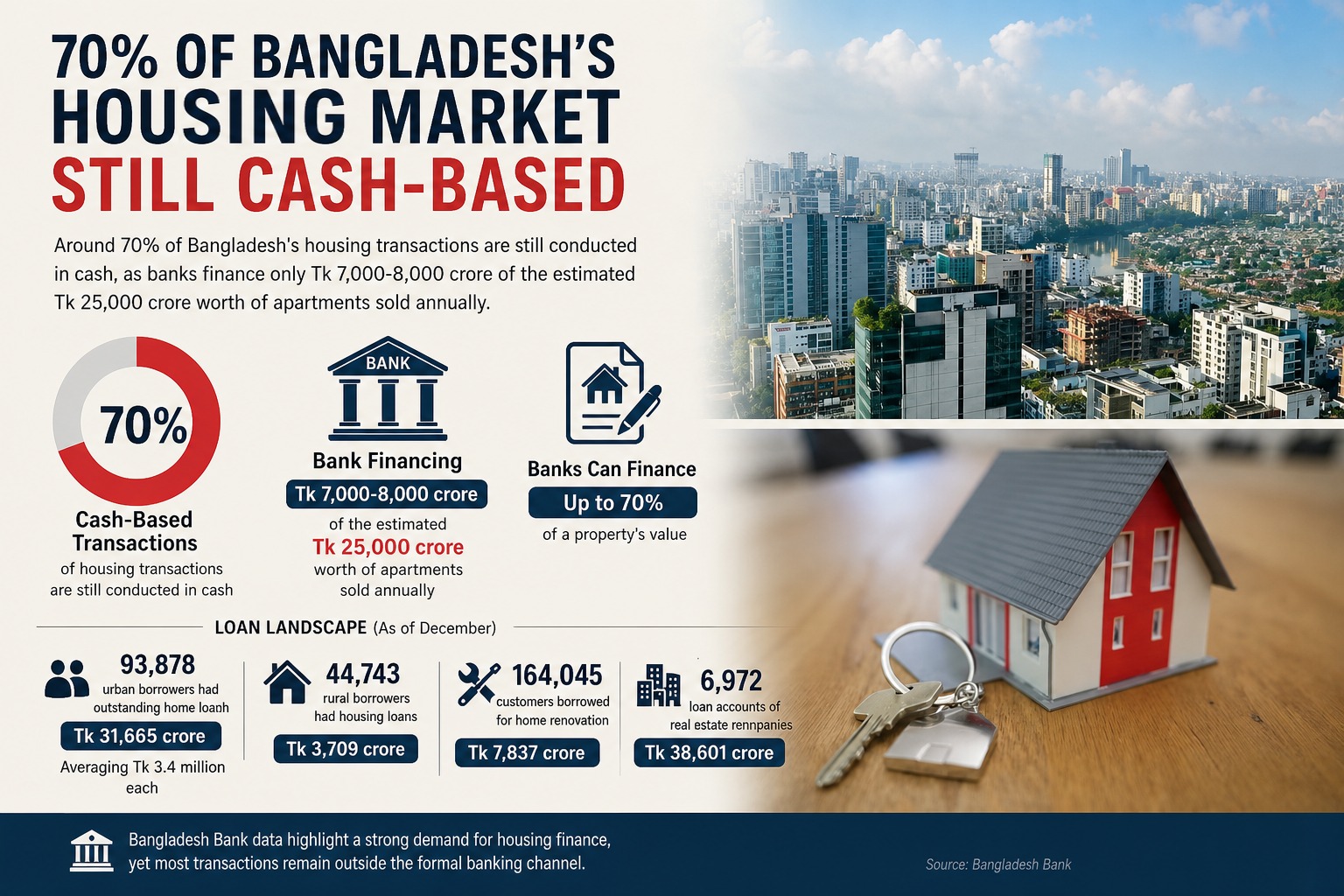
Around 70% of Bangladesh's annual housing transactions are still conducted through cash or informal payments, highlighting the country's underdeveloped mortgage market and the heavy reliance on unreported funds in the real estate sector.
Industry estimates show that apartments worth approximately Tk 25,000 crore are sold each year, while banks and financial institutions provide only Tk 7,000–8,000 crore in housing loans. This means that only about 30% of property purchases are financed through formal banking channels, leaving the remaining 70% to be settled primarily in cash.
An analysis of data from Bangladesh Bank, the Real Estate and Housing Association of Bangladesh (REHAB), and various research organisations indicates that REHAB member companies have sold nearly three million apartments over the years, but only a small proportion of these purchases involved bank financing.
Sector experts and bankers say that in most developed and emerging economies, housing markets are driven by long-term, low-interest mortgage financing. Affordable home loans enable even lower-middle-income families to purchase homes. In Bangladesh, however, high interest rates, cumbersome loan procedures, expensive property registration fees, and widespread cash transactions have prevented the mortgage market from expanding.
According to Bangladesh Bank, as of December last year, only 93,878 urban borrowers had outstanding home loans for apartment purchases, with total loans amounting to Tk 31,665 crore—an average of about Tk 3.4 million per borrower.
In rural areas, 44,743 borrowers had housing loans worth Tk 3,709 crore, averaging Tk 829,000 each. Another 164,045 customers obtained Tk 7,837 crore for home renovation, with an average loan size of Tk 478,000.
Real estate companies themselves had outstanding bank loans of Tk 38,601 crore through 6,972 loan accounts, averaging Tk 55.4 million per account.
Industry insiders argue that luxury apartments in Dhaka are often purchased entirely with cash, much of which is suspected to originate from undeclared or illicit income. At the same time, middle-income buyers face difficulties due to poor construction quality, delayed project delivery, legal complications over land ownership, and limited access to affordable bank financing.
To improve access to housing finance, Bangladesh Bank revised its mortgage policy in January this year. Under the new rules, banks with non-performing loan (NPL) ratios below 5% may provide housing loans of up to Tk 4 crore per borrower. Banks with NPLs between 5% and 10% can lend up to Tk 3 crore, while banks with NPLs above 10% remain capped at Tk 2 crore.
However, the loan-to-value ratio remains unchanged at 70:30, meaning banks can finance a maximum of 70% of a property's value, while buyers must arrange the remaining 30% from their own funds.
Economists say Bangladesh needs longer repayment periods and lower-interest mortgage products to make home ownership affordable for salaried middle-class families. They also note that expanding the housing finance market would stimulate nearly 500 related industries, including steel, cement, paint, furniture, timber and construction materials, while providing banks with a relatively secure lending portfolio backed by tangible collateral.
