
Bangladesh and the Makkah Defence Pact: Strategic Opening or a Test of Dhaka’s Balancing Diplomacy?
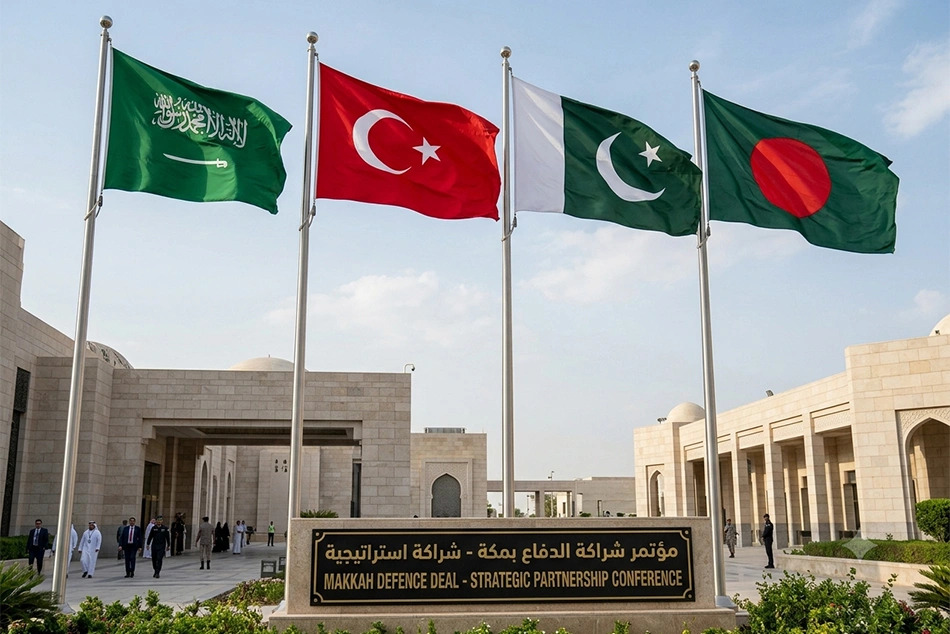
Dhaka’s interest in the Saudi Arabia–Pakistan–Türkiye framework reflects its search for diversified partnerships, defence technology and greater diplomatic space. But a collective-defence commitment would carry consequences extending far beyond military cooperation.
Bangladesh’s indication that it is open to exploring participation in the Makkah Joint Defence Agreement involving Saudi Arabia, Pakistan and Türkiye could mark an important moment in the evolution of its foreign policy. It does not mean that Dhaka has decided to join the pact. Nor does it constitute a formal application for membership. Nevertheless, the expression of interest is politically significant because it places Bangladesh within a wider debate over the emerging security architecture of the Muslim world.
The agreement was signed in Makkah on August 7, 2026, by Saudi Arabia, Pakistan and Türkiye. Its central collective-defence provision reportedly stipulates that an armed attack on one signatory would be regarded as an attack on all three. The framework also seeks to institutionalise political and military coordination, joint exercises, defence production, technology transfer and cooperation in such areas as air defence, unmanned systems, electronic warfare, artificial intelligence and military logistics. Reuters reported that the three governments plan coordination among their defence and foreign ministers and senior military commanders.
Against that background, the reported comments of Humayun Kobir, the Bangladeshi prime minister’s adviser for foreign affairs, deserve careful interpretation. He said Bangladesh maintained a positive approach towards the possibility of joining an economic or defence framework involving the three countries, subject to its interests and the changing global economic and trading environment. He also placed that possibility within a “Bangladesh First” foreign-policy approach.
This language is deliberately cautious. A positive attitude towards a possibility is not the same as a commitment to enter a military alliance. It is better understood as a diplomatic signal: Bangladesh is willing to examine new strategic arrangements but intends to judge them according to national interest rather than religious solidarity, ideological alignment or pressure from any external power.
From friendship with all to strategic diversification
Bangladesh’s traditional foreign-policy principle “friendship to all, malice towards none” was formulated in a very different international environment. It remains valuable, but today it must operate within a world shaped by great-power rivalry, regional conflicts, supply-chain insecurity, technological competition and uncertainty about traditional security guarantees.
Dhaka can no longer protect its interests through declarations of neutrality alone. It needs defence capabilities, access to technology, resilient energy supplies, diversified trade, maritime security and partnerships capable of responding to both conventional and non-conventional threats.
Bangladesh’s interest in the Makkah framework therefore should not automatically be portrayed as an abandonment of non-alignment. It may instead represent an attempt to practise multi-alignment: maintaining productive relations with India, China, the United States, the European Union, Japan and Russia while developing stronger partnerships with important Muslim-majority countries.
Saudi Arabia, Pakistan and Türkiye offer Bangladesh three distinct sets of strategic opportunities.
Saudi Arabia is a major source of employment, remittances, energy cooperation and investment. Millions of Bangladeshi workers have contributed to the Saudi economy, while their remittances remain important to Bangladesh’s external financial stability. Riyadh is also seeking to diversify its international partnerships and economic base, creating opportunities for Bangladeshi labour, infrastructure companies, agricultural ventures and investors.
Türkiye has emerged as an increasingly influential defence-industrial power. Its drones, naval platforms, armoured vehicles, electronic-warfare systems and aerospace technologies have attracted international attention. For Bangladesh, which is attempting to modernise its armed forces, cooperation with Türkiye could provide alternatives to excessive dependence on any single supplier.
Pakistan possesses a large and experienced military establishment, a developed defence industry and nuclear capability. Although the unresolved history of 1971 continues to cast a shadow over bilateral relations, Dhaka and Islamabad have recently shown interest in restoring normal diplomatic, commercial and people-to-people engagement. Normalisation, however, cannot require historical amnesia. A mature relationship should permit cooperation while preserving Bangladesh’s historical truth and national dignity.
What could Bangladesh gain?
The most immediate benefit would be wider access to defence technology and training. Bangladesh’s armed forces need modern surveillance systems, air-defence capabilities, naval platforms, cybersecurity infrastructure, drones and electronic-warfare technology. Joint development and production could be more valuable than simply purchasing finished equipment.
Bangladesh should seek partnerships that create domestic industrial capacity. Assembly plants, maintenance centres, technical education, licensed production and research cooperation could gradually reduce the country’s dependence on foreign suppliers. A defence relationship that merely turns Bangladesh into another market would offer limited long-term strategic value.
The pact could also strengthen maritime cooperation. Bangladesh sits at the northern edge of the Bay of Bengal, close to crucial sea routes connecting the Indian and Pacific oceans. Its commercial future increasingly depends on ports, shipping, offshore resources and secure maritime communications. Cooperation with the Turkish and Pakistani navies, supported by Saudi investment, could enhance training, search-and-rescue capacity, maritime-domain awareness and protection of commercial shipping.
Cybersecurity is another potential area. Bangladesh’s banking system, government networks, energy facilities, ports and telecommunications infrastructure face growing cyber risks. A modern security partnership must therefore extend beyond soldiers, aircraft and warships. Cooperation in cyber defence, artificial intelligence, intelligence analysis and the protection of critical infrastructure could serve civilian as well as military interests.
Diplomatically, closer engagement with these three countries could strengthen Bangladesh’s position in the Organisation of Islamic Cooperation. Dhaka has long sought greater international support for resolving the Rohingya crisis and securing the safe, voluntary and dignified return of refugees to Myanmar. If a deeper strategic relationship translated into more sustained diplomatic pressure on Myanmar, it would provide Bangladesh with an important benefit.
Yet Dhaka must not assume that military cooperation will automatically produce political support. Every partner has its own priorities, and these may not always coincide with Bangladesh’s interests.
The collective-defence dilemma
The pact’s most consequential element is the principle that an attack on one member would be considered an attack on all. Such language may create deterrence, but it also raises difficult questions.
What constitutes an “armed attack”? Who determines the aggressor? Would members be obliged to send combat forces, or could they provide political, logistical or intelligence support? Would the commitment apply to disputed territories, cross-border operations, proxy conflicts, cyberattacks or attacks on overseas military assets? Could a member refuse involvement if it considered another signatory responsible for escalating a conflict?
These are not academic questions. Saudi Arabia is deeply connected to Gulf security, energy routes and Middle Eastern rivalries. Türkiye is a NATO member with military involvement and security interests extending across several regions. Pakistan has a long and difficult relationship with India and continues to face internal and cross-border security threats.
Bangladesh, by contrast, has avoided direct involvement in distant interstate conflicts. Its armed forces are internationally respected largely because of their extensive role in United Nations peacekeeping. Entering a binding collective-defence arrangement could create expectations that are fundamentally different from peacekeeping.
Dhaka must therefore distinguish between joining a cooperation platform and accepting an automatic war commitment. Participation in joint exercises, defence manufacturing, training, maritime security or counterterrorism cooperation would be one matter. Accepting an obligation to enter an armed conflict involving another member would be something else entirely.
Before considering membership, Bangladesh would need access to the full text of the agreement and any classified protocols defining its obligations. A state cannot responsibly accept an open-ended security guarantee based only on broad political declarations.
India will be watching
Any movement by Bangladesh towards a defence framework involving Pakistan will inevitably attract scrutiny in New Delhi. India surrounds Bangladesh on three sides, shares a border of more than 4,000 kilometres with it and remains central to its geography, trade, transport, water management and regional connectivity.
Indian strategic circles may interpret Bangladeshi participation as the emergence of a Pakistan-linked security presence close to India’s vulnerable northeastern region and the Bay of Bengal. The inclusion of Türkiye, whose relations with India have sometimes been strained over Kashmir and its close association with Pakistan, could reinforce such concerns.
However, India’s possible discomfort cannot constitute a veto over Bangladesh’s sovereign foreign-policy choices. Bangladesh has the right to diversify its partnerships. At the same time, sovereignty is exercised most effectively through foresight rather than defiance. Dhaka should avoid allowing a new partnership to become an anti-India platform or a vehicle for the intelligence and military competition of external powers.
Transparent communication with New Delhi would therefore be essential. Bangladesh could explain that any cooperation would be defensive, would not permit foreign bases and would not be directed against a neighbouring state. Confidence-building measures could help prevent exaggeration and misunderstanding.
India, for its part, should recognise that Bangladesh’s diversification is not necessarily hostility. If New Delhi wants to remain Dhaka’s most trusted strategic partner, it must build that position through respect, reciprocity and responsiveness not through demands for exclusivity.
The China and United States calculations
China is Bangladesh’s largest source of defence equipment and a major partner in infrastructure and trade. Beijing would closely assess whether the Makkah framework complemented or challenged its interests.
Pakistan is one of China’s closest strategic partners, while Saudi Arabia and Türkiye maintain important economic relations with Beijing. The agreement is therefore not inherently anti-Chinese. Nevertheless, Bangladesh must consider how membership might affect its existing defence supply chains and its relationship with China in the Bay of Bengal.
The United States would also examine the pact carefully. Türkiye is a NATO member, and Saudi Arabia and Pakistan have longstanding security relationships with Washington. But an autonomous defence grouping could reflect growing doubts about reliance on Western guarantees and a desire for greater regional independence.
Bangladesh should not frame the arrangement as a choice between Western and Muslim-majority partners. It has significant interests in American and European markets, investment, technology, development cooperation and maritime security. Any decision that created sanctions exposure, interoperability problems or restrictions on advanced technology would need rigorous evaluation.
Economics must not disguise military obligations
Bangladeshi officials have referred to both economic and defence possibilities. There is merit in connecting security partnerships with economic benefits, but the two must not be blurred.
An agreement may promise investment, jobs, energy security or defence-industrial cooperation. These benefits, however, should not become inducements for accepting undefined military obligations. Dhaka should assess the economic framework and collective-defence clause separately.
If Bangladesh is invited to join, it should seek measurable commitments: Saudi investment in energy and infrastructure, Turkish defence-technology transfer, expanded market access, skilled employment for Bangladeshis, joint industrial ventures and support for maritime development. Vague assurances of brotherhood would not be sufficient.
Nor should religion substitute for strategy. Bangladesh is a Muslim-majority country, but it is also a secular republic with a foreign policy that must protect citizens of every faith. Its participation in an international arrangement must be based on constitutional interests, not the appearance of joining a sectarian bloc.
This is particularly important because the Middle East contains overlapping rivalries involving Iran, Israel, Gulf states and non-state armed groups. Bangladesh maintains friendly relations with Iran and supports Palestinian rights. It should avoid being drawn into a Sunni–Shia geopolitical confrontation or any arrangement interpreted as endorsing military escalation in the region.
Democratic and institutional scrutiny
A decision of this magnitude cannot be made by a small circle behind closed doors. Parliament, the foreign ministry, the defence establishment, economic policymakers and national-security specialists should be involved in a structured review.
The government should publish as much of the proposed framework as national security permits. Parliament should debate the costs, obligations and exit provisions. Independent experts should examine compatibility with the Constitution, international law, UN peacekeeping responsibilities and existing bilateral agreements.
The financial consequences also require attention. Collective defence is not cost-free. Membership may entail greater defence spending, force interoperability, joint exercises, procurement commitments, overseas deployments or logistical contributions. Bangladesh must determine whether these expenditures would strengthen national defence or divert resources from more immediate needs.
The country’s principal security challenges include the Rohingya crisis, instability in Myanmar, border management, cybercrime, climate disasters, maritime protection and the modernisation of its armed forces. Any alliance should be evaluated according to how effectively it helps Bangladesh address those challenges.
A cautious path forward
Bangladesh need not reject the Makkah framework, but neither should it rush towards full membership. A phased approach would be wiser.
Dhaka could initially seek observer or dialogue-partner status. It could participate selectively in disaster response, maritime rescue, military medicine, cyber defence, officer training, counterterrorism and defence-industrial projects. This would allow Bangladesh to test the framework’s practical value without immediately assuming an automatic collective-defence obligation.
The government should also establish clear red lines: no permanent foreign military bases, no deployment of Bangladeshi forces without constitutional authorisation, no involvement in sectarian conflicts and no use of Bangladeshi territory against a third country.
Most importantly, the arrangement should be tested against a simple question: does it increase Bangladesh’s strategic autonomy, or merely replace one form of dependence with another?
The Makkah Joint Defence Agreement represents the emergence of a potentially influential security grouping connecting South Asia, the Gulf and the eastern Mediterranean. Bangladesh’s interest reflects its growing ambition to move beyond a narrowly reactive foreign policy and to acquire a wider range of strategic options.
That ambition is legitimate. But strategic partnerships are valuable only when their obligations are understood, their benefits are tangible and their risks remain manageable. “Bangladesh First” must mean more than a slogan. It must require patient diplomacy, institutional scrutiny, economic calculation and a refusal to be drawn into conflicts that do not serve the country’s interests.
Bangladesh should keep the door open but it should read every clause before walking through it.
(Shahidul Alam Swapan is a Switzerland-based private-bank financial crime compliance specialist, columnist and poet)
