
Where Red Bricks Speak of Language and Freedom
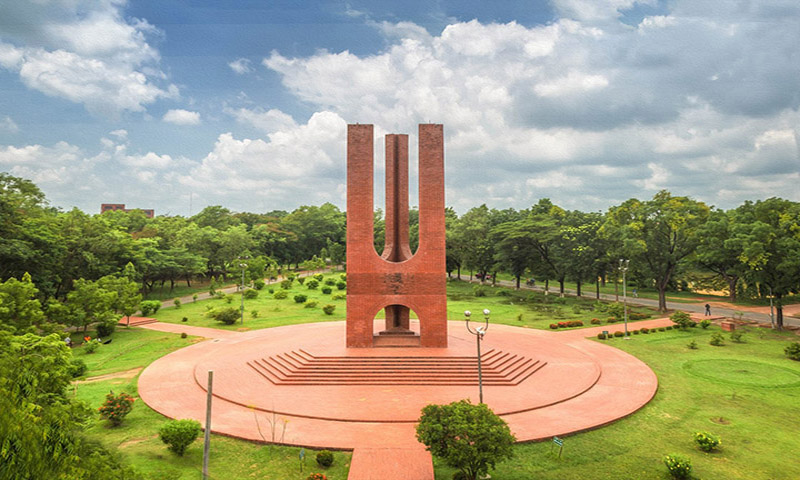
Amid the lush greenery of Jahangirnagar University(JU), a red-brick monument rises as a powerful reminder of the Bengali people’s struggle for linguistic rights and independence. With three towering pillars, landscaped surroundings and distinctive triangular pathways, the Central Shaheed Minar is more than an architectural landmark rather it is a symbol of history, sacrifice and national identity.
Located in front of the Faculty of Arts and Humanities, the monument stands 71 feet tall and is widely recognised as the tallest Shaheed Minar in Bangladesh. Its architectural design brings together the natural beauty of the campus and the historical significance of the Language Movement and the Liberation War.
The university’s journey towards building the present monument began with a smaller Shaheed Minar in front of Al-Beruni Hall, the first of its kind on campus. In 1985, during the tenure of then Vice-Chancellor Professor Dr A.F.M. Kamaluddin, it was relocated to the front of the Central Library. As students continued to call for a more prominent memorial, the foundation stone of the current structure was laid on November 6, 2004, under the initiative of then Vice-Chancellor Professor Khandaker Mustahidur Rahman. Designed by renowned architect Rabiul Hossain, it was formally inaugurated on February 13, 2008.
The monument’s dimensions carry profound historical symbolism. Its 52-foot-diameter base recalls the Language Movement of 1952, while its 71-foot height represents the Liberation War of 1971. Eight steps symbolise the significant years of the Bengali struggle for rights and independence: 1947, 1952, 1954, 1962, 1966, 1969, 1970 and 1971.
Its three triangular pillars represent Bengali language, literature and culture; the land, people and heritage; and the ideals of independence, sovereignty, economic emancipation and democracy.
Every February 21, teachers, students and university employees gather at the monument to pay tribute to the language martyrs with flowers. Yet its significance extends beyond commemorative occasions, reminding new generations of the sacrifices behind their linguistic and national identity.
Preserving this landmark requires collective responsibility. Keeping its surroundings clean, preventing damage and maintaining an atmosphere of respect are essential to protecting its legacy.
More than bricks and mortar, Jahangirnagar University’s Shaheed Minar is a monument to a nation's memory. Its enduring message is clear: language and freedom were hard-won achievements, and preserving their history is a responsibility shared by every generation.
