
Deposit growth nears 12%, while private-sector credit growth stands at just 4.75%, non-performing loans exceed Tk 6 lakh crore
Bank deposits rise, but private-sector lending remains sluggish
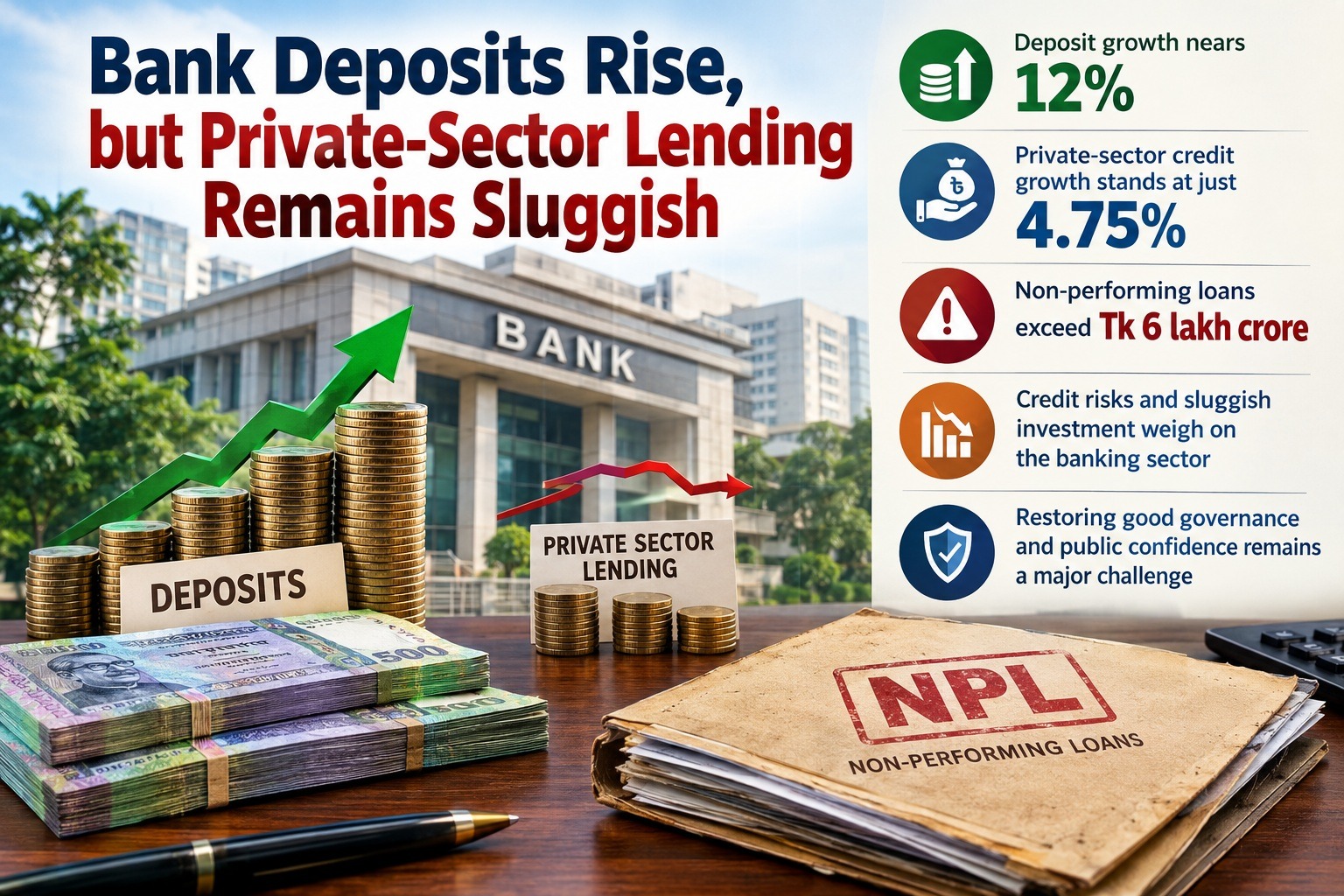
Despite rising deposits in the country's banking sector, credit flow to the private sector has failed to gain expected momentum. While deposit growth has reached nearly 12%, private-sector credit growth stands at just 4.75%. This widening gap has raised concerns over the effective utilization of funds mobilized by banks, the pace of private investment and the banking sector's capacity to finance productive activities. The situation is further compounded by a massive burden of non-performing loans (NPLs), credit risk concerns and sluggish investment.
According to the Bangladesh Bank's Major Economic Indicators: Monthly Update, August 2026, total deposits in the country's banking sector stood at approximately Tk 21,33,101 crore in August. This represented year-on-year growth of 11.96%. Meanwhile, outstanding bank credit to the private sector amounted to around Tk 18,30,062 crore. Annual private-sector credit growth stood at 4.75%, down from 6.35% in August of the previous year. In other words, while deposit growth accelerated, the pace of private-sector credit expansion slowed compared with the same period a year earlier.
An increase in bank deposits does not mean that all the additional funds can be disbursed as new loans. Banks must maintain the prescribed liquidity reserves and take into account their financial strength, borrowers' repayment capacity and the prevailing investment climate. Weak credit demand, high borrowing costs, business uncertainty and banks' own credit risk management practices can also affect lending. Therefore, the gap between deposit growth and private-sector credit growth is not merely a question of how much money banks hold. The availability of viable investment opportunities and demand from creditworthy borrowers are equally important.
A senior official of a private commercial bank, speaking on condition of anonymity, said rising non-performing loans put pressure on banks' earnings and liquidity management. Banks are also required to maintain provisions against loans, which can affect their capacity to extend fresh credit. In such circumstances, banks need to assess risks more carefully before lending, even to viable and capable entrepreneurs.
However, the burden of non-performing loans should not be passed on to ordinary borrowers or depositors. Transparency in loan approvals, monitoring the use of borrowed funds, accountability for irregularities and effective measures to recover overdue loans are essential. Proper supervision of banks' financial positions and protection of depositors' interests are equally important, the official said.
Non-performing loans remain one of the biggest concerns for the banking sector. According to data published by Bangladesh Bank, classified loans in the country's banking sector reached Tk 6,06,555 crore at the end of June 2026, accounting for 32.78% of total outstanding loans. The figure stood at Tk 5,88,704 crore at the end of March. This means classified loans increased by Tk 17,851 crore in just three months.
When a large volume of loans remains unpaid, banks come under pressure in terms of earnings, capital adequacy and liquidity management. The requirement to maintain provisions against these loans can also constrain their ability to extend fresh credit. If banks become more cautious about lending under these circumstances, genuine and financially capable entrepreneurs may also face difficulties in accessing finance. However, rising non-performing loans alone cannot explain the slowdown in credit growth. Investment demand, borrowing costs, business uncertainty and broader economic conditions also play significant roles.
Weak private-sector credit growth can hamper industrial expansion, the establishment of new businesses and plans to create employment. Access to finance is particularly important for small and medium-sized enterprises. At the same time, expanding lending must go hand in hand with proper assessment of borrowers' financial capacity, monitoring of loan utilization and timely recovery of outstanding debts. Otherwise, even if new lending increases, the banking sector could face an even heavier burden of non-performing loans in the future.
Addressing the current situation requires effective measures to recover defaulted loans, greater transparency in loan approvals, accountability for irregularities and stronger corporate governance in banks. At the same time, access to finance must be expanded for creditworthy borrowers in productive sectors. Strengthening banks' financial foundations, improving the investment climate and keeping borrowing costs at manageable levels are also important. The problem cannot be resolved simply by changing policy interest rates. It is equally necessary to assess how effectively credit reaches the real economy and supports productive activities.
Overall, the banking sector faces two major challenges: reducing the burden of non-performing loans and restoring banks' financial strength, while increasing credit flow to sectors that drive production, business activity and employment. Although deposit growth is encouraging, the economy will struggle to realize its expected benefits unless those funds are effectively channeled into productive investment. Ensuring good governance, accountability and sound risk management in lending, while expanding access to finance for genuine entrepreneurs, will therefore be crucial to restoring confidence and dynamism in the banking sector.
