
Energy shortages and credit constraints drive up industrial costs, slow investment
Rising production costs, uncertainty over energy supplies and sluggish investment are creating renewed concerns across Bangladesh's industrial sector. Unreliable gas and electricity supplies, high borrowing costs and business uncertainty are putting pressure on production planning and expansion activities.
These challenges are affecting industrial competitiveness, new investment and the potential for job creation. Although production and export activities continue in some sectors, broader economic indicators point to signs of weakness in the private sector.
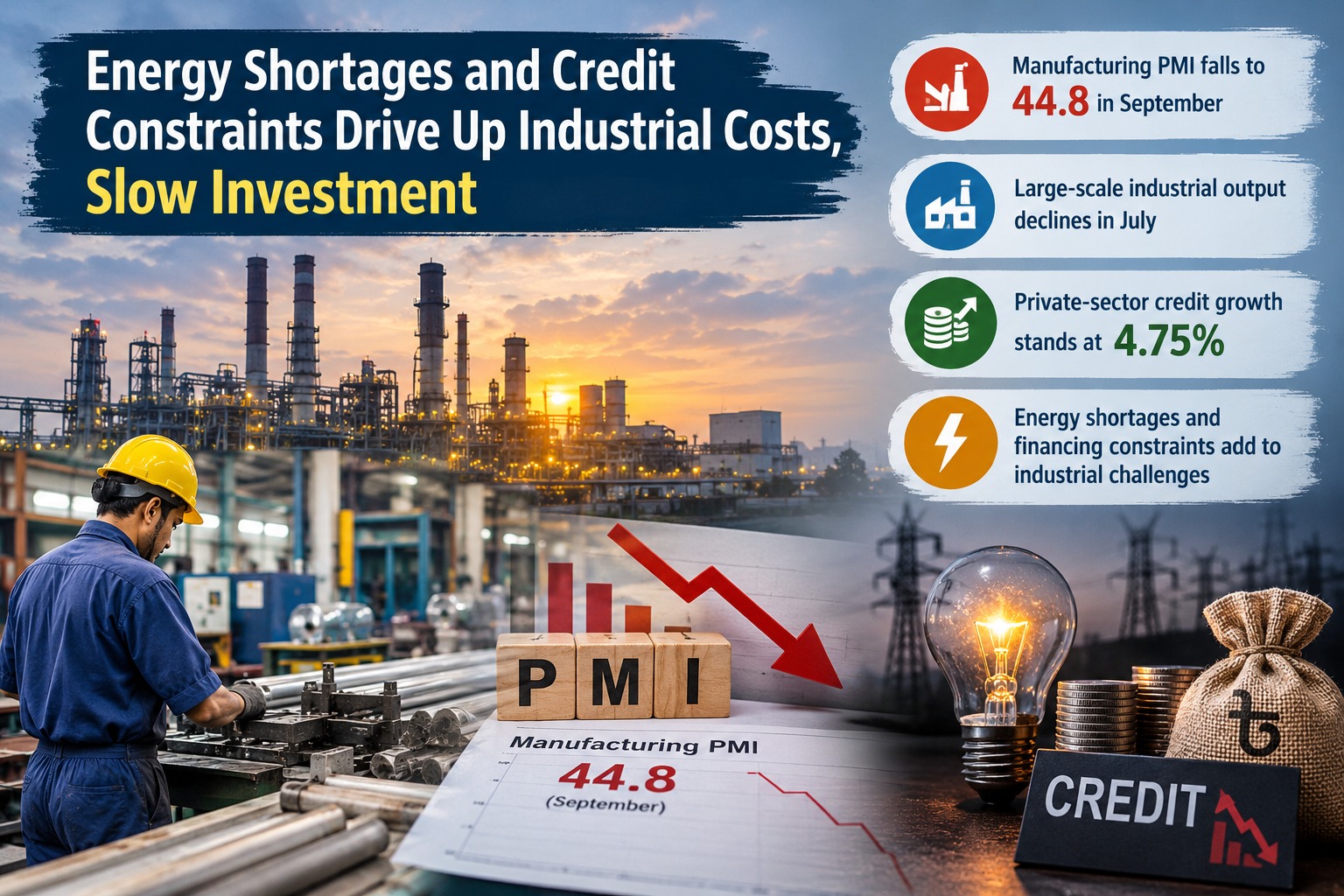
According to data from the Bangladesh Bureau of Statistics (BBS), large-scale industrial output fell by 0.22% in July, the first month of the 2026-27 fiscal year, compared with the same month a year earlier. During this period, output in the readymade garment industry declined by more than 2%, while the textile industry recorded growth of over 5% and the food manufacturing industry expanded by more than 20%. This indicates that conditions vary across different segments of the industrial sector. Nevertheless, the decline in overall large-scale industrial production, alongside contraction in several important sectors, points to weaknesses in the production environment.
Another important indicator of private-sector activity is the Purchasing Managers' Index (PMI). According to the index published by the Metropolitan Chamber of Commerce and Industry, Dhaka, and Policy Exchange Bangladesh, the overall private-sector PMI fell to 48.6 in September from 49.9 in August. The manufacturing PMI dropped to 44.8. A reading below 50 generally indicates contraction rather than expansion in the relevant sector. Weakness in production, new orders and raw material procurement during September further underscored the situation.
Stable energy supplies have become a major challenge for industrial entrepreneurs. Shortages of gas and electricity can prevent factories from operating machinery at full capacity. In some cases, businesses are forced to revise production schedules, incur additional operating expenses and face delays in delivering goods. These disruptions increase production costs and make it more difficult for manufacturers to meet customer demand in both domestic and international markets.
However, there have also been indications of some improvement in energy supplies. According to supply data from Petrobangla, daily gas supplies in the final week of September increased compared with the previous month. Therefore, an assessment of industrial production should consider not only the extent of the supply constraints but also how far factory operations have returned to normal following the increase in supplies. A temporary improvement does not guarantee long-term stability. Industries need a reliable supply system that allows entrepreneurs to plan production and make investment decisions with greater certainty.
Financing constraints are also weighing on the sector. According to data from Bangladesh Bank and the General Economics Division of the Planning Commission, private-sector credit growth stood at 4.75% in August, down from 6.35% in the same month of the previous year. During the same period, bank deposit growth was approximately 12%. The relatively slow expansion of private-sector credit despite rising deposits has raised questions about the pace of financing for productive investment. High borrowing costs, risks within the banking sector and weakening business confidence may all be contributing to the situation.
From the perspective of industrial owners, the central challenge is managing rising production costs while coping with business uncertainty. When the costs of energy, raw materials, transportation and financing increase, businesses cannot always pass those additional expenses on to consumers through higher prices. Export-oriented companies, in particular, face intense competition in international markets and have limited scope to raise prices at will. When production costs rise without a corresponding increase in selling prices, profit margins come under pressure. This can also affect decisions on purchasing new machinery, expanding factories and recruiting additional workers.
From an energy-sector perspective, long-term solutions require greater domestic gas exploration and production, better management of the risks associated with import dependence, and improvements in the capacity of electricity and gas distribution networks. Effective planning is also necessary to balance energy demand and supply in industrial zones. Alongside efforts to increase supplies, regularly assessing the scale of shortages in different locations and identifying the sectors most affected would help ensure more efficient use of limited resources.
Economic analysts emphasise that restoring investment requires not only reliable energy supplies but also confidence in the financial sector, easier access to credit and policy consistency. Lowering interest rates or temporarily increasing energy supplies alone will not resolve the underlying problems over the long term. Investors also need a predictable business environment, faster administrative services and adequate infrastructure. Regular publication of sector-specific data is equally important for tracking progress in new investment and employment generation.
The current situation in the industrial sector therefore represents both a challenge in managing production and operating costs and a test of the country's ability to revive investment. Greater stability in energy supplies, improved access to financing and a business-friendly environment could help industries make better use of their production capacity. These efforts must be supported by effective policy coordination and consistent implementation. Industrial production and investment influence not only business profitability but also the country's exports, employment and overall economic growth.
