
Bangladesh's economy trapped in "Stagflation-Like Pressures", World Bank warns
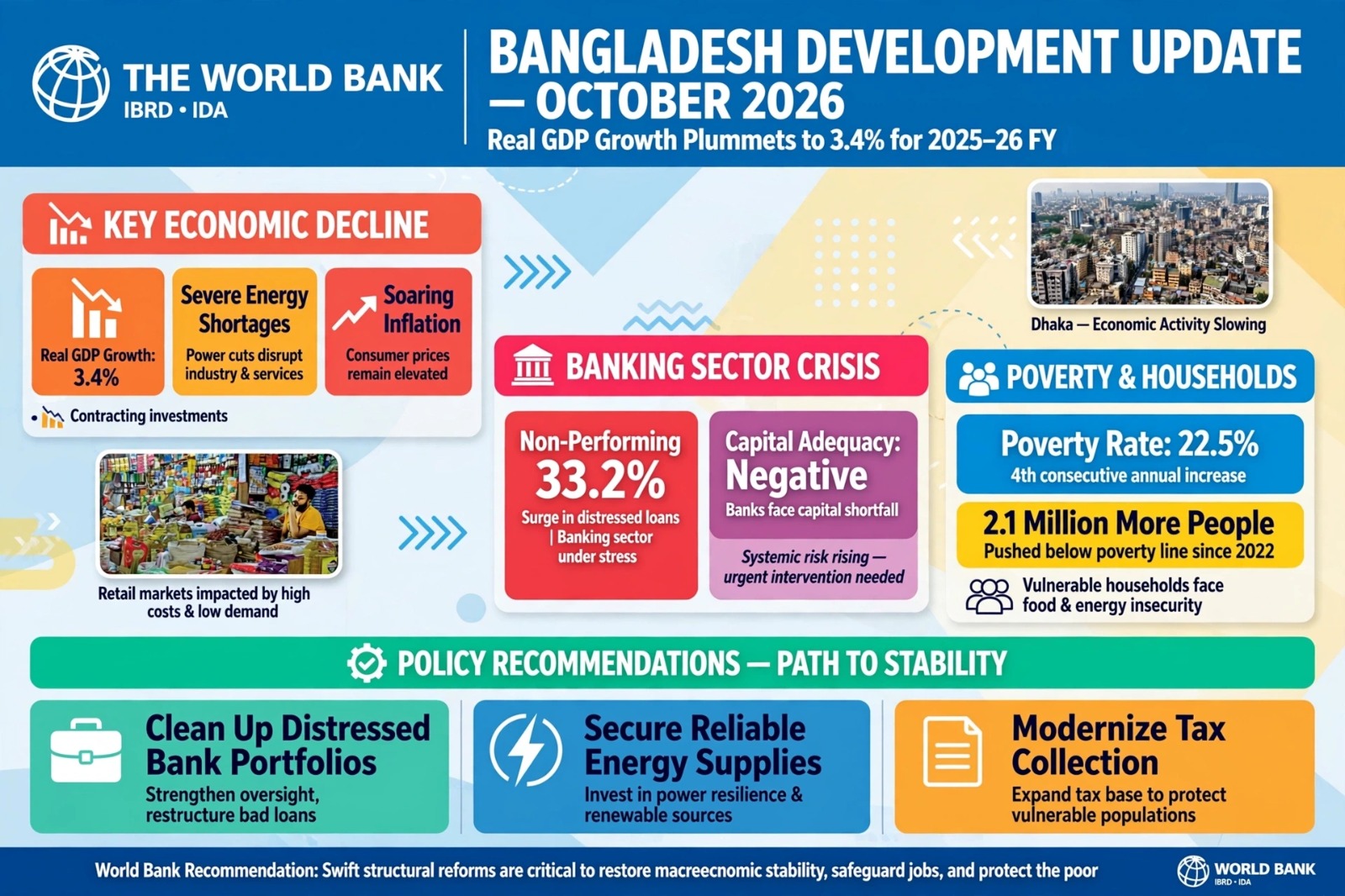
Bangladesh’s economic growth has stalled significantly, dragged down by a severe contraction in investment, a worsening banking crisis, and soaring inflation that continues to erode ordinary citizens' purchasing power.
According to the World Bank’s October 2026 Bangladesh Development Update, titled “Make Subsidies and Social Protection Work Better for the Poor,” the country’s real GDP growth has plummeted to 3.4% for the 2025–26 fiscal year. This marks a sharp decline from 5.8% in 2022–23 and sits well below the country's ten-year historical average of 5.6%. Worst still, growth hit a pandemic-era low of 2.2% in the third quarter of the fiscal year.
The report paints a sobering picture of an economy squeezed on multiple fronts, where systemic vulnerabilities in the financial sector and chronic energy shortages threaten long-term stability.
Investment Drought and Industrial Paralysis
The primary driver behind the economic slowdown is a severe contraction in domestic investment. Private investment dropped by 0.5%, and public investment fell by 0.7% in 2025–26, while real exports of goods and services contracted by 4.8%.
Industrial growth crawled to roughly 2%, with the third quarter seeing a 0.3% contraction in industrial output—the first quarterly decline since the COVID-19 pandemic. Chronic gas and electricity shortages have forced many factories to operate below capacity, curtail operating hours, or resort to layoffs.
Power and energy supply bottlenecks, coupled with a 16.7% surge in retail electricity prices, have kept inflation stubbornly high. Although headline inflation eased from 10% to 8.7%, low-income workers' real wages turned negative by August, unable to keep pace with the cost of living.
A Deepening Banking Crisis
Perhaps the most alarming red flag raised by the World Bank concerns the stability of the financial sector. Defaulted loans surged to 33.2% by June 2026, up dramatically from 20.2% at the close of 2024. The crisis is acute in Islamic banks, where non-performing loans skyrocketed to 58.9%, while state-owned commercial banks saw defaults rise to 43.2%.
The banking sector’s aggregate capital adequacy ratio plunged to a negative 2.6% by December 2025, falling far short of the 10% regulatory minimum. Meanwhile, regulatory relaxations have allowed banks to sidestep provisioning worth approximately $17 billion, obscuring the true extent of financial distress. Uncollateralized liquidity support from the central bank to weak institutions reached 760 billion taka ($76 billion) by June.
Rising Poverty and Fiscal Pressures
The human cost of this prolonged slowdown is mounting. National poverty estimates suggest the poverty rate has climbed for the fourth consecutive year, reaching an estimated 22.5%. Under international thresholds, roughly 2.1 million people slipped below the poverty line in 2025–26 alone, pushing that poverty rate to 10.1%.
Simultaneously, the government’s fiscal deficit widened to 3.9% of GDP. With revenue collection lagging behind targets—the National Board of Revenue achieved just 82.6% of its goal—the government has relied heavily on the banking sector, financing 81.5% of its budget shortfall through domestic borrowing in the first eleven months of the fiscal year.
The Path to Reform
The World Bank has outlined three critical priorities to pull the economy out of its current trajectory:
Financial Restructuring: Accelerate asset-quality reviews for banks, enforce accountability for losses, and phase out regulatory forbearance.
Energy Security: Boost domestic gas production, diversify LNG infrastructure, expand renewable energy investments, and ensure competitive bidding for power procurement.
Fiscal Modernization: Separate tax policy from tax administration, leverage data sharing to curb tax evasion, and roll back inefficient tax exemptions while targeting social safety nets directly toward the vulnerable.
With growth projected to remain sluggish at 3.4% in the upcoming 2026–27 fiscal year, international lenders emphasize that swift, transparent structural reforms are no longer optional—they are imperative to prevent deeper economic erosion.
