
Police baton-charge protesters as Bangladesh signs Chittagong terminal deal with DP World
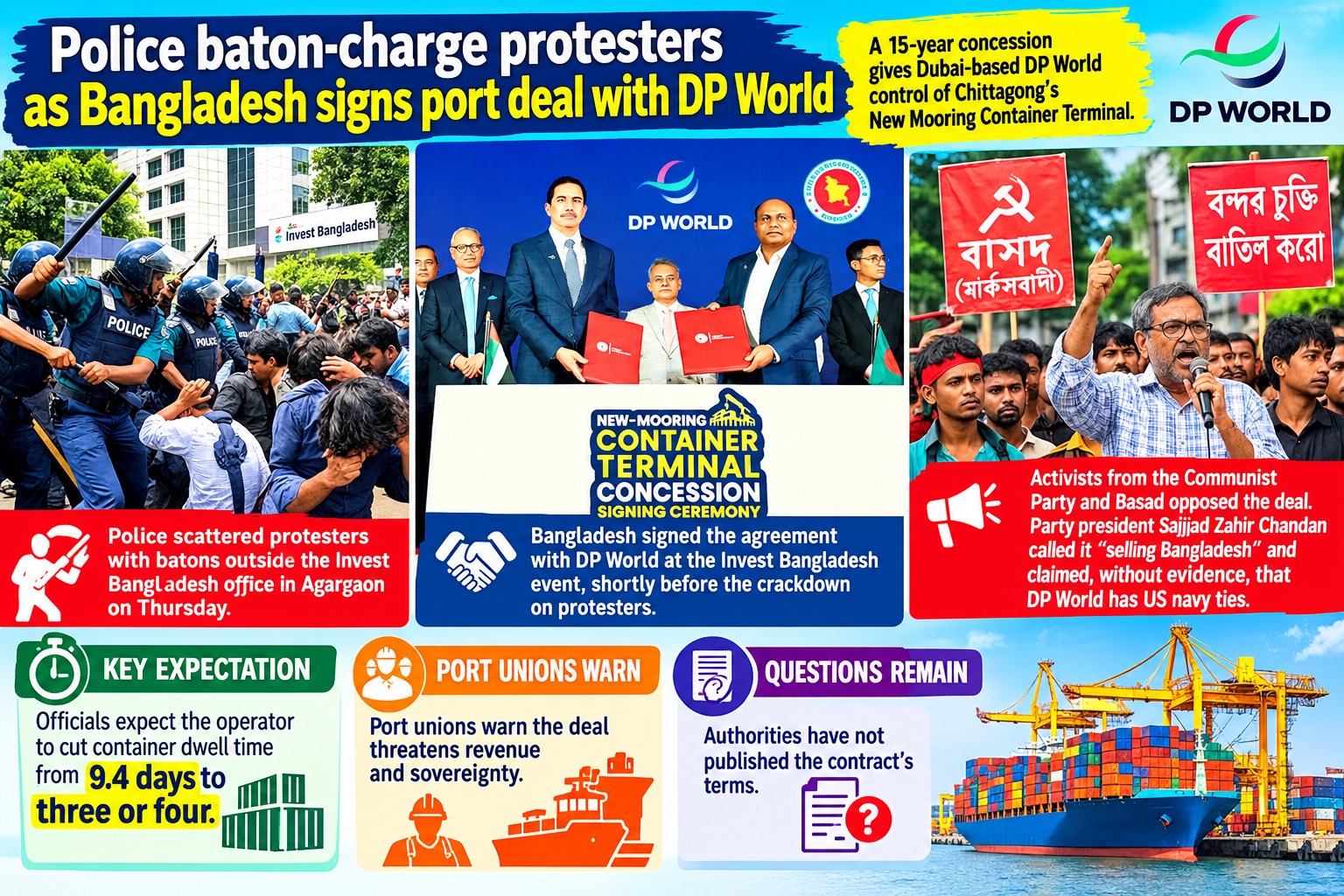
Left-wing groups accuse the government of selling sovereignty as the Dubai-based operator wins a 15-year concession for the country's busiest container terminal.Police beat back protesters with batons in Dhaka on Thursday, less than an hour before Bangladesh signed a 15-year agreement that hands its largest container terminal to the Dubai-based operator DP World.
Activists from the Communist Party of Bangladesh (CPB), the Socialist Party of Bangladesh (Basad) and several other organisations gathered from 2pm outside the Invest Bangladesh office in Agargaon, formerly the investment development authority. Around 2.45pm, police charged the crowd with batons and scattered it.
Sajjad Zahir Chandan, the CPB president, told the daily Prothom Alo that he joined an anti-imperialist and anti-war alliance to oppose the deal. "We believe this agreement amounts to selling Bangladesh," he said.
He claimed DP World has ties to the US navy and pointed to the company's website as evidence. This report could not verify the claim. "America can interfere directly in our independence and sovereignty," Chandan said. "They will use our seaports and airports."
Officials signed the concession around 3.30pm inside the building. Ashik Chowdhury, chairman of the investment agency, and Essa Kazim, chairman of DP World's board, attended. The shipping minister, Sheikh Robiul Alam, planned to brief the press afterwards.
The New Mooring Container Terminal (NCT) ranks first among Chittagong's four main container terminals. Last fiscal year it handled about 1.385 million twenty-foot units, roughly 44% of the port's container traffic. Protest groups say it generates most of the port's revenue.
The government approved the draft concession in principle on 1 October. The process has dragged on for four or five years, with repeated postponements.
Officials expect the new operator to cut the time containers spend in port from 9.4 days to three or four. A television reporter covering the signing put current delays at 10 to 12 days, against two to five in Mumbai and two to four in Pakistan. Exporters bear the cost. Kabir Ahmed, a commentator on the sector, valued their annual shipments at $42bn to $52bn.
Ahmed called the signing "a very auspicious day" for the port and for trade. DP World operates about 67 ports in 37 countries, he said, and its arrival would raise Chittagong's global rating while cutting insurance and chartering costs for shipping lines. He cited public reports that the company guarantees $52m in revenue and that the port authority will receive 40% to 67% of earnings. DP World reportedly sought a 30-year term.
He dismissed fears for jobs as "propaganda", arguing that existing workers would keep their posts and gain new technology skills. He noted that the port handles about 90% of the country's trade and that India lets global operators run terminals.
Yet Ahmed conceded he could not judge whether the contract protects national interests, because its detailed clauses remain unpublished.
He also urged the government to bring an international operator to Mongla port in the south, where industry grows quickly. He said talks with the Chinese government reportedly continue, though he did not know their progress. He voiced pessimism about Payra port, which suffers from silt over 60 to 70 kilometres.
Thursday's baton charge capped days of protest. The Port Protection Committee Chattogram called the deal "unacceptable" and warned that a unilateral agreement ignoring public opinion would enter history as a "black agreement". The committee held a sit-in at the port building's main gate earlier in the week. On Wednesday night, the Port Protection Coordination Council marched with torches from the same spot.
Port labour unions and several political parties argue that a foreign operator will cut the port's revenue and endanger Bangladesh's sovereignty. Concerns that earnings would flow overseas circulated shortly before the signing. Officials answered that the government will weigh the national interest, though they have not published the terms.
With the contract signed and its clauses still hidden from the public, opponents show no sign of retreat.
