
Bangladesh’s biggest labour market falters as Houthi strikes ground flights to Saudi Arabia
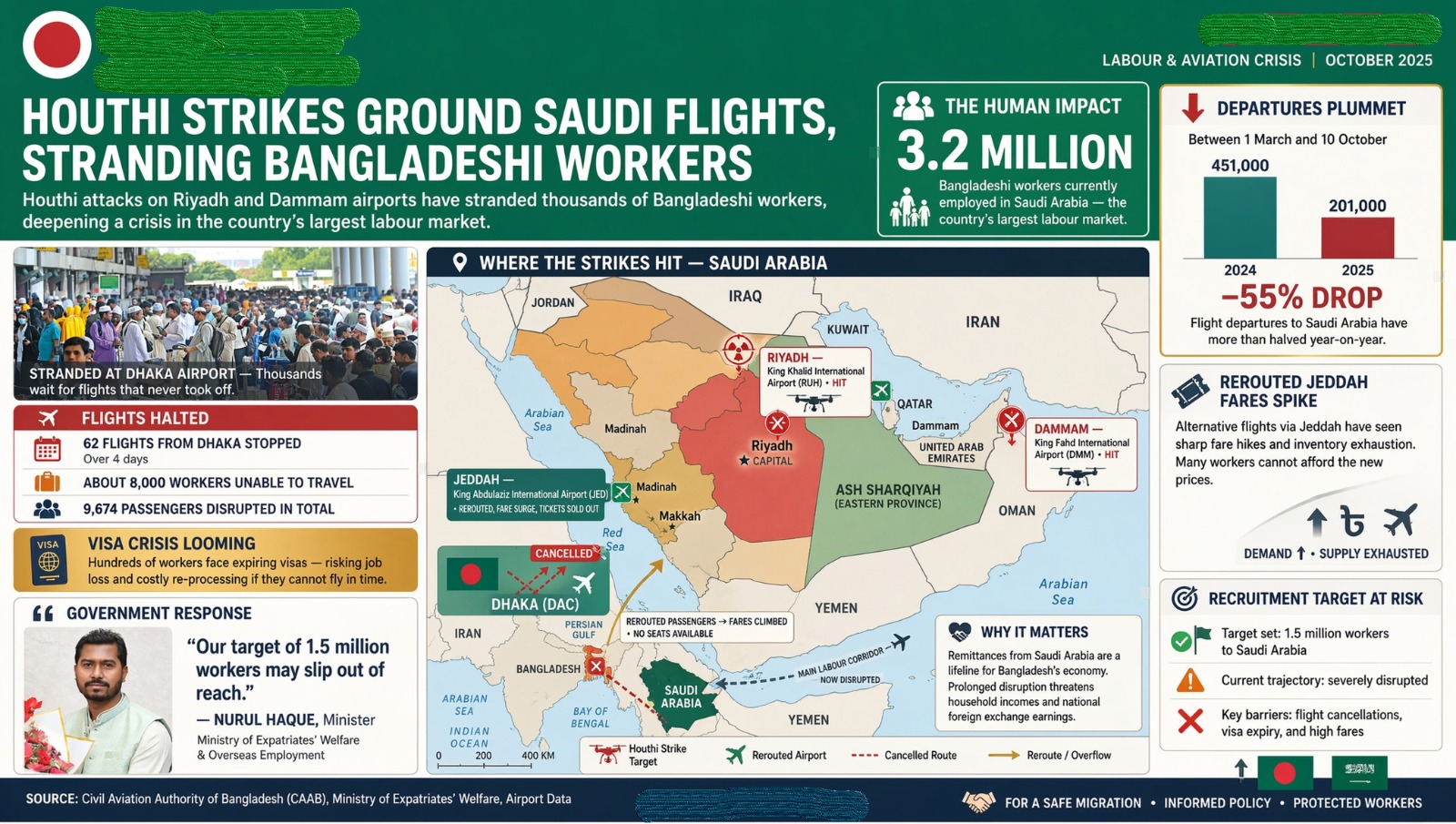
Departures to the kingdom have fallen by more than half since the Iran conflict began, and attacks on two airports have stranded thousands more.
Thousands of Bangladeshi migrant workers face expiring visas and lost wages after Houthi attacks on Saudi airports grounded flights, deepening a crisis that has already cut departures to the kingdom by more than half this year.
Saudi Arabia hosts more Bangladeshi workers than any other country. Dhaka’s home ministry puts the number at about 3.2 million and hopes to raise it to 4 million. The latest disruption threatens that ambition.
Diplomatic sources say about 8,000 workers cannot travel after security concerns disrupted Riyadh airport and airlines cancelled several Dhaka-Riyadh flights. Many had come home on leave and now wait to resume their jobs. At Riyadh airport, the Bangladesh embassy says, roughly 500 Bangladeshis found themselves stuck, among them departing workers, Umrah pilgrims and passengers heading to other destinations. Bangladeshi nationals also suffered casualties in the attacks, and the episode has revived anxiety about expatriate safety.
Over four days, 62 international flights from Dhaka stopped as Riyadh and Dammam airports shut. Twenty-three direct Saudi services halted: nine by Biman Bangladesh Airlines, seven by Riyadh Air, five by Saudia and two by US-Bangla. Thirty-nine transit flights also stopped, including 16 by IndiGo, nine by Emirates, and five each by Qatar Airways and flydubai. At least 9,674 passengers suffered disruption. Officials at Hazrat Shahjalal International Airport said some Jeddah-bound flights had also vanished from the schedule.
Mohammad Musa Kalim, owner of the recruitment agency Musa International, has sent 150,000 workers to Saudi Arabia. He told the newspaper Khabarer Kagoj that about 60 of his clients, all holding valid papers, could not leave after the airports closed. Several face visa expiry within days. His agency now tries to route them through Jeddah, then onward to Riyadh and Dammam, but airlines have raised fares on that route and tickets have run out. “We suffer along with the workers,” he said.
The Middle East absorbs about 75% of Bangladesh’s overseas employment, and Saudi Arabia takes roughly 70% of that share. Before the war, the market looked healthy. In January and February, 160,276 Bangladeshis went abroad for work, against 100,291 a year earlier.
Then the US and Israel launched joint strikes on Iran, and tension spread across the region. Houthi attacks on Saudi oil fields, pipelines, airbases and civilian airports have since complicated the security picture. According to the Bureau of Manpower, Employment and Training, 201,000 Bangladeshis travelled to Saudi Arabia between 1 March and 10 October. The same period last year saw 451,000, a fall of about 55%.
Fakhrul Islam, a former joint secretary general of the recruiters’ association Baira, said an average of 1,200 new workers flew to Saudi Arabia each day this year, joined by 600 to 700 returning workers. By that arithmetic, about 8,000 people have got caught in the disruption over the past four days. He warned that the backlog will grow if flights stay suspended.
Nurul Haque, state minister for expatriates’ welfare and overseas employment, conceded that the Middle East war had cut jobs abroad and that Saudi Arabia now posed a fresh worry. The government’s goal of sending 1.5 million workers in its first year may slip out of reach, he said. He promised that officials would discuss, at government level, the cases of stranded workers and those whose visas near expiry.
For Dhaka, the stakes extend beyond one season of lost departures. A single destination dominates its overseas labour trade, and a regional conflict now squeezes that destination from several sides: security, airline capacity and ticket prices. Recruiters say the delays will worsen the longer Riyadh and Dammam stay closed, and workers with lapsing visas have little room to wait
