
Many Poor people remain excluded from assistance despite massive Govt allocation
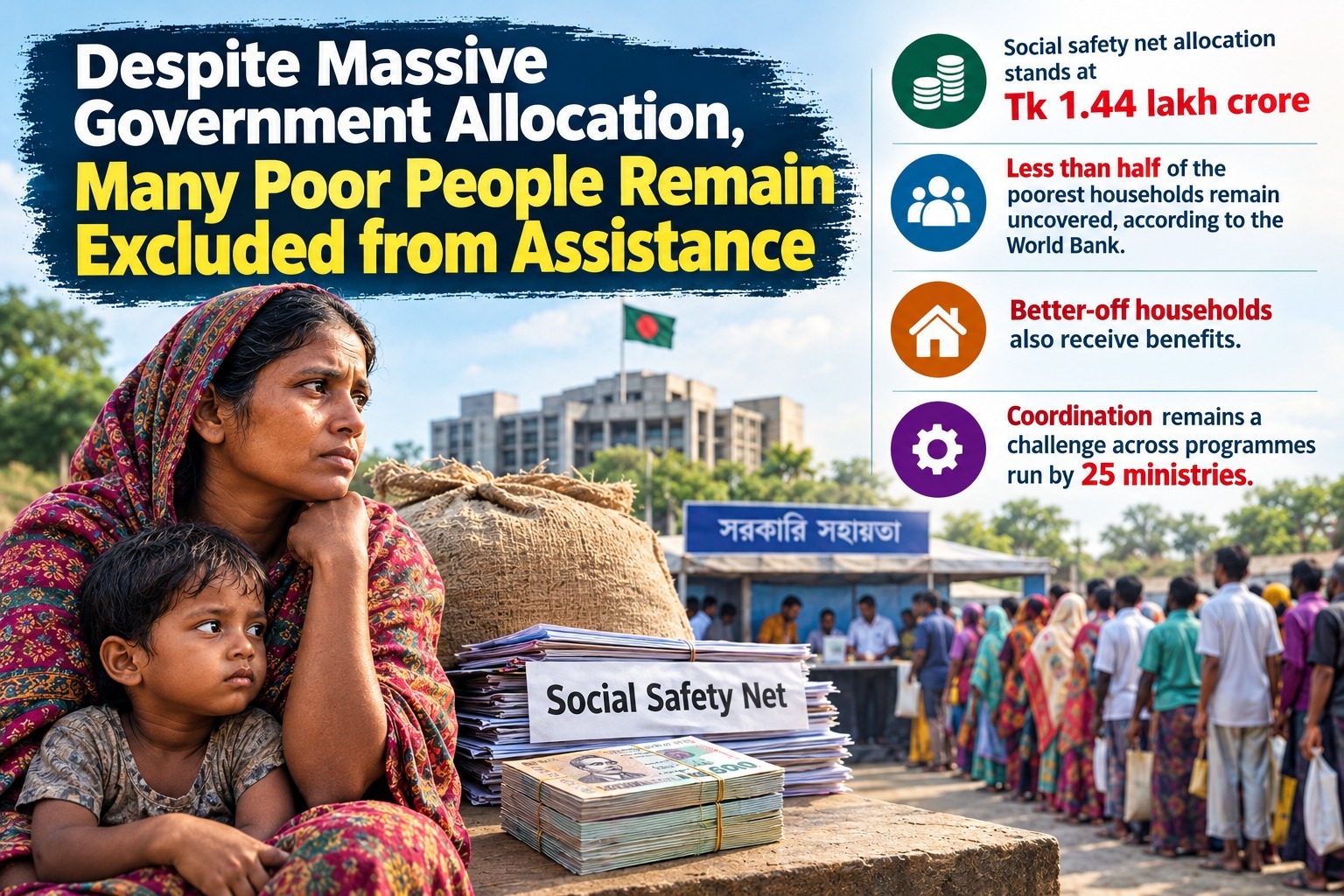
The government is expanding social safety net programmes to address poverty, old age, disability, food insecurity and unemployment. For the 2026-27 fiscal year, Tk 144,338 crore has been allocated to this sector.
According to the Finance Division’s social safety net budget report, the government plans to spend the funds through 90 programmes under 25 ministries and divisions. However, questions remain over how much of this substantial allocation actually benefits the poor. The World Bank’s recent poverty and equity assessment indicates that weaknesses in targeting social assistance have left a significant proportion of the poorest households without support, while government benefits have also reached relatively affluent households.
The World Bank’s 2025 report, Bangladesh Poverty and Equity Assessment: Navigating the Path to Prosperity, states that in 2022, only 50.8 per cent of households in the poorest 20 per cent of the population received social assistance. In other words, nearly half of these households were not covered by any social assistance programme. Meanwhile, 35.1 per cent of households in the wealthiest 20 per cent also received such assistance. Although the coverage of social assistance expanded between 2016 and 2022, the proportion of benefits reaching relatively affluent households increased. According to the World Bank’s analysis, these weaknesses in targeting limit the effectiveness of public spending in reducing poverty.
The same report shows that the proportion of urban households receiving social assistance increased from 16 per cent in 2016 to 34.5 per cent in 2022. Despite the expansion of programmes in urban areas, assistance has not been fully directed away from households that are not poor. Consequently, the effectiveness of the system for identifying genuine beneficiaries has become just as important as expanding programme coverage. However, these figures are based on an analysis of the 2022 Household Income and Expenditure Survey and should not be interpreted as the current beneficiary coverage rates for 2026.
According to the Finance Division’s social safety net budget report for the 2026-27 fiscal year, the total allocation accounts for 15.39 per cent of the national budget and 2.11 per cent of gross domestic product (GDP). However, not all of this money is transferred directly to poor people as cash assistance. Under the report’s classification, Tk 66,750.70 crore has been allocated to social assistance programmes, Tk 35,389.40 crore to social insurance and Tk 34,972.70 crore to general subsidies. Labour market programmes, social care, community development and technical assistance are also included in the budget. Therefore, the total allocation alone does not indicate how much money reaches poor households directly.
The government has also set targets for several major programmes for the current fiscal year. According to the Finance Division’s report, the Family Card programme aims to provide Tk 2,500 per month to 4.1 million female-headed households, with an allocation of Tk 14,500 crore. The Farmer Card programme has an allocation of Tk 1,400 crore and aims to bring 4.25 million farmers under its coverage. Under the old-age allowance programme, the government plans to provide Tk 700 per month to 6.2 million people. The allowance programme for widows and financially disadvantaged women abandoned by their husbands has a target of 3 million beneficiaries, while the disability allowance and education stipend programmes aim to cover 3.9 million people. These figures represent budgeted targets and do not confirm that all intended beneficiaries have already received assistance.
The government report indicates that, with programmes being administered by 25 ministries and divisions, coordination, beneficiary selection and the risk of the same individual or household receiving benefits from multiple programmes remain important challenges. Other concerns include the erosion of the real purchasing power of allowances due to inflation, gaps in social protection for the urban poor and limited access to social insurance for workers in the informal sector. Therefore, even as allocations increase, it is also necessary to assess whether the assistance provided is sufficient to meet households’ basic needs.
The situation of people vulnerable to falling into poverty is also concerning. Based on 2022 data, the World Bank’s 2025 assessment estimated that around 62 million people were living just above the poverty line but remained at risk of slipping back into poverty. Limited savings, declining income, illness, unemployment or shocks such as natural disasters could push them back into poverty. Not all members of this group are poor, but some lack adequate protection against sudden financial or personal crises. It is therefore important for social safety net programmes to consider the needs of vulnerable households alongside those already living in poverty.
To improve beneficiary selection, the Finance Division’s report emphasises a unified registration system, verification of information against national identity cards and birth registration records, and coordination among the databases of different programmes. It also highlights the importance of identifying eligible households by assessing their socioeconomic conditions. If implemented effectively, these measures could reduce the risk of individuals receiving benefits irregularly from multiple programmes while also preventing eligible people from being excluded. However, alongside technology-based verification, there must be mechanisms to correct inaccurate information, lodge complaints when applications are rejected and verify beneficiary lists at the local level.
The success of social safety net programmes cannot be measured solely by the size of the allocation or the number of programmes. Regular disclosure of information is essential to establish how many genuinely poor people receive assistance, how many eligible people are left out, how many relatively affluent households receive benefits and what changes the assistance brings to their living conditions. Ensuring the proper use of funds, maintaining transparent beneficiary lists and publishing programme-specific outcomes would improve the prospects of government assistance reaching those who need it most.
