
Beyond the famous surname: Zaima Rahman steps onto the UN stage
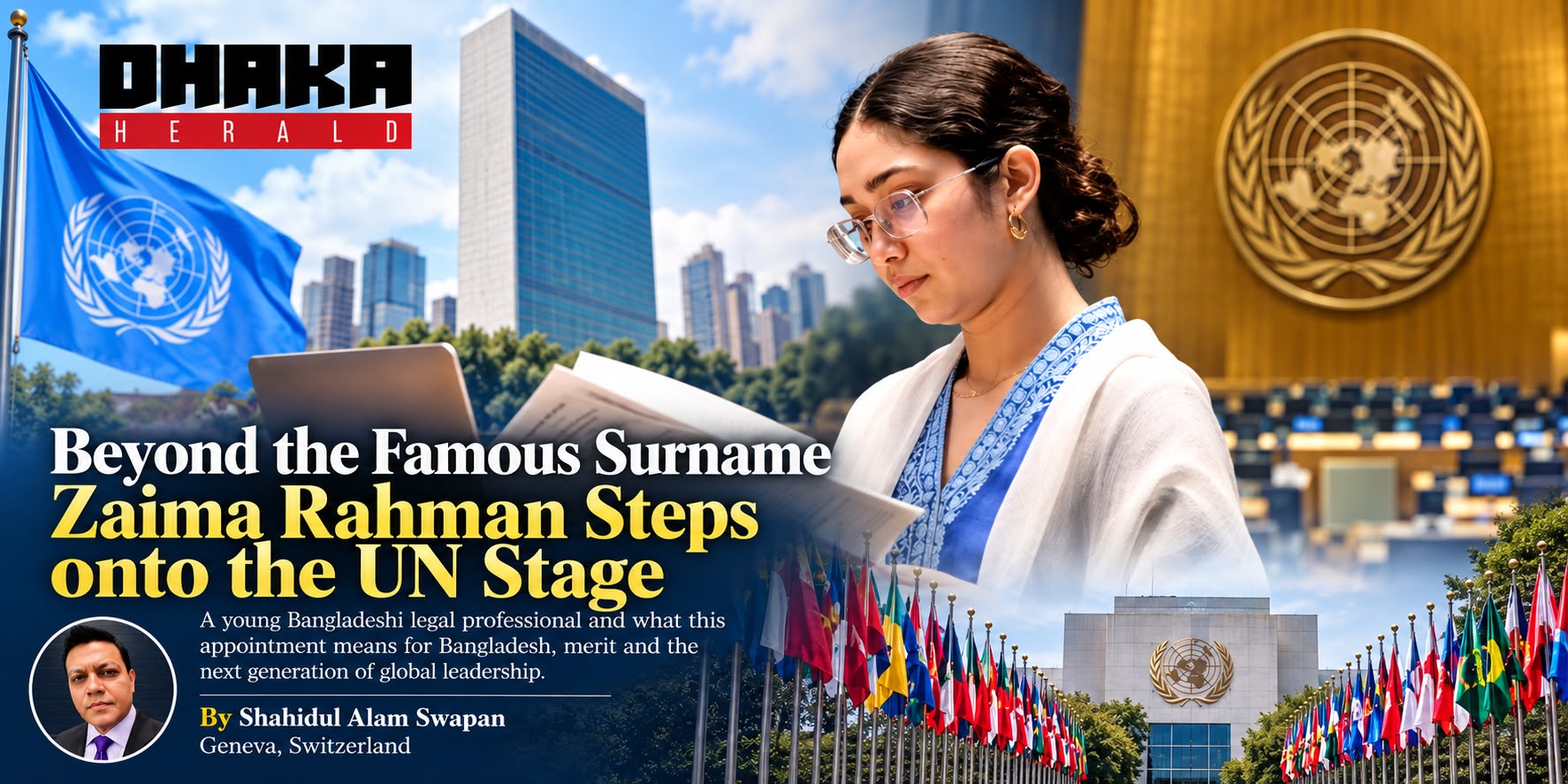
Sometimes an appointment attracts attention not because of the position itself, but because of the person stepping into it. Zaima Rahman’s appointment as a legal officer in the Office of Khalilur Rahman, President of the 81st Session of the United Nations General Assembly, is one such case.
Zaima is the daughter of Bangladesh Prime Minister Tarique Rahman, and that inevitably gives the appointment political visibility. But reducing her new role merely to her family identity would miss the more important question: what can a young Bangladeshi legal professional contribute and learn inside one of the world’s most important multilateral institutions?
For Zaima, this is an opportunity. For Khalilur Rahman, it is part of the larger task of assembling a capable international team. For Bangladesh, it represents another point of engagement with the multilateral system at a time when diplomacy is becoming increasingly complex.
Khalilur Rahman assumed the presidency of the 81st UN General Assembly with an ambitious agenda centred on restoring trust and managing transformation. Although he is Bangladeshi, the presidency is not a national position. The President of the General Assembly must serve all 193 UN member states, navigate competing geopolitical interests and maintain the credibility and impartiality of the institution.
That distinction is essential when assessing appointments to his office. The President’s team is not an extension of Bangladesh’s government or diplomatic mission. It is an international office whose effectiveness depends on professional competence, diversity and institutional independence.
This is precisely why Zaima Rahman’s appointment deserves both interest and scrutiny.
At the United Nations, diplomacy is not simply about speeches, handshakes and high-profile meetings. Behind every resolution, declaration and negotiation lies a complex architecture of international law, institutional rules, precedents and procedures. Sometimes a single word or phrase can become the subject of prolonged negotiations because different countries understand its legal and political implications differently.
A legal officer therefore works at the intersection of law and diplomacy. The position requires careful interpretation, precise drafting, sound judgement and an understanding of how legal principles interact with political realities.
For Zaima, the experience could be particularly valuable. Working within the UN General Assembly presidency offers exposure to multilateral negotiations, international legal questions, institutional procedures and diplomatic decision-making at the highest level.
But her family background also means that her performance will inevitably receive greater attention than that of many other officials.
That should not necessarily be seen as unfair or hostile. Public scrutiny is legitimate when people closely connected to political leaders receive positions in prominent international institutions. Transparency about qualifications, recruitment procedures and responsibilities helps protect both the institution and the individual concerned.
The strongest response to such scrutiny is professional performance.
Being the daughter of a prime minister may attract attention, but it cannot substitute for competence inside the United Nations. Legal documents still have to be understood. Procedures must be followed. Advice must be defensible. Colleagues from different countries and political cultures must be able to rely on one another.
In that environment, reputation ultimately has to be earned.
The broader composition of Khalilur Rahman’s office is also important. The presidency requires expertise across political affairs, international law, development, climate change, technology, artificial intelligence, humanitarian issues and administration. It therefore depends on a multinational team capable of dealing with an unusually wide range of global challenges.
The 81st General Assembly is taking place at a difficult moment for the international system. Wars and humanitarian crises continue to test multilateral institutions. Climate change is placing growing pressure on vulnerable countries. Artificial intelligence is developing faster than many regulatory systems can respond. Economic fragmentation, geopolitical rivalry and questions about the effectiveness of global institutions have further complicated international cooperation.
The presidency therefore requires more than ceremonial diplomacy. It requires negotiation, credibility and the ability to find areas of agreement among countries whose strategic interests frequently collide.
Khalilur Rahman brings considerable multilateral experience to that challenge. But no General Assembly president works alone. The quality of the office surrounding the president matters enormously. Every appointment should therefore be considered against the same basic standards: competence, professionalism, integrity and the ability to serve an international institution impartially.
Zaima Rahman should be judged by those standards as well.
There is also a broader lesson for Bangladesh. The country needs a new generation of professionals who understand how international institutions actually work.
Modern diplomacy is no longer confined to traditional foreign ministries. Trade now intersects with sanctions, financial integrity and national security. Climate diplomacy overlaps with development finance. Artificial intelligence raises questions of regulation, ethics and sovereignty. Migration, maritime security, supply chains, cyber threats and cross-border financial crime increasingly require lawyers, economists, technologists and diplomats to work together.
Bangladesh therefore needs professionals capable of operating confidently in New York, Geneva, Brussels, Washington, Beijing and other centres of international decision-making.
Experience inside the United Nations can help develop precisely that kind of institutional understanding.
But there is an equally important principle. Access to such opportunities should be based on professional merit rather than political lineage. That principle is important not only for institutional credibility but also for Zaima herself. The most meaningful outcome of this appointment would be for her eventually to establish a professional identity independent of her family name.
That may be the real test awaiting her in New York.
Zaima Rahman enters the United Nations carrying one of the most recognisable political surnames in Bangladesh. Some will naturally view her appointment through the prism of domestic politics. Others will see it as an opportunity for a young Bangladeshi lawyer to gain valuable international experience.
Both realities can coexist.
The appointment deserves neither automatic celebration nor automatic suspicion. What matters is whether the process is transparent, whether the professional qualifications match the responsibilities and, above all, how she performs.
For Khalilur Rahman, the larger responsibility is equally clear. His presidency will ultimately be judged not by the nationality or family connections of individual staff members, but by whether his office can operate effectively, independently and credibly on behalf of the entire UN membership.
Bangladesh currently enjoys unusual visibility at the centre of multilateral diplomacy. That visibility creates opportunities, but it also brings responsibility and scrutiny.
For Zaima Rahman, this appointment offers something more valuable than a prestigious title. It offers the chance to demonstrate that she can stand on her own professional credentials in one of the most demanding international environments.
In the end, the most important story should not be that the daughter of Bangladesh’s prime minister has entered the Office of the UN General Assembly President.
It should be what Zaima Rahman does once she is there.
(The writer is based in Geneva, Switzerland, and is a political analyst, private banking financial crime compliance specialist, columnist and poet. He regularly contributes on South Asian geopolitics, international affairs, global financial integrity and strategic affairs. Email: shahidul.alam@bluewin.ch)
