
Bangladesh securities regulator collects just 0.35% of fines imposed for stock manipulation
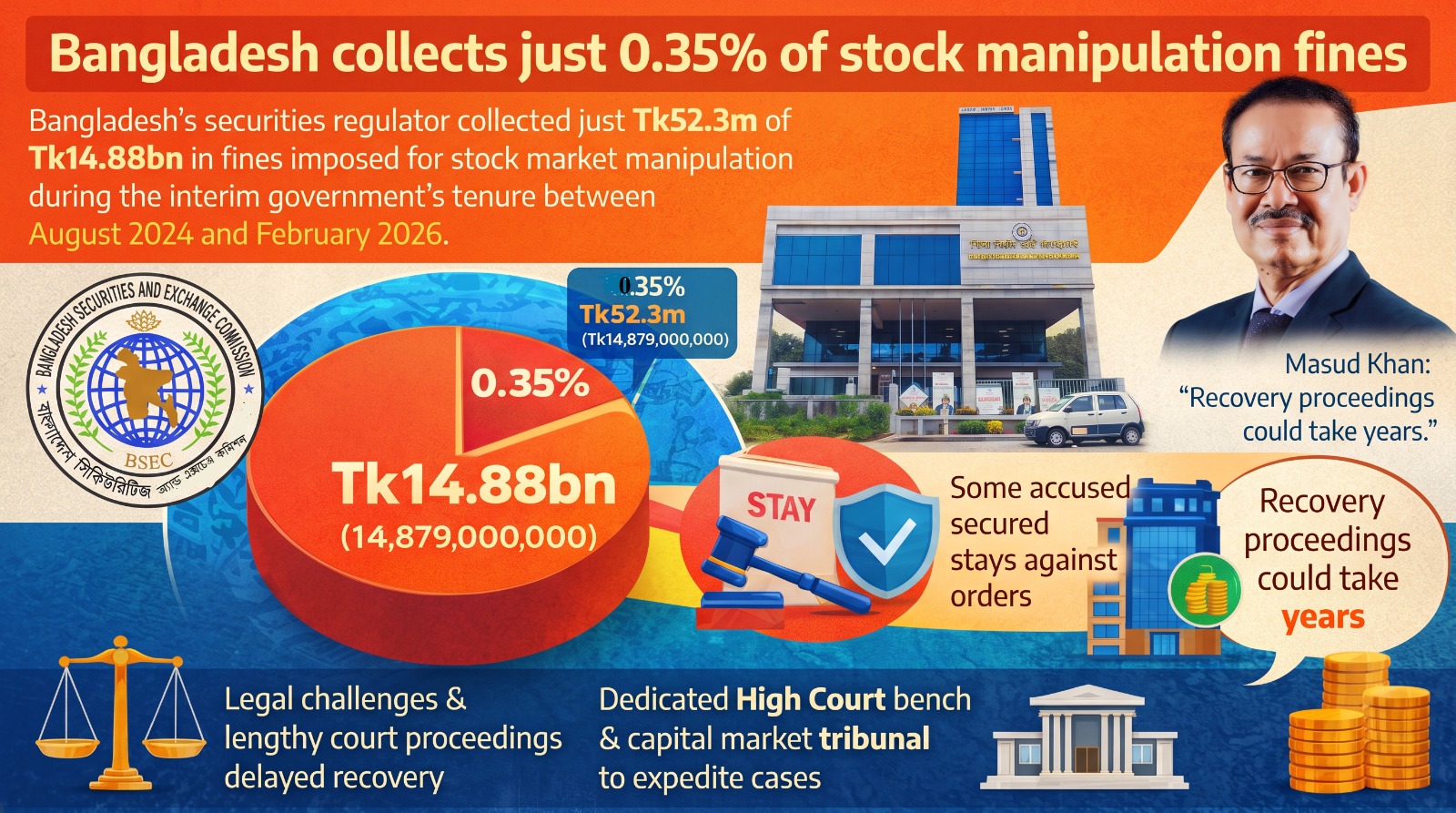
The regulator imposed Tk14.88bn in penalties during the interim government’s tenure, but collected only Tk52.3m, raising questions about enforcement and the effectiveness of market regulation.
Bangladesh’s securities regulator imposed fines totalling Tk14.88bn (£approximately £100m) for stock market manipulation during the country’s interim government, but collected just Tk52.3m, or 0.35% of the total, according to an assessment submitted to the finance ministry.
The Bangladesh Securities and Exchange Commission (BSEC) imposed the penalties between 8 August 2024 and 16 February 2026, the report showed. The remaining 99.65% has yet to be collected, highlighting the gap between imposing financial penalties and enforcing them.
The figures have raised questions about whether large fines can effectively deter market manipulation when those held responsible can delay payment through lengthy legal proceedings.
A further 65 disciplinary orders were issued between 17 February and 15 October this year, resulting in fines of Tk115.58m, according to BSEC data.
The regulator has imposed substantial penalties in several high-profile cases. Individuals and companies accused of manipulating Beximco shares were fined a combined Tk4.28bn. In another case, penalties totalling Tk1.94bn were imposed on Abul Khayer, an official of the Department of Cooperatives, cricketer Shakib Al Hasan and their associates.
At least 50 people were fined a combined Tk3.51bn over alleged manipulation involving shares of several insurance companies. The commission has also imposed penalties for other securities law violations, including failure to pay dividends, for which fines totalled Tk288.7m.
However, the amount collected remains small compared with the penalties imposed.
A BSEC official, speaking to the newspaper the daily Morning Bell on condition of anonymity, said the collection figures required clarification. Much of the Tk52.3m collected against the Tk14.88bn in fines came from penalties imposed before the commission led by Khandaker Rashed Maksud took office, the official said.
During the interim government’s tenure itself, collections amounted to just Tk330,000, according to the official.
The discrepancy highlights the importance of distinguishing between fines imposed under successive commissions and the money actually recovered during a particular administration.
BSEC chairman Masud Khan has also expressed concern about the difficulties of collecting penalties. Speaking at a recent event, he said a previous commission had imposed about Tk15bn in fines over nearly two years but had collected only Tk330,000.
Khan said the process of recovering unpaid penalties through certificate cases was particularly slow. In some instances, collection proceedings did not begin until five years after a case was filed. By then, the addresses and other details of those liable to pay had often become outdated, making them difficult to trace.
Legal challenges have further complicated enforcement. According to the regulator, some individuals and companies have challenged penalty orders in the courts, delaying recovery for years.
Market participants say those facing large fines can seek stays from the High Court, leaving enforcement dependent on lengthy litigation. BSEC rules also provide time for appeals, meaning payment is not necessarily immediate after a penalty is imposed.
Khan said the commission was considering establishing a separate High Court bench to expedite capital market cases and creating a mechanism that would allow cases to be filed directly with a capital market tribunal.
The precise amount of outstanding fines tied up in court proceedings remains unclear. The regulator has not separately disclosed how much is subject to judicial stays, how much is awaiting collection and how much has yet to enter an effective recovery process.
Among the more recent penalties were Tk72m against Fortune Shoes, Tk14m against Khan Brothers, Tk13.5m against Aftab Automobiles and Tk7.376m against Trust Islami Life. These formed part of the 65 disciplinary orders issued between 17 February and 15 October.
A BSEC official told Kalbela that the commission was now more active than at other times in pursuing violations and promoting transparency. Delays in collecting fines, the official said, were largely the result of legal complications.
But market analysts argue that imposing penalties is only one part of effective regulation. Without the recovery of fines, the deterrent effect of enforcement remains limited.
Abu Ahmed, chairman of the Investment Corporation of Bangladesh and a capital market analyst, said BSEC was fulfilling its responsibility by imposing penalties on those involved in share manipulation. The difficulty arose when those penalised used legal procedures to delay payment, he said, adding that responsibility for imposing fines should be distinguished from the separate legal challenges involved in collecting them.
The finance minister, Amir Khasru Mahmud Chowdhury, told parliament on 12 July that BSEC had imposed Tk14.97bn in fines on individuals and institutions over irregularities, manipulation and corruption in the stock market during the previous government.
Market participants say the regulator should regularly publish updated figures showing the penalties imposed, the amounts collected, outstanding liabilities and cases pending before the courts. Such disclosure would make it easier to assess the effectiveness of enforcement.
Until the regulator can demonstrate that penalties are being recovered as well as imposed, the collection figures are likely to continue raising questions about accountability in Bangladesh’s capital market.
