
Dhaka’s canals disappear under concrete, waste and encroachment
For generations, Dhaka’s canals carried rainwater away from neighbourhoods and connected the city’s drainage network to surrounding rivers. Many of those waterways now exist only on maps.
Across the capital, canals have narrowed, disappeared or become little more than stagnant drains as land filling, unplanned development and illegal construction steadily consume them. Researchers and water experts say the loss of these natural waterways has weakened Dhaka’s ability to drain rainwater and increased the city’s exposure to waterlogging and environmental damage.
Studies by the Institute of Water Modelling (IWM) and research published in the Geoscape journal have documented the deteriorating condition of several of the city’s major canals.
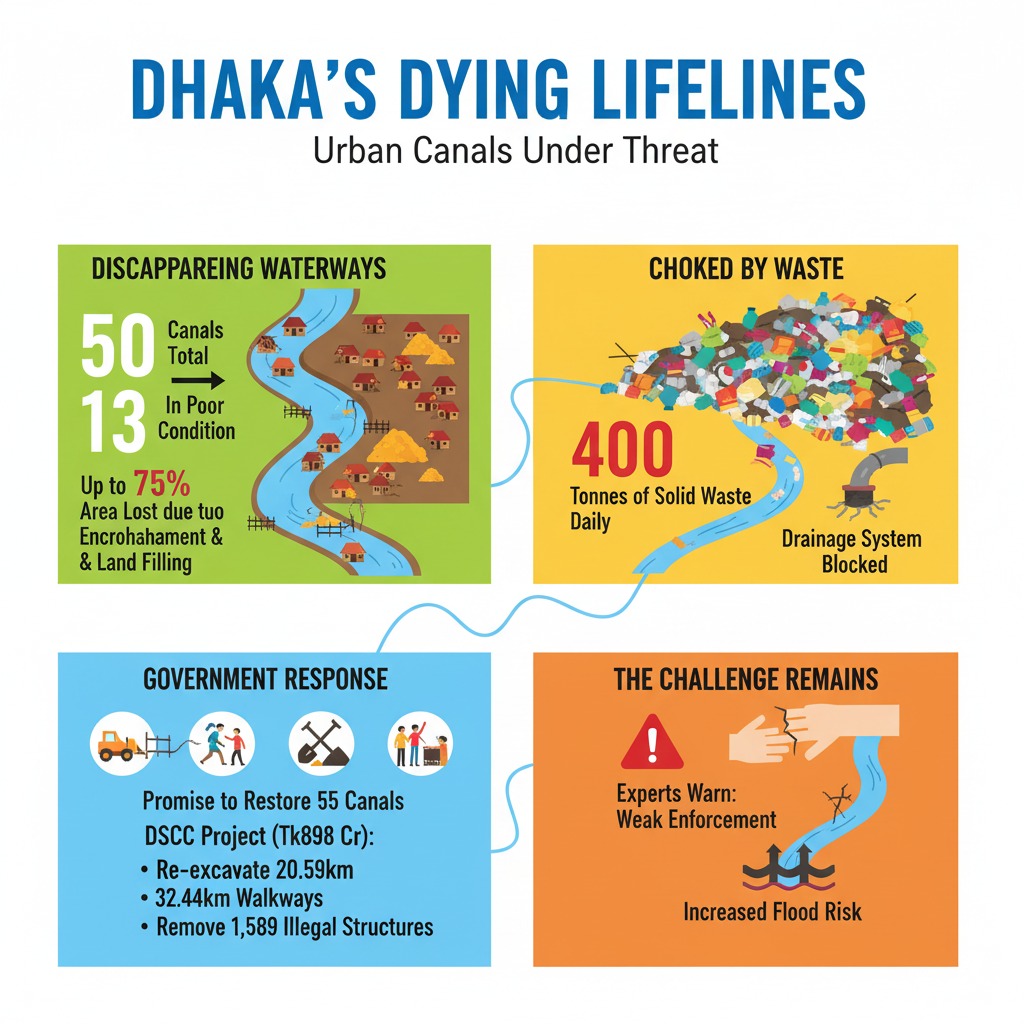
IWM says Dhaka currently has about 50 canals, but at least 13 face severe degradation. These waterways once carried water from neighbourhoods towards the surrounding rivers. In many places, however, their routes have become difficult to identify on the ground.
The Kalyanpur canal, for example, serves parts of Kalyanpur, Adabor, Baitul Aman Housing and Shyamoli. Large sections have been occupied, with makeshift houses built on bamboo structures and a market developing over the canal. Commercial buildings have also appeared along its course.
Around 40% of the canal has been illegally occupied, according to the material cited in the research.
The Ramchandrapur canal faces a different but equally damaging problem. Waste has accumulated at several points, choking water flow and creating breeding grounds for mosquitoes. Plastic and other household rubbish have turned sections of the waterway into stagnant pools.
Researchers have also identified roads running along canal banks and poorly designed, narrow box culverts as major obstacles to water flow. Instead of restoring the waterways, authorities have often relied on isolated engineering projects, such as installing box culverts at selected points.
The pressure is particularly visible around the Katasur canal, where dense settlements have grown along both banks. Much of the canal has been covered by narrow and poorly planned structures.
The Baunia canal, which runs between Mirpur and Uttara, has also come under intense pressure from rapid urban expansion. Land filling has reduced the waterway and left its future uncertain.
Research on the Dighun canal found extensive encroachment in areas where wetlands once stretched across the northern and western sections. New settlements have expanded towards the canal from the direction of Rupnagar and Eastern Housing. One study estimated that about 75% of the canal had been filled, while buildings occupying the canal’s land were obstructing a substantial part of its flow.
Some waterways have virtually vanished. The Segunbagicha canal, once part of the capital’s drainage network, no longer exists as a recognisable canal.
The situation around the Manda and Jirani canals is similarly severe. Waste from densely populated areas including Khilgaon, Basabo and Mugdapara enters the waterways. Land filling has also continued along parts of the Manda canal, including an area associated with the Green Model Town housing project.
Along the Boalia canal in the Uttarkhan and Khilkhet areas, around 80% of the waterway has reportedly been occupied. Unauthorised land filling has made even the original boundaries difficult to establish.
City authorities have carried out eviction drives along the Ramchandrapur and Lautala canals in Mohammadpur, but the gains have often proved temporary. After an operation clears a section, residents and developers gradually occupy or narrow the waterway again.
The problem extends beyond encroachment. Research cited in the reports says about 400 tonnes of solid waste generated in Dhaka ends up in canals every day, partly because of inadequate sanitary landfill facilities.
The consequences are not limited to waterlogging. Research on the Ashulia floodplain found that unplanned land development had reduced groundwater levels by between 1.02 and 2.46 metres a year.
In 2010, a parliamentary standing committee recommended preserving at least 40% of drainage-basin areas as wetlands. According to National River Conservation Commission chairman S M Firoz Alam, the recommendation largely remained on paper.
There are now fresh promises to restore Dhaka’s waterways.
Local government state minister Mir Shahe Alam has said all canals under the two city corporations will undergo excavation and restoration, with work on 55 canals to be completed in phases.
Dhaka South City Corporation says it is implementing an Tk898 crore project to restore the Kalunagar, Manda, Jirani and Shyampur canals. The project includes re-excavating 20.59km of canals, defining their boundaries, constructing 32.44km of walkways and removing 1,589 illegal structures.
But Firoz Alam says the commission itself lacks the power and resources to enforce such measures.
“We have no executive power to take action under the existing law,” he said, adding that the commission has sent a proposed amendment to the government seeking stronger enforcement powers.
“We have no dedicated manpower and no adequate budget,” he said.
For Dhaka’s canals, the challenge is therefore no longer simply restoration. It is whether the city can prevent the waterways from disappearing again after the next eviction drive, excavation project or political promise.
