
Europe Is Burning. But This Is About More Than Politics.
From Paris to Tirana, a generation that feels poorer, unheard, and betrayed is taking to the streets.
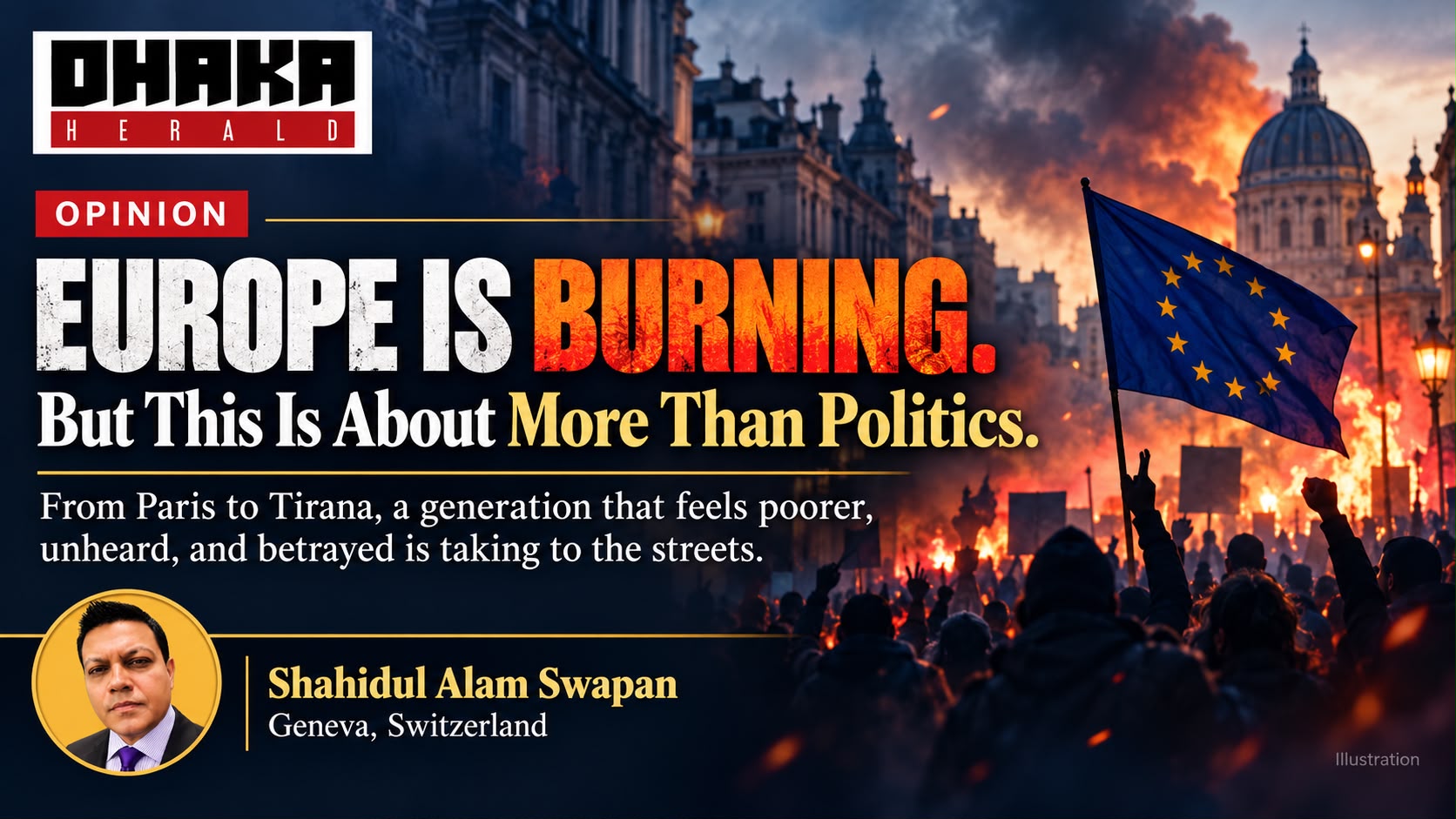
Across the continent, scenes once associated with a different era are returning to television screens: mass demonstrations, clashes with police, burning barricades, occupied public squares, and growing public fury. From Paris to Tirana, and from Brussels to Madrid, citizens are pouring into the streets to protest against a political and economic order they increasingly believe no longer works for them. 
At first glance, the grievances appear different. In France, protesters are denouncing the rising cost of living and deteriorating public services. In Spain, housing affordability has become a national flashpoint. Belgian students are demonstrating against education costs, while Albanian protesters are demanding accountability and reform. Italy, meanwhile, is wrestling with the frustrations of a generation trapped in economic stagnation. 
Yet beneath these different movements lies a remarkably similar frustration.
Millions of Europeans feel they are paying more and receiving less.
They pay more for housing, food, energy, transport, healthcare, and education. They face higher taxes and living costs. Yet they increasingly perceive public services as weakening, economic opportunity as shrinking, and their political leaders as detached from everyday realities.
This is not merely a wave of protests.
It is a crisis of confidence.
And it may be one of the most significant political tests Europe has faced since the aftermath of the global financial crisis.
The Broken Promise of the European Dream
For decades, Europe's social model was admired across the world.
The implicit bargain was straightforward. Citizens accepted high levels of taxation because governments provided robust healthcare, affordable education, reliable public transport, social protection, and economic security. The arrangement helped create some of the world's most stable and prosperous societies.
Today, however, that bargain appears increasingly strained.
Economic growth across much of Europe has been sluggish. Governments are grappling with fiscal pressures and mounting public debt. Meanwhile, the cost of everyday life has risen sharply over recent years, leaving many households feeling financially vulnerable despite official indicators suggesting recovery. 
The result is a dangerous perception that the burden on ordinary citizens continues to increase while the benefits they once enjoyed are diminishing.
Whether this perception is entirely accurate is, in some respects, beside the point.
Politics is often driven not by statistics but by lived experience.
And across Europe, that experience is becoming increasingly uncomfortable.
France: The Anger Spreads Beyond the Streets
Nowhere is this more visible than in France.
Long known as Europe's capital of political protest, France has become the epicentre of the current unrest. Demonstrations that began around concerns over education and public services have evolved into a much broader expression of dissatisfaction with living standards, inequality, and economic insecurity. Large-scale protests have drawn hundreds of thousands of participants nationwide. 
France's significance lies not merely in the size of the protests but in what they reveal.
A growing number of citizens believe that social mobility is weakening. Public institutions are under strain. Housing is increasingly difficult to afford. Young people worry that they may inherit a future less prosperous than the one enjoyed by their parents.
That fear may be the most powerful political force of all.
When a generation begins to doubt that tomorrow will be better than today, social stability becomes fragile.
Spain's Housing Revolt
If France reflects frustration over public services, Spain highlights a different but equally explosive issue: housing.
Across major Spanish cities, rents and property prices have become a source of profound social tension. Housing demonstrations have gained momentum as growing numbers of people, particularly younger citizens, struggle to secure affordable accommodation. 
For many, home ownership has become a distant aspiration.
Even renting often consumes a disproportionate share of monthly incomes.
The consequences extend beyond economics. Housing influences family formation, social mobility, career decisions, and quality of life. When people cannot afford a stable place to live, frustrations inevitably spill over into politics.
That process is now visible across much of Southern Europe.
Italy's Long Economic Exhaustion
Italy's situation reveals another dimension of Europe's malaise.
Unlike short-term crises triggered by sudden shocks, Italy's frustrations have accumulated over decades of weak growth and limited opportunities.
Many young Italians face a difficult reality: secure employment is harder to find, wage growth remains subdued, and the costs of everyday life continue to rise.
The result is not a sudden burst of anger but a gradual erosion of optimism.
And societies that lose optimism often become unpredictable.
Economic stagnation does not produce immediate political explosions. Instead, it quietly undermines confidence until public frustration eventually reaches a breaking point.
Belgium and the Politics of Anxiety
The protests in Belgium may appear more limited in scope, focusing largely on education and university costs. Yet they carry significance well beyond campuses. 
Historically, student movements have often served as early indicators of broader social discontent.
Students tend to be among the first groups to react when they perceive declining opportunities, rising costs, or uncertain futures.
Their concerns frequently foreshadow wider societal tensions.
What is happening in Belgium, therefore, should not be viewed solely as a debate over tuition fees or educational budgets. It is part of a broader conversation about opportunity, affordability, and the future direction of European societies.
Albania: Different Context, Familiar Message
Albania's protests emerged from a different political environment but ultimately echo many of the same frustrations seen elsewhere.
Initial demonstrations centred on issues including governance, development policies, environmental concerns, and allegations of corruption. Over time, wider concerns involving affordability, education, and accountability entered the conversation. 
The common denominator remains clear: a widening gap between ordinary citizens and political elites.
Whether in Western Europe or the Balkans, many people increasingly feel disconnected from decision-makers.
That perception is profoundly destabilising.
The Real Drivers of the Unrest
The current protests are often portrayed as isolated national crises.
They are not.
They are manifestations of several broader European trends.
First is the persistent cost-of-living squeeze. Inflation may have slowed, but consumers continue to live with the consequences of higher prices. Once costs rise, they rarely return to previous levels.
Second is the housing crisis. Across much of Europe, affordable housing is becoming scarce, particularly in major urban centres.
Third is declining trust in institutions. Citizens increasingly question whether governments, political parties, and bureaucracies can effectively address their concerns.
Finally, and perhaps most importantly, there is a growing sense of generational insecurity.
For much of the post-war era, Europeans generally assumed each generation would enjoy greater prosperity than the last.
That assumption is no longer guaranteed.
And when societies lose faith in progress, politics becomes considerably more volatile.
Could This Spread Further?
It would be unwise to dismiss the current unrest as a temporary phenomenon.
The structural pressures driving these demonstrations are not confined to one country. High housing costs, pressures on public finances, slow growth, stretched public services, and youth disillusionment can be found across large parts of the continent. 
Moreover, in the age of social media, national protests no longer remain national for long.
Grievances travel quickly.
Images from Paris can inspire demonstrators in Madrid. Campaigns launched in Brussels can resonate in Rome. Political frustration increasingly crosses borders just as rapidly as information does.
This does not mean Europe is on the verge of collapse.
But it does suggest that governments can no longer afford to treat these protests as isolated incidents.
Europe's Warning Sign
The real lesson of today's unrest is not that Europeans are suddenly becoming more radical or more confrontational.
Rather, it is that many feel increasingly disconnected from the promise that once underpinned European prosperity.
People can tolerate hardship when they believe it is temporary.
They can endure economic pressures when they see a path forward.
What they struggle to accept is the belief that they are working harder, paying more, and receiving less, with little reason to believe the future will improve.
That sentiment is now echoing across the continent.
The demonstrations in France, Spain, Italy, Belgium, and Albania are therefore about much more than fuel prices, housing shortages, university fees, or government budgets.
They represent a deeper and more troubling question:
What happens when citizens begin to lose faith not just in their governments, but in the future itself?
Europe does not yet have an answer.
Until it finds one, the anger on its streets is unlikely to disappear.
——
The writer is a political analyst, private banking financial crime compliance specialist, columnist and poet based in Geneva, Switzerland. He can be reached at shahidul.alam@bluewin.ch
