
More Dreams Than Memories: Why Tareq Rahman’s UNGA Speech Matters
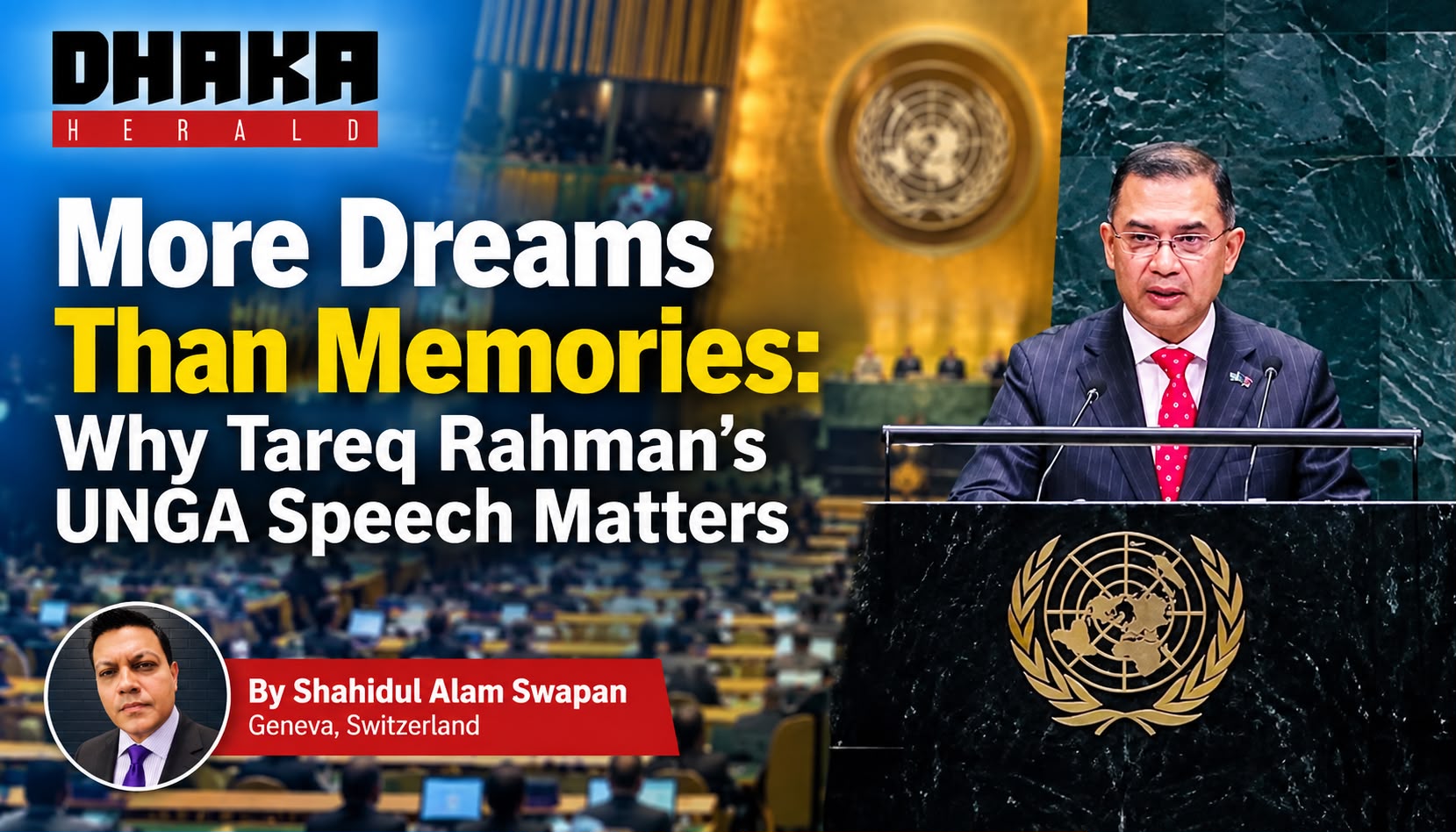
Political speeches rarely change a country. But they can reveal where a leader wants to take it. A textual analysis of the English translation of Prime Minister Tareq Rahman's address to the United Nations General Assembly suggests something noteworthy. According to the analysis, 48 per cent of the speech was focused on the future, 32 per cent on present challenges, and only 20 per cent on the past.
The precise percentages are less important than the broader picture. The speech appeared to spend far more time discussing where Bangladesh is going than where it has been. That might sound like a small thing. It is not. For decades, Bangladesh's political discourse has often been dominated by history. Competing narratives about liberation, political legitimacy, historical injustices, and past conflicts have consumed enormous amounts of public attention. History matters and always will. A nation without memory is a nation without identity. But a nation that talks only about its memories eventually runs out of dreams.
That is why Thomas Friedman's famous question remains relevant: "Do you have more dreams than memories? Or more memories than dreams?" Successful countries tend to have a higher dreams-to-memories ratio. They understand their history, but they do not become trapped by it. Their political energy is directed towards the next decade, not the previous one.
Viewed through that lens, Rahman's UNGA speech stands out.
The speech did not ignore history. Nor should it have. Historical references were present throughout the address. However, they appeared largely as context rather than as the main event. The core message was about Bangladesh's future prospects, current challenges, and long term ambitions. That is a healthier balance than what often dominates political debate.
The reason is simple. Bangladesh's biggest opportunities no longer lie in its past. They lie ahead.
The country has already achieved what many once thought impossible. It has transformed from a symbol of developmental pessimism into one of the world's most discussed economic success stories. Poverty has fallen dramatically. Life expectancy has risen. Infrastructure has expanded. Manufacturing has flourished. A new generation has grown up with opportunities that barely existed thirty years ago.
But the next stage of development will be harder than the last. Moving from poverty reduction to prosperity creation requires a different mindset. The questions facing Bangladesh today are fundamentally economic. How does the country attract more investment? How does it create millions of higher paying jobs? How does it boost productivity? How does it develop a workforce ready for artificial intelligence, automation, and a digital economy? How does it become more competitive as global supply chains evolve? How does it diversify beyond existing export strengths?
These are the questions that will determine Bangladesh's standing over the next twenty years. They cannot be answered through historical arguments alone. This is where a future oriented political narrative becomes important.
When leaders focus on the future, political competition shifts away from who can tell the best story about the past and towards who can deliver the best results. Debates become centred on growth, investment, education, energy security, infrastructure, technology, and governance. In other words, they become centred on outcomes. That shift matters because citizens ultimately care about outcomes. Voters may have strong views on history and identity, but they also care about wages, inflation, employment, healthcare, education, and the quality of public services. They want competent government, economic opportunity, and rising living standards. They want a future that is better than the present.
The countries that perform best tend to keep those priorities at the centre of their national conversation. This does not mean the future should become a substitute for accountability. Every government must be judged not only by its promises but also by its performance. History remains important because it provides lessons and context. Ignoring the past can be just as dangerous as becoming obsessed with it.
The challenge is balance. Too much focus on history risks trapping politics in an endless cycle of grievance and division. Too much focus on grand visions risks producing empty slogans disconnected from reality.
The most effective leaders do both. They understand where their country has come from, address the problems of the present, and keep their attention fixed on the future. Interestingly, the breakdown identified in this speech reflects precisely that hierarchy. The past was acknowledged. The present was addressed. But the future received the greatest share of attention.
That alone does not guarantee success. Plenty of leaders deliver inspiring speeches. Far fewer deliver transformative results. The real test will be whether this emphasis on the future extends beyond the UN podium and into domestic policymaking. Will national debates increasingly focus on competitiveness, productivity, innovation, skills, and investment? Will economic outcomes take precedence over political score-settling? Will the country's vast institutional and political energy be directed towards solving tomorrow's problems instead of endlessly revisiting yesterday's?
Those questions matter far more than any textual analysis. Yet the analysis remains useful because it highlights something often overlooked: where leaders choose to focus public attention. At a time when many political systems around the world are increasingly polarised by arguments over history and identity, there is value in a narrative that places economic opportunity and future ambition closer to the centre of the conversation.
Bangladesh's next chapter will not be written by memory alone. It will be written by its ability to generate investment, create productive jobs, strengthen institutions, embrace technology, and compete in a rapidly changing global economy.
Those are future focused challenges. They require future focused thinking. If the UNGA speech is any indication, Tareq Rahman wants that future to occupy a larger share of Bangladesh's national conversation. Whether that aspiration is ultimately translated into policy and results remains to be seen. But as a statement of priorities, the signal is clear.
Nations rise not because they forget their past, but because they refuse to live in it. The countries that move fastest are usually those with more dreams than memories. The most interesting aspect of Rahman's UNGA address is that it appears to understand exactly that.
The writer is based in Geneva, Switzerland, and is a political analyst, private banking financial crime compliance specialist, columnist and poet. He regularly contributes on South Asian geopolitics, international affairs, global financial integrity and strategic affairs. Email: shahidul.alam@bluewin.ch
