
Rabindranath Tagore vs ‘The World Poet’
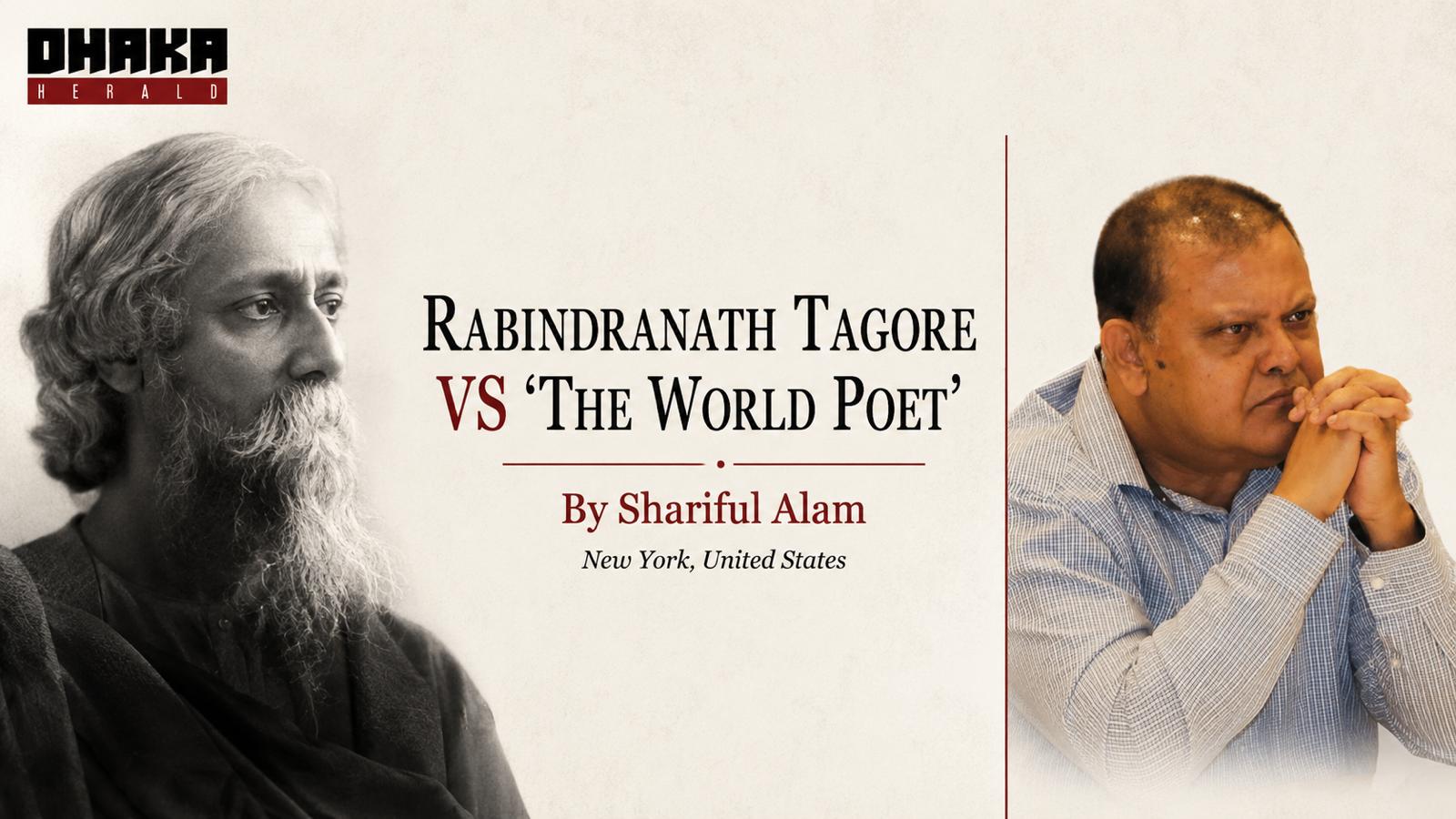
Tagore’s greatness does not depend on an unquestionable title. A serious reassessment of his global readership, social position, contested legacy and the limits of Bengali literature’s international reach may strengthen rather than diminish his place in history.
Devoted admirers of Rabindranath Tagore may find this essay uncomfortable. Some may even regard its central question as irreverent. Yet literature cannot flourish when admiration becomes immunity from criticism. No poet, however celebrated, should be placed beyond historical inquiry or intellectual disagreement.
Tagore was unquestionably one of the most versatile creative figures produced by Bengal. He was a poet, novelist, short story writer, playwright, essayist, composer, educator and painter. His influence on Bengali language and culture is so profound that separating modern Bengali identity from his work would be almost impossible.
But acknowledging his greatness does not require us to accept every popular description of him without examination. The question is not whether Tagore was a great poet. He clearly was. The question is whether the familiar Bengali title “Bishwakabi,” usually translated as “World Poet,” represents a measurable global literary position or primarily expresses the emotional reverence of Bengali readers.
That distinction matters
Every major writer is shaped by a particular social world. Tagore, Bankim Chandra Chattopadhyay and Leo Tolstoy did not write from identical experiences or historical circumstances. Their literary powers cannot be placed on a single scale without considering the societies that produced them.
The influence of Bengal’s landed elite and the zamindari order can be detected in Tagore’s life and writing. Bibhutibhushan Bandyopadhyay drew much of his literary strength from rural Bengal and its intimate relationship with nature. Manik Bandopadhyay confronted poverty, class and economic desperation. Sarat Chandra Chattopadhyay explored moral conflict, social prohibition and the suffering created by conservative customs.
Contemporary writers face a different reality. Their subjects include climate change, ecological collapse, digital alienation, migration, war, refugees, unemployment and the anxiety of an uncertain future. Modern literature also contains the ordinary details of everyday life: midnight tea, unpaid rent, narrow apartment balconies, unexpected guests, street crime, complicated relationships, family pressure, folk beliefs, spiritual healers, amulets and the enduring humour of rural society.
The modern writer does not lack material. What is often missing is the ability to transform that material into literature capable of surviving beyond the immediate moment.
Homer and Tolstoy created readerships that have endured across languages, borders and centuries. Most contemporary Bengali writers have not achieved that scale. The fault does not belong exclusively to writers. Economic hardship, declining attention spans, digital distractions, weak publishing institutions and the absence of serious translation all affect reading habits.
Many younger readers are reluctant to engage with long novels or extended essays. Some live under severe financial and emotional pressure. Others consume literature through short posts and fragmented digital content. Writers themselves may also fail to complete the promise of their ideas because of weak construction, insufficient editing or a lack of institutional support.
It is against this background that the title “World Poet” deserves reconsideration.
Tagore travelled widely across Asia, Europe and the Americas. He delivered lectures, met prominent thinkers and participated in major international conversations. His journeys helped introduce an Indian and Bengali literary voice to audiences unfamiliar with either tradition.
But travelling across many countries cannot, by itself, make someone a world poet. Numerous writers and ordinary travellers have visited more countries than Tagore did. Geography is not the measure of literary universality.
The more relevant questions concern readership, translation, continuing influence and cultural recognition. How widely is Tagore read outside South Asia today? Does he occupy the same place in the everyday literary consciousness of Europe and North America as Goethe, Tolstoy, Kafka, T S Eliot, Arthur Rimbaud or Charles Baudelaire?
My experience in the United States suggests otherwise
I have asked many people what they know about Tagore. A common response has been simple: “We do not know him because we have not read him.” Personal encounters cannot constitute a scientific survey, and they should not be treated as conclusive evidence. Nevertheless, they point toward a gap between Tagore’s enormous status within Bengal and his visibility among general readers elsewhere.
The title “World Poet” was not formally awarded by an international literary institution. It is a Bengali honorific born from admiration, cultural pride and the global recognition associated with his Nobel Prize. It has emotional legitimacy, but emotional legitimacy is not necessarily the same as universal readership.
Tagore received the Nobel Prize in Literature in 1913. His English collection Gitanjali: Song Offerings was central to that recognition. It is sometimes claimed that he received the award merely for an English translation rather than for the original Bengali Gitanjali. That formulation is misleading.
The English volume was not a literal translation of the Bengali book bearing the same title. It included poems selected from Gitanjali and several other Bengali collections. Tagore rendered the poems into English himself. The Nobel Committee recognised the sensitivity, freshness and beauty of the verse that had become accessible to Western readers through his English presentation.
The English Gitanjali therefore opened the international door, but the literary imagination behind it remained unmistakably Tagore’s.
His international success was genuine. It was also historically uneven. Enthusiasm for Tagore grew rapidly in parts of Europe after the publication of Gitanjali, assisted by figures such as W B Yeats. That enthusiasm did not remain equally powerful everywhere. Outside academic, literary and South Asian circles, his presence in the contemporary Western reading culture is limited.
Recognising that limitation does not erase his achievement. It simply places it within a more realistic frame.
Tagore’s social and political legacy also deserves critical examination. Allegations concerning his relationship with Muslims, his position as a zamindar, his supposed opposition to the establishment of the University of Dhaka and alleged discriminatory practices at Santiniketan continue to circulate, particularly on social media.
Such claims must be approached carefully.
There is no convincing archival evidence establishing that Tagore led or chaired a protest against the creation of the University of Dhaka. The frequently repeated story about a meeting at Kolkata’s Garer Math is not supported by reliable contemporary documentation. The University of Dhaka later awarded Tagore an honorary Doctor of Literature degree.
Similarly, the assertion that Muslim students were categorically barred from Santiniketan does not fit the broader historical record. Syed Mujtaba Ali became one of the early Muslim students of Visva Bharati. Initiatives relating to Islamic culture and Persian studies also developed there.
Statements attributed to Tagore concerning Islam and Prophet Muhammad must likewise be supported by verifiable publications, dates and original documents. A quotation that circulates without a traceable source cannot responsibly be treated as historical fact, especially when it concerns a sensitive religious subject.
None of this means that Tagore should escape scrutiny
He came from a powerful zamindar family and participated in estate administration. The zamindari system rested on a deeply unequal economic relationship between landlords and peasants. It is therefore legitimate to investigate his role in rent collection and the conditions experienced by tenants living under that structure.
But criticism becomes credible only when it is supported by evidence. Claims about double taxation, religious levies or systematic discrimination require estate records, contemporary testimony and serious historical research. Repeating an accusation does not turn it into proof.
Context is equally important when examining Tagore’s literary works. A line spoken by a character in a play cannot automatically be presented as the personal belief of the playwright. A sentence from an essay must be read within the circumstances in which it was written. Literature often dramatises prejudice, violence and moral conflict without endorsing them.
Tagore should be examined critically, but he should not be convicted through isolated quotations and unverifiable claims.
The deeper problem is that Bengali culture often moves between two extremes. We either elevate cultural figures into untouchable icons or attempt to demolish them entirely. Neither approach produces serious criticism. Tagore does not need worship, and he does not deserve careless vilification. He needs reading, research and debate.
The same intellectual honesty should be applied to Bengali literature’s international position.
Bangla has produced many writers of exceptional quality. Shamsur Rahman, Syed Shamsul Haq, Humayun Azad, Humayun Ahmed, Helal Hafiz, Nirmalendu Goon and Hasan Hafizur Rahman all made important contributions. Lalon Shah, Shah Abdul Karim and Jibanananda Das continue to attract academic interest beyond Bangladesh.
Yet few Bengali writers have secured a sustained place in the global literary marketplace.
By contrast, Haruki Murakami of Japan, Han Kang of South Korea, Mahmoud Darwish of Palestine, Nguyen Du of Vietnam, Forugh Farrokhzad of Iran and the Pashto poet Khushal Khan Khattak have achieved varying degrees of visibility beyond their linguistic communities.
Their international presence is not based solely on literary quality. Translation, publishing networks, scholarship, cultural diplomacy, university programmes, political history and global marketing all play decisive roles.
Bengali literature has suffered from weaknesses in nearly all these areas. Too many translations are literal, lifeless or poorly edited. Important works remain unavailable in major international languages. Publishing institutions rarely develop long term strategies for introducing Bengali writers to global audiences. Archives, manuscripts and critical editions are often incomplete or difficult to access.
Bangladesh does not lack international relevance. The Language Movement, the Liberation War, colonialism, famine, military rule, mass migration, river erosion, the garment industry and climate vulnerability all possess immense global significance. The country’s literature contains stories that can speak to readers everywhere.
The problem is not an absence of stories. It is our failure to carry those stories across linguistic and institutional borders.
With strong translations and serious international publishing, Lalon, Shah Abdul Karim, Jibanananda Das, Syed Shamsul Haq, Humayun Azad and Humayun Ahmed could reach far larger audiences. Their works could be discussed regularly in international newspapers, universities and literary festivals.
Tagore went further than any Bengali writer of his generation in crossing that border. His Nobel Prize created an opening, and his work gave Bengal an international literary presence at a time when colonial attitudes often denied intellectual equality to non European cultures.
That achievement must be honoured.
But honour does not require exaggeration. Rumi is read across languages and cultures on a scale that Tagore does not currently enjoy outside South Asia. Goethe, Tolstoy and Kafka remain embedded in the global literary canon in ways that Tagore’s work, despite its brilliance, often is not.
The answer is not to abandon the title “World Poet.” Bengalis are entitled to use it as an expression of affection, pride and cultural inheritance. The title becomes problematic only when emotional respect is presented as unquestionable evidence of universal recognition.
Tagore’s place in history does not depend on a grand title. His poetry, songs, fiction, essays, educational experiments and artistic imagination are substantial enough to withstand criticism.
Indeed, questioning the mythology surrounding Tagore may help us encounter the real writer more honestly. A human Tagore, shaped by his class, time, privileges, insights and contradictions, is far more intellectually compelling than an immaculate cultural monument.
A great poet does not need protection from questions. He survives them.
Tagore’s literature remains his strongest claim to the world. Whether we call him “World Poet” or simply Rabindranath Tagore, the more urgent task is to read him critically, translate him imaginatively and allow his work to stand on its own extraordinary merits.
