
From Privilege to Purpose
How Ramon Magsaysay Awardee Runa Khan Carried Hope to Bangladesh’s Forgotten Frontiers
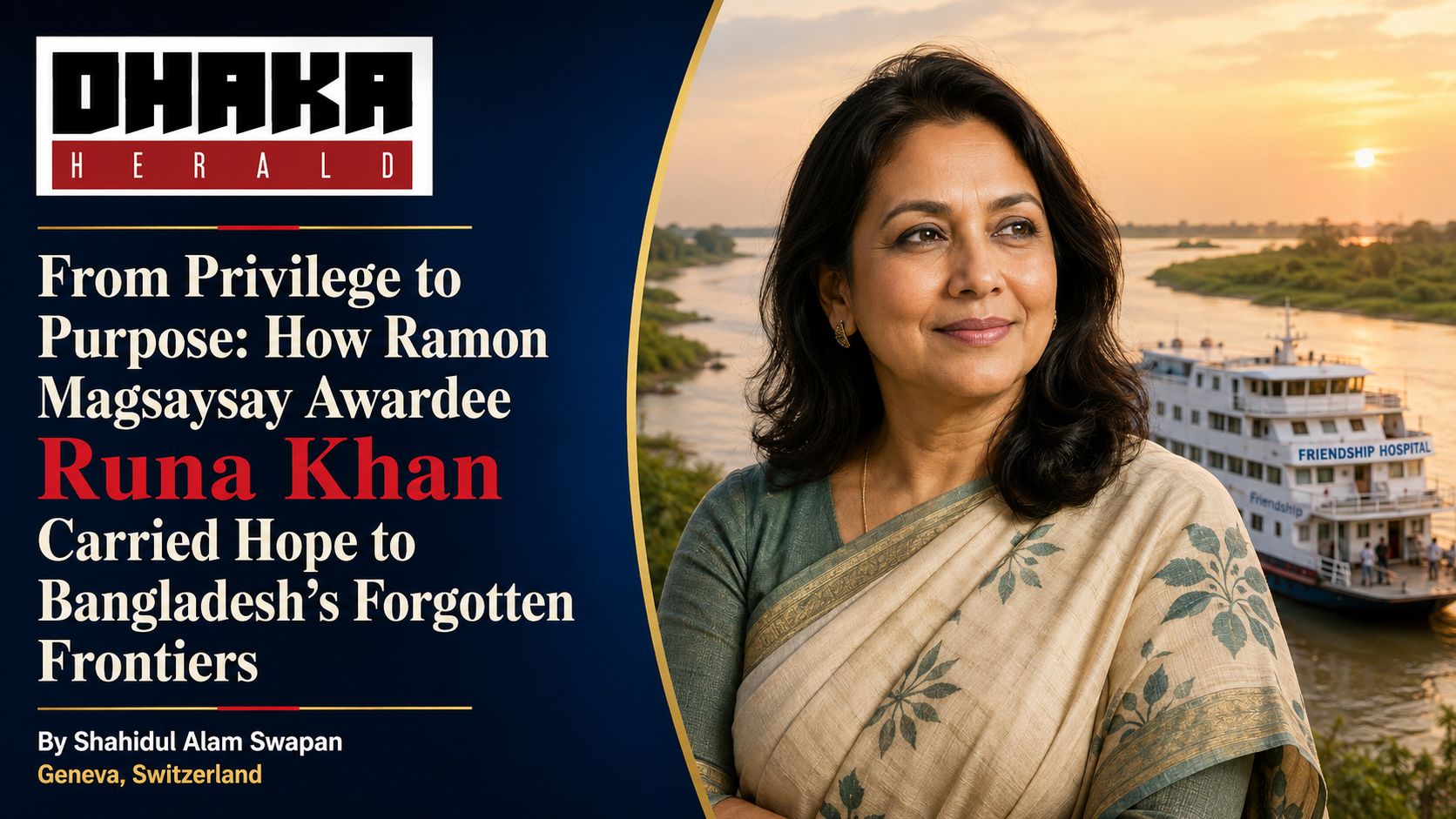
In the shifting river islands of Bangladesh, geography often determines destiny. A family living on a remote char may be separated from the nearest hospital by hours of hazardous travel. A child’s education can disappear with the riverbank overnight. A cyclone, flood or sudden erosion may destroy not only a home but also land, livelihood and the fragile sense of security upon which an entire life has been built.
These are places where conventional development frequently struggles to arrive and where Runa Khan chose to begin.
The Bangladeshi social entrepreneur and founder of Friendship has been named a 2026 Ramon Magsaysay Awardee, one of Asia’s most prestigious recognitions for public service and moral leadership. The honour is not simply an acknowledgement of a distinguished individual. It is recognition of a development philosophy that starts with the people who are hardest to reach and too often excluded from national progress.
The Ramon Magsaysay Award Foundation recognised Khan for her profound empathy for Bangladesh’s poorest communities and for the courage, vision and perseverance with which she built Friendship. The foundation’s citation captures the moral essence of her journey: in her hands, privilege became a responsibility a resource to be shared so that others could live with hope, opportunity and dignity.
That transformation from privilege into public responsibility is what makes Runa Khan’s story so compelling.
An award for service rooted in human dignity
Established in 1957 and first presented in 1958, the Ramon Magsaysay Award honours individuals and organisations whose work demonstrates integrity, courage and selfless service to the peoples of Asia. It is named after Ramon Magsaysay, the seventh president of the Philippines, and has often been described as “Asia’s Nobel Prize.”
The 2026 awardees were announced in Manila on August 31, the anniversary of Magsaysay’s birth. Alongside Runa Khan, the foundation selected Singaporean diplomat and international-law scholar Tommy Koh and Myanmar human-rights activist Bo Kyi. The formal presentation is scheduled to take place at the Metropolitan Theatre in Manila on November 15. Ramon Magsaysay Award Foundation
The three recipients represent different fields, but their work shares a common principle: leadership derives its legitimacy not from status or authority alone, but from service.
For Bangladesh, Khan’s recognition carries particular significance. The country is frequently presented to the world through the language of vulnerability floods, cyclones, poverty, overcrowding, river erosion and climate displacement. Runa Khan’s work offers another narrative: Bangladesh as a source of humanitarian ingenuity, community resilience and development models that can inform the wider world.
Her achievement belongs to her, but its meaning reaches far beyond one individual. It honours the health workers navigating unpredictable rivers, the teachers continuing lessons in flood-prone settlements, the women building livelihoods under severe constraints, and the communities that refuse to surrender their futures to geography or climate.
The journey began where the road ended
Runa Khan’s engagement with disadvantaged children began long before Friendship was formally established. According to the Ramon Magsaysay Award Foundation, she began teaching children from poor communities in 1979. That experience appears to have shaped a conviction that service must not be based on pity. It must expand people’s ability to make choices, exercise rights and build their own futures.
Friendship was founded in 2002. Its early work centred on a floating hospital serving communities living on the chars of the Jamuna-Brahmaputra river system.
The charlands are among Bangladesh’s most precarious human environments. Created, reshaped and sometimes erased by river currents, these islands and sandbars are home to communities that may remain outside the practical reach of conventional public services. Roads are limited or nonexistent. Transport is expensive and dependent on weather and river conditions. Permanent hospitals and schools are difficult to maintain where the land itself may disappear.
The idea behind the first hospital ship was therefore both simple and radical: if isolated communities could not reach essential healthcare, healthcare would travel to them.
That decision embodied the philosophy that would come to define Friendship. Instead of requiring vulnerable people to fit within rigid institutional systems, the organisation would redesign services around the realities of their lives.
What began with one floating hospital gradually evolved into an integrated development organisation working across healthcare, education, climate adaptation, disaster management, livelihoods, economic empowerment, access to justice and social inclusion. The Ramon Magsaysay Award Foundation says Friendship now operates seven hospital ships, two land-based hospitals and approximately 550 mobile clinics, supported by a workforce of more than 7,500 people.
These figures are impressive. But numbers alone do not fully explain the organisation’s influence. Its deeper contribution lies in demonstrating how multiple dimensions of deprivation can be addressed together.
Poverty is never a single problem
A patient may receive treatment, but without safe drinking water the illness may return. A child may enter school, but if the family loses its land and income to erosion, education may become unaffordable. A woman may acquire a new skill, but without market access, legal awareness or control over income, her economic independence may remain limited. A coastal community may survive a cyclone, yet still be forced to migrate if salinity destroys agriculture and drinking-water sources.
Friendship’s work reflects an understanding that poverty is not a single shortage. It is a web of interconnected disadvantages.
This is why its approach extends beyond immediate relief. Healthcare is connected to nutrition, maternal health and community awareness. Education is connected to social mobility and local leadership. Disaster preparedness is linked to climate adaptation. Livelihood support is connected to dignity, gender equality and freedom from dependence. Access to justice is tied to the ability of vulnerable people to protect their rights.
By addressing these issues together, Friendship has moved beyond the traditional model of an aid organisation delivering isolated projects. It has developed a social-purpose model that seeks to remain alongside communities before, during and after emergencies.
This distinction is crucial. Humanitarian assistance saves lives during moments of crisis, but long-term development requires more than emergency response. It requires institutions, knowledge, trust, local participation and the ability to prepare for the next shock.
Runa Khan’s leadership has helped build that bridge between relief and resilience.
Floating hospitals as a symbol of adaptive development
The hospital ships remain among Friendship’s most recognisable innovations. They are also an important symbol of what development can become when it listens to geography.
Conventional policy often assumes fixed infrastructure: a permanent hospital, a permanent school, a permanent administrative centre. In Bangladesh’s riverine regions, however, the environment is mobile. Rivers change course, islands emerge and disappear, and communities are repeatedly displaced.
A floating hospital responds to that reality. It turns a river often regarded only as a barrier into a route through which medical services can travel.
This is innovation in its most meaningful form. It is not technology introduced for prestige, but practical adaptation shaped around human need. It asks a different question: not why remote people fail to access the system, but why the system has failed to reach them.
The same philosophy can be seen in Friendship’s climate-resilient settlements, dismantlable schools, disaster-preparedness programmes, water initiatives and mangrove restoration. Its work recognises that climate adaptation cannot be separated from health, education, employment or justice.
For countries confronting similar geographical and environmental challenges, the model has wider relevance. From the river deltas of South and Southeast Asia to the small islands threatened by rising seas, the lesson is clear: development systems must adapt to communities and ecosystems, rather than demanding that vulnerable people adapt indefinitely to inaccessible institutions.
Climate justice through practical action
Bangladesh is among the countries most exposed to climate related risks despite having contributed only a small share of historic global greenhouse gas emissions. For its poorest citizens, climate change is not a future scenario. It is already experienced through coastal salinity, river erosion, extreme heat, unpredictable rainfall, floods, cyclones and forced migration.
Runa Khan’s work is significant because it approaches climate change through the lives of people rather than through abstract policy language.
A climate resilient village is not merely a collection of stronger buildings. It must have accessible healthcare, safe water, functioning education, secure livelihoods, community leadership and reliable disaster preparedness. Adaptation succeeds when people can remain safe without surrendering their dignity or prospects.
Friendship’s climate programmes received major global recognition in 2025 when the organisation won the Earthshot Prize in the “Fix Our Climate” category. The prize highlighted its integrated approach to building resilience in vulnerable parts of Bangladesh.
According to the Earthshot Prize, Friendship reaches more than 7.5 million people annually with healthcare services, has provided over 8.3 million days of emergency food support, and has helped more than 80,000 people obtain safe drinking water in coastal communities. Its environmental work includes restoring over 60 kilometres of mangrove belts and planting more than 650,000 trees across approximately 200 hectares near the Sundarbans, helping protect more than 125,000 people. The Earthshot Prize.
Mangroves are not simply trees planted for environmental symbolism. They help reduce the force of storm surges, limit erosion, provide habitat and support livelihoods. In this context, ecological restoration becomes a form of social protection.
The Magsaysay recognition, following the Earthshot Prize, affirms the global importance of a model developed in Bangladesh’s most difficult terrain.
Women’s empowerment beyond slogans
Runa Khan’s work also holds a powerful message about women’s leadership. In many vulnerable communities, women carry a disproportionate burden during disasters. They often manage food, water, children’s safety, elderly relatives and household recovery, even while having limited access to money, property, public decision-making and mobility.
Effective development cannot treat women merely as beneficiaries. They must be recognised as decision-makers, income earners, community leaders and holders of knowledge.
Friendship’s programmes have sought to strengthen women’s access to healthcare, education, livelihoods, rights and community participation. The significance of such work lies not only in improving individual incomes but also in altering the balance of possibility within families and communities.
When women gain financial capacity, legal awareness and a voice in local affairs, the impact extends to children’s education, nutrition, health and protection. Empowerment becomes intergenerational.
Khan’s own leadership offers another example. She has shown that compassion and executive discipline are not opposing qualities. An organisation may be deeply humane while remaining operationally ambitious. It may respect local realities while working at scale. It may begin with one vessel and grow into a multifaceted institution without abandoning its founding values.
Dignity as a development principle
One of the most frequently used words in descriptions of Runa Khan’s work is “dignity.” In international development, however, dignity can easily become an attractive but vague expression. Friendship’s work gives the idea practical meaning.
Dignity means that a pregnant woman living on a remote char should not be considered less deserving of skilled medical care because of her address. It means that a child’s education should not become disposable whenever a river changes course. It means that a climate displaced family should be regarded as citizens with rights and potential, not merely as statistics in a disaster report.
It also means listening.
Development interventions often fail when they are designed far from the communities they intend to serve. Decisions are made according to donor cycles, administrative convenience or assumptions about what poor people need. Runa Khan’s model challenges this hierarchy by placing communities at the centre of planning and delivery.
This does not romanticise hardship. Nor does it imply that communities can solve structural inequality alone. Rather, it recognises that sustainable change is built with people, not imposed upon them.
Turning privilege into responsibility
The award foundation’s observation about privilege may become the defining line of Runa Khan’s public legacy. It challenges a broader culture in which privilege is often understood as something to preserve, display or pass down.
Privilege can take many forms: wealth, education, social networks, mobility, institutional access or the confidence to enter rooms from which others are excluded. The moral question is what one chooses to do with it.
Runa Khan’s life offers a clear answer. Privilege becomes meaningful when it is converted into access for others. Leadership becomes credible when it reduces the distance between the protected and the exposed, the visible and the forgotten, the centre and the margins.
Her story should therefore be read not only as a celebration but also as a challenge to Bangladesh’s political, corporate and social elites. The country does not suffer from a shortage of talent, resources or entrepreneurial ability. It suffers too often from a failure to direct them towards public purpose.
If more privileged citizens regarded advantage as responsibility, Bangladesh’s development journey could become more inclusive, humane and sustainable.
What Bangladesh can learn
The 2026 Ramon Magsaysay Award should encourage policymakers to study the institutional lessons behind Friendship’s success.
First, public services must be designed around the country’s diverse geography. What works in Dhaka may not work in a char, a coastal island, a wetland settlement or a hill community.
Second, climate adaptation should be integrated into health, education, housing, water, livelihoods and social protection. Treating climate change as a separate environmental portfolio ignores how deeply it shapes human development.
Third, locally tested innovations deserve pathways to national scale. Bangladesh has many successful community initiatives, but they often remain confined to individual organisations or donor-funded projects. Government, civil society, universities and the private sector should collaborate to identify, evaluate and replicate models that work.
Fourth, development should be measured not merely by the amount of money spent or the number of projects completed, but by whether people gain lasting agency, security and dignity.
Finally, humanitarian work must never become a substitute for state responsibility. Organisations such as Friendship can innovate, reach neglected communities and demonstrate effective models. But ensuring healthcare, education, justice and protection for every citizen remains fundamentally a public obligation. The best partnership is one in which civil society innovation strengthens inclusive state capacity.
A victory shared with the communities
Runa Khan’s name will appear on the award certificate, but the recognition inevitably belongs to a much larger human story.
It belongs to the boat crews carrying medical teams through difficult waters; to the doctors, nurses and paramedics serving where permanent facilities are scarce; to teachers maintaining classrooms under unstable conditions; to local women organising communities; and to families rebuilding after losing homes, crops and land.
Most importantly, it belongs to the people of the chars and coastal regions whose resilience has too often been admired from a distance while their rights and needs remained neglected.
The danger of international awards is that they may turn a long and complicated struggle into an inspiring individual story. Runa Khan’s achievement should instead direct attention back to the millions of people whose lives reveal both the severity of inequality and the possibility of change.
Her work does not tell us that one leader can solve every problem. It tells us that determined leadership can build institutions capable of reaching people whom established systems have overlooked.
Hope carried across the water
More than two decades after Friendship launched its first hospital ship, Runa Khan’s vision has travelled far beyond the river on which it began. Yet its central purpose remains remarkably consistent: to ensure that remoteness does not become a sentence of exclusion.
The Ramon Magsaysay Award recognises her humanitarian innovation, but it also honours something more fundamental—the refusal to accept that some lives should remain beyond the reach of opportunity.
At a time when development is increasingly discussed through figures, targets and global frameworks, Runa Khan reminds us that progress ultimately concerns people: whether a mother survives childbirth, whether a child can remain in school, whether a family can withstand a cyclone, and whether a person living at the geographical margins is treated as an equal citizen.
Her journey from privilege to purpose is therefore not only an inspiring chapter in Bangladesh’s story. It is a model of leadership for Asia and beyond.
Runa Khan carried healthcare, education and hope to places where roads could not go. The 2026 Ramon Magsaysay Award now carries the story of those communities to the world and reminds us that the true measure of leadership is how far it is prepared to travel to stand beside those who have been left behind.
