
Hasina’s December Return and the Dhaka-Delhi Equation
A Strategic Reckoning for Bangladesh and India
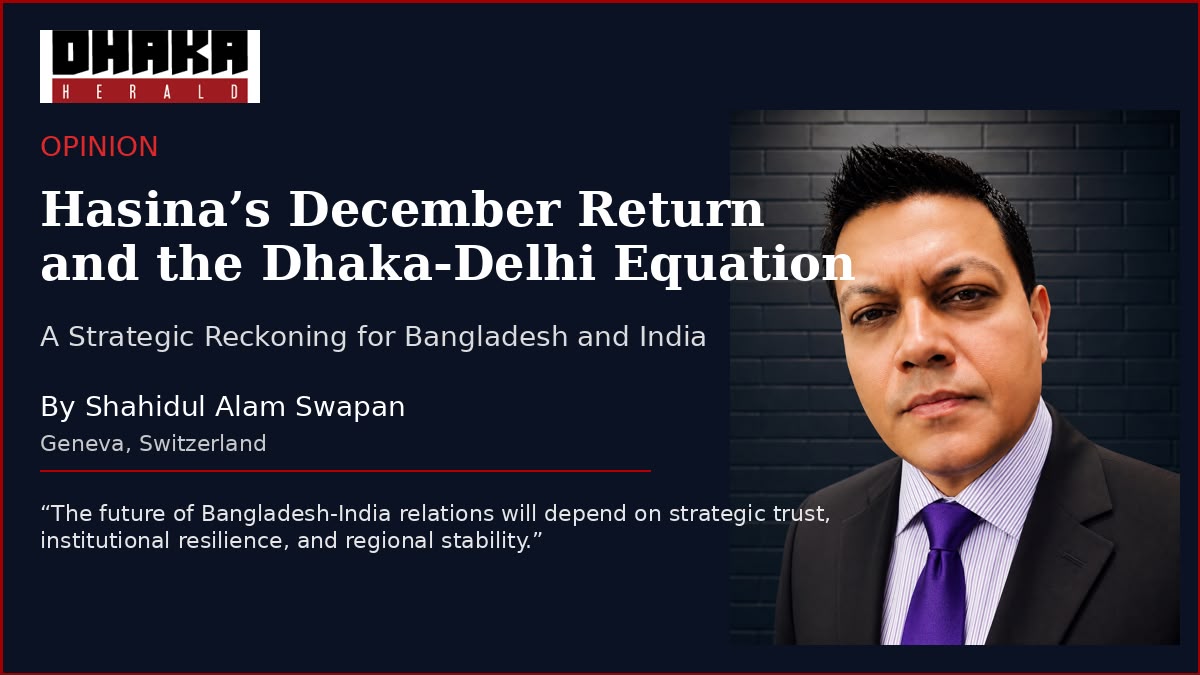
Bangladesh’s political transition has become more than a domestic contest. It now sits at the intersection of South Asian geopolitics, India’s security calculus, regional stability, and the evolving balance of power in the Bay of Bengal.
Former Prime Minister Sheikh Hasina's latest interview with Indian media outlet The Wall is significant not only because of what she said about her possible return to Bangladesh in December, but also because of what her comments reveal about the deeper strategic calculations shaping Bangladesh-India relations. Her remarks on political succession, security concerns, regional extremism, India's role in Bangladeshi politics, and her own future suggest that the political contest surrounding Bangladesh is no longer merely a domestic struggle. It has increasingly become part of a broader geopolitical equation involving Delhi, Dhaka, regional security, and the balance of power in South Asia.
The most consequential aspect of Hasina's interview is arguably not her determination to return to Bangladesh, but her insistence that Bangladesh's future cannot be separated from India's security interests. Whether one agrees with her assessment or not, the argument deserves careful examination because it reflects a strategic reality that policymakers in both countries have grappled with for decades.
For more than fifteen years, India and Bangladesh built one of the strongest bilateral relationships in South Asia under the Awami League government. Cooperation expanded in trade, energy, connectivity, border management, counterterrorism, and regional integration. India viewed Hasina's administration as a reliable partner in containing anti-India militant networks operating from Bangladeshi territory. Bangladesh, in return, benefited from increased economic cooperation and infrastructure support.
The political transition that followed the dramatic events of 2024 altered that equation significantly.
Today, Delhi faces a complicated challenge. India cannot be seen as openly intervening in Bangladesh's internal politics, yet it remains deeply concerned about political instability, rising anti-India sentiment, and the possibility of extremist groups exploiting a prolonged period of uncertainty. Hasina's comments appear designed to remind Indian policymakers that her government historically aligned closely with India's security priorities.
Her warning regarding the potential rise of extremist forces should therefore be understood in both political and strategic terms. Critics may regard such statements as political messaging aimed at international audiences. Supporters may consider them legitimate security concerns. Regardless, India is unlikely to dismiss these warnings outright because New Delhi's approach to Bangladesh has always been heavily influenced by security considerations.
However, Delhi's strategic calculus is far more complex than many observers assume.
Contrary to popular political narratives within Bangladesh, India does not necessarily have an interest in supporting any individual politician indefinitely. Rather, India seeks predictability. Its primary goals include border security, uninterrupted connectivity to the northeastern states, protection of economic investments, prevention of radicalisation, and maintaining regional stability.
From Delhi's perspective, an unstable Bangladesh creates several risks. First, any deterioration of law and order along the long Bangladesh-India border increases security vulnerabilities. Second, political uncertainty can disrupt connectivity projects that are central to India's regional economic strategy. Third, prolonged instability may encourage external powers to expand their influence in ways that complicate India's strategic environment.
This is where Bangladesh's domestic politics become intertwined with broader geopolitical competition.
South Asia is witnessing increasing strategic engagement from China, the United States, and various Gulf actors. Bangladesh's geographic position makes it particularly valuable. Situated along the Bay of Bengal and located between South and Southeast Asia, the country plays a crucial role in regional trade routes and maritime security.
As a result, any major political transition in Bangladesh is watched carefully not only in Delhi but also in Beijing, Washington, Tokyo, and other regional capitals.
Hasina's remarks about India's support for Bangladesh's electoral process and her comments concerning BNP Acting Chairman Tarique Rahman also highlight another important dimension of Bangladesh-India relations: trust.
Historically, relations between India and the BNP have often been marked by suspicion, though there have also been periods of engagement and cooperation. If Bangladesh experiences a significant political realignment, India will seek assurances that future governments remain committed to existing bilateral frameworks.
For Bangladesh, however, the challenge is equally serious.
Many Bangladeshis across the political spectrum have long argued that bilateral relations should not become dependent on any single political party. Sustainable state-to-state relations require institutional strength rather than personality-driven diplomacy. This argument has gained increasing relevance amid the country's current political polarisation.
Indeed, one of the major lessons from recent events is that Bangladesh's foreign policy must be resilient enough to survive changes of government. If bilateral relations become excessively associated with one leader or one political party, they become vulnerable whenever domestic political change occurs.
This reality applies to India as much as it applies to Bangladesh.
Another noteworthy aspect of Hasina's interview concerns succession within the Awami League. By effectively ruling out an active political role for Sheikh Rehana and identifying Sheikh Selim as the senior leader who would perform leadership responsibilities in her absence, Hasina appears to be sending a message about organisational continuity.
The statement suggests an effort to reassure party supporters that the Awami League remains structurally intact despite unprecedented political challenges. From a strategic standpoint, such messaging is important because political movements often face serious risks when questions emerge regarding leadership succession.
Yet the bigger issue is whether Bangladesh's political system can move beyond personality-centred politics altogether.
The country's future stability will depend less on the fate of individual leaders and more on the credibility of institutions, electoral processes, judicial independence, and political inclusiveness. International partners, including India, are ultimately interested in a Bangladesh that is stable, economically dynamic, and capable of managing political transitions peacefully.
Hasina's assertion that December carries symbolic significance because it is Bangladesh's month of victory is also politically strategic. December occupies a unique place in the national imagination due to the country's liberation history. By linking her planned return to the month of victory, she seeks to frame her political comeback within a larger narrative of historical legitimacy and national identity.
Whether such messaging resonates with the broader population remains uncertain.
Bangladesh today is markedly different from the country that existed even a decade ago. A younger generation of voters is increasingly focused on jobs, inflation, governance, accountability, education, and economic opportunities. Historical narratives continue to matter, but they may not be sufficient on their own to determine political outcomes.
Furthermore, if Hasina does attempt to return, the political and legal implications could be enormous. Questions regarding security, legal proceedings, political mobilisation, and public reaction would immediately become central issues. Any miscalculation by political actors could deepen divisions at a time when national reconciliation may be more necessary than confrontation.
For India, the preferred outcome is likely to be a stable and internationally accepted political settlement in Bangladesh, regardless of which political force ultimately gains power. Delhi understands that instability in Bangladesh inevitably spills across borders through economic disruption, security concerns, migration pressures, and diplomatic complications.
For Bangladesh, meanwhile, the overriding national interest should be preserving sovereignty while maintaining constructive relations with all major partners. Neither excessive dependence on India nor unnecessary hostility toward India serves Bangladesh's long-term interests. Geography alone ensures that the two countries will remain deeply interconnected for decades to come.
*”The future of Bangladesh-India relations will depend not on personalities alone, but on institutions, strategic trust, economic interdependence, and the ability of both nations to navigate an increasingly complex geopolitical landscape.”*
Ultimately, Sheikh Hasina's interview is less about one politician's return and more about the strategic crossroads facing Bangladesh. The questions raised go beyond party politics: What kind of political system will emerge from the country's current transition? Can Bangladesh maintain internal stability while balancing competing international interests? And can Dhaka and Delhi redefine their relationship on the basis of enduring national interests rather than temporary political alignments?
The answers to these questions will shape not only Bangladesh's future but also the strategic landscape of South Asia.
As December approaches, both Dhaka and Delhi will be closely watching the next moves. What happens thereafter may well determine the trajectory of one of South Asia's most important bilateral relationships for years to come.
(About the Author: Shahidul Alam Swapan is a Geneva-based political analyst, private banking financial crime compliance specialist, columnist, and poet. He regularly writes on South Asian geopolitics, international affairs, global financial integrity, strategic security issues, and emerging geopolitical trends. Email: shahidul.alam@bluewin.ch)
