
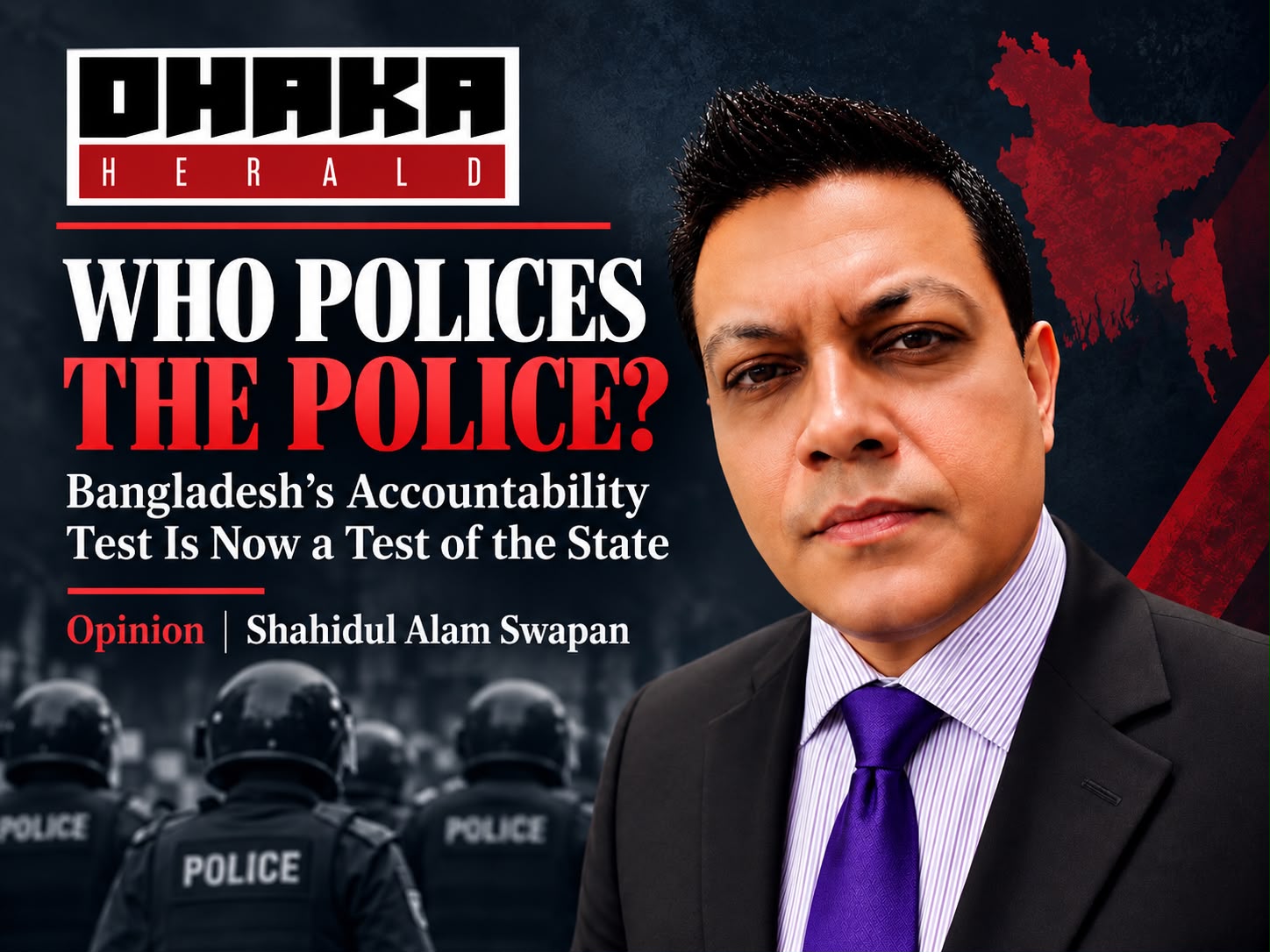
Who Polices the Police? Bangladesh’s Accountability Test Is Now a Test of the State
Bangladesh has spent decades debating how powerful its police and security forces should be. It has spent far less time answering a more consequential question: *who holds that power accountable when it is abused?
That question has returned with unusual force after UN High Commissioner for Human Rights Volker Türk told the 63rd session of the Human Rights Council in Geneva on September 7 that Bangladesh needs a strengthened and independent national institution capable of overseeing its security forces. His intervention should not be dismissed as another piece of international criticism. It goes to the heart of Bangladesh’s unfinished democratic transformation.
The issue is not whether Bangladesh needs strong law enforcement. It unquestionably does. A country confronting organised crime, political violence, extremism, narcotics, trafficking and increasingly sophisticated financial and cybercrime cannot function with weak policing. But there is *a fundamental difference between a strong security institution and an institution free from accountability.*
A democratic state needs the first. It should fear the second.
The lesson Bangladesh cannot afford to forget
Bangladesh’s political history demonstrates a recurring institutional problem. Governments change, political victims and beneficiaries exchange places, and the rhetoric surrounding law enforcement changes accordingly. Yet allegations that police and security institutions are being politically influenced return with remarkable consistency.
That suggests the problem is larger than any single government, party, police chief or security agency.
It is structural.
The February 2025 UN fact finding report into the July and August 2024 uprising made 44 recommendations covering accountability, security sector reform and stronger civilian oversight. The report estimated that as many as 1,400 people may have been killed between July 15 and August 5, 2024, with firearms used by security forces responsible for a large proportion of the deaths, according to the UN assessment.
Whatever one’s political interpretation of that turbulent period, Bangladesh cannot build its future by treating accountability as something required only when political opponents control the state.
That is precisely how institutional impunity survives.
When Party A governs, its supporters may justify coercive policing in the name of stability. When Party B comes to power, the same people suddenly discover the importance of civil liberties. Eventually the roles reverse.
A democratic republic cannot operate on this revolving definition of human rights.
Rights must belong to citizens, not governments.
Independent oversight is not anti-police
One of the biggest mistakes Bangladesh could make is to interpret civilian oversight as an attempt to weaken the police.
The opposite is true.
In England and Wales, the Independent Office for Police Conduct oversees the police complaints system and independently investigates the most serious and sensitive cases, particularly incidents involving deaths or serious injuries. Importantly, it operates independently of both the police and government.
Ontario, Canada, provides another instructive example. Its Special Investigations Unit is a civilian agency independent of the police. It investigates circumstances involving police where there has been death, serious injury, firearm discharge at a person or an allegation of sexual assault. Where evidence provides reasonable grounds to believe that an officer committed a criminal offence, the SIU director can lay charges.
Bangladesh does not need to copy Britain or Canada mechanically. Its institutions, political history and security environment are different.
But the democratic principle travels remarkably well: *the institution accused of serious wrongdoing should not have the final word on investigating itself.*
Internal police discipline remains necessary. Most routine complaints can and should be handled through professional standards mechanisms. But allegations involving custodial death, enforced disappearance, torture, unlawful lethal force or other grave abuses require a higher threshold of independence.
Without that separation, even an honest internal investigation may struggle to command public confidence.
Bangladesh needs an institution with teeth
Bangladesh therefore faces a choice.
It could create another commission, appoint distinguished personalities, allocate offices, produce annual reports and congratulate itself on institutional reform.
Or it could establish something that actually works.
A genuinely independent *Police and Security Forces Accountability Commission,* whatever its eventual name, would require statutory independence from the executive, its own professional investigators, protected funding and authority to obtain official documents, detention records, CCTV footage, digital evidence, weapons records and testimony.
Deaths in custody, alleged disappearances, serious torture and deaths or grave injuries resulting from security force action should trigger mandatory notification to the independent body.
Its leadership cannot simply be selected behind closed doors by whichever government happens to hold office. A credible appointment process should incorporate transparent nominations, professional qualifications, public scrutiny and meaningful institutional checks.
The commission should report publicly and regularly to parliament. Where evidence indicates criminal conduct, cases should move into the appropriate prosecutorial and judicial process.
The objective is not to create another court.
It is to ensure that the road to court cannot be blocked by institutional self-protection.
Protect the police as well as the public
There is another side to accountability that Bangladesh’s political debate frequently ignores.
Police officers can themselves become victims of politics.
They operate under extraordinary pressure. They make rapid decisions in dangerous environments. They confront armed criminals, violent crowds and life threatening situations. They can also face malicious, fabricated or politically motivated allegations.
An independent oversight institution should therefore protect due process for officers just as rigorously as it protects citizens.
If allegations are proven, consequences should follow.
If allegations are demonstrably false, the officer concerned should be cleared promptly and publicly.
This matters because professional policing cannot emerge from a system in which officers are first pressured to obey political instructions and later personally sacrificed when political power changes hands.
Accountability must therefore travel upwards as well as downwards.
If an unlawful operation resulted from political or senior administrative instructions, investigating only the constable who executed the order while ignoring those who designed or authorised it would not constitute accountability.
It would constitute scapegoating.
Reform must reach beyond uniforms
Bangladesh has often confused security sector reform with administrative reorganisation.
Changing uniforms is not reform.
Renaming agencies is not reform.
Buying vehicles, surveillance technology or modern weapons is not reform.
Professional reform means changing the incentives governing police behaviour.
Recruitment, promotion, posting, transfer and disciplinary decisions must progressively be insulated from partisan political pressure. Officers need modern investigative training, forensic capabilities, adequate salaries, psychological support, reasonable working conditions and protection against improper political orders.
At the same time, unlawful behaviour cannot enjoy institutional immunity.
That balance is difficult, but it is indispensable.
Bangladesh should also decide whether the reformed National Human Rights Commission can credibly perform part of this oversight function or whether a specialised body is necessary. The UN recommendations have specifically stressed stronger authority for the NHRC to investigate allegations involving police, armed forces and other security agencies, alongside adequate resources and an appointment process consistent with international standards.
What Bangladesh does not need is two weak commissions where one strong institution would suffice.
Sovereignty is strengthened by accountability
There is also an international dimension.
Bangladesh understandably resists external interference in its domestic affairs. Sovereignty matters. But sovereignty is most persuasive when national institutions are capable of investigating national failures.
The strongest response to an international allegation of abuse is not an angry press conference.
It is credible evidence produced by an independent Bangladeshi institution.
When allegations of custodial deaths, disappearances or unlawful force can be investigated transparently at home, Bangladesh reduces rather than increases the space for international pressure.
In that sense, Türk’s proposal should not primarily be understood as a demand from Geneva.
It should be understood as a question for Dhaka.
Can Bangladesh build institutions strong enough to investigate the state itself?
That is one of the defining tests of democratic maturity.
From fear to trust
For too long, political discussions in Bangladesh have presented security and human rights as competing objectives. The assumption is that protecting rights somehow ties the hands of police, while effective law enforcement requires giving security agencies exceptional freedom.
That is a false choice.
Police ultimately depend on public cooperation. Citizens provide information, testify in court, report suspicious behaviour and assist investigations when they believe the justice system deserves their confidence.
Fear can produce obedience.
It cannot produce lasting legitimacy.
Bangladesh therefore does not need weaker police. It needs *better police:* professionally trained, technologically capable, politically neutral, operationally confident and legally accountable.
Nor does the country need a watchdog designed to humiliate its security forces. It needs one capable of distinguishing lawful force from unlawful violence, professional mistakes from criminal misconduct and genuine complaints from politically motivated accusations.
The principle should be simple: the greater the coercive power entrusted to an institution, the stronger the democratic accountability surrounding that power must become.
The real question before Bangladesh is therefore no longer merely who governs the country.
It is who watches those who exercise the state’s most formidable powers.
A police officer can ask a citizen to account for his actions. A democratic Bangladesh must possess an institution capable, when necessary, of asking the police officer, the commander and even the political authority behind them an equally simple question:
You exercised the power of the state. Was that power exercised according to law?
If Bangladesh can build an institution capable of asking that question without fear or favour, it will have achieved something much larger than satisfying a UN recommendation.
It will have strengthened the republic itself.
(Shahidul Alam Swapan is a Geneva-based political analyst, private banking financial crime compliance specialist, columnist, and poet. He regularly writes on South Asian geopolitics, international affairs, global financial integrity, strategic security issues, and emerging geopolitical trends. Email: shahidul.alam@bluewin.ch)
