
Beyond One Resignation
What South Asia Must Learn from the Saima Wazed Episode
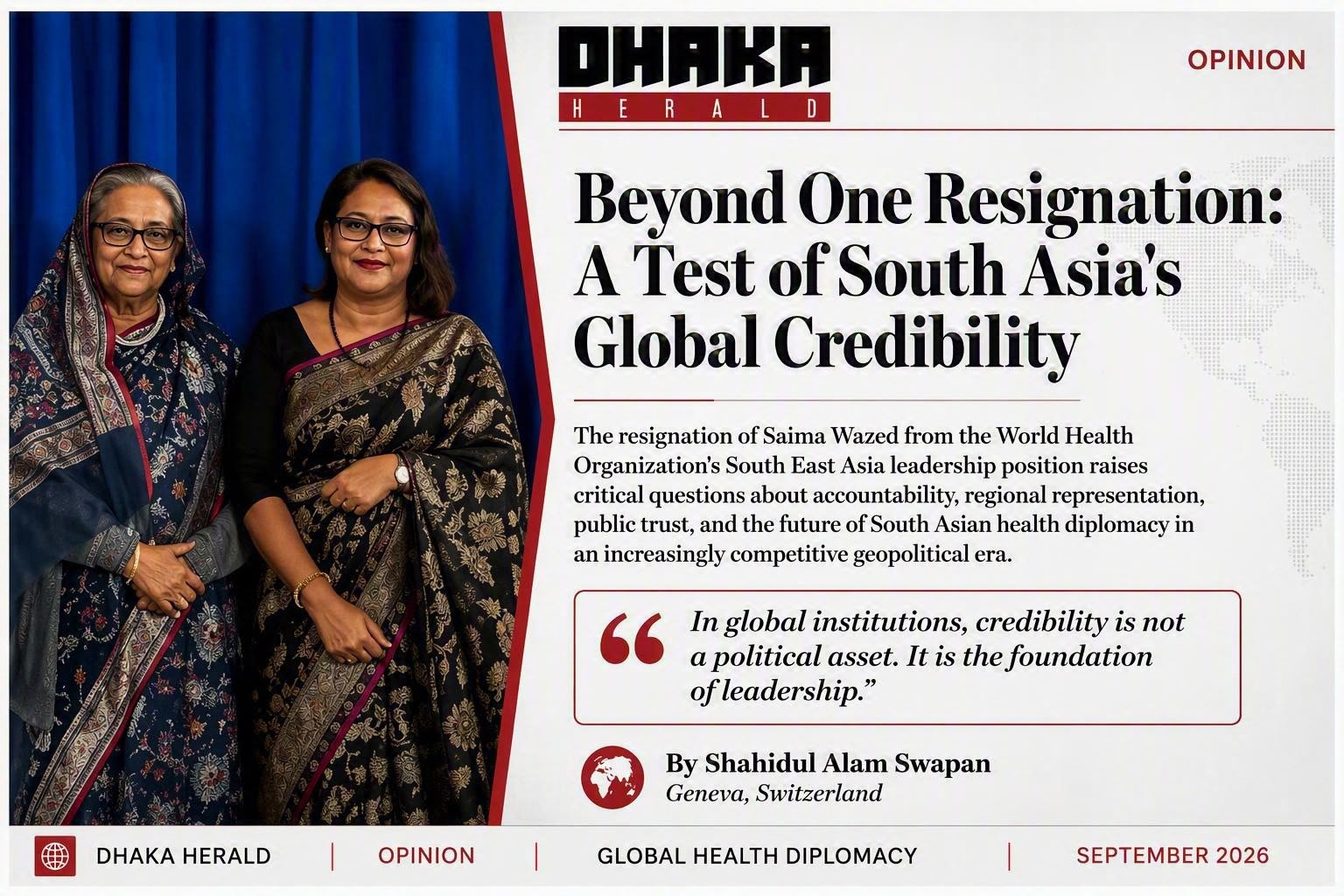
The resignation of Saima Wazed from the position of Regional Director of the World Health Organization's South East Asia Region is more than an individual career setback. It is a moment that forces South Asia to reflect on the evolving relationship between national politics, international institutions, public accountability, and global health diplomacy.
Whether the allegations against Saima Wazed are ultimately substantiated or disproven through due process is a matter for investigators and relevant authorities. However, the broader implications of her resignation extend well beyond Bangladesh. They touch the credibility of international organizations, the strategic positioning of South Asian nations in global governance, and the delicate balance between political legitimacy and institutional integrity.
For decades, South Asia has struggled to secure meaningful representation in major international organizations. Whenever a national from Bangladesh, India, Sri Lanka, Nepal, Bhutan, Maldives, Pakistan, or other countries from the region assumes a senior leadership role within the United Nations system, it is often seen as a collective regional achievement. Such appointments provide opportunities to shape global conversations on health, development, climate resilience, migration, and social protection.
The resignation of a regional chief from WHO under the cloud of an ongoing investigation inevitably raises difficult questions about vetting processes, accountability mechanisms, and political influence in international appointments. Yet it would be a mistake to reduce the issue to a partisan political debate within Bangladesh.
The larger lesson is that international leadership today requires a much higher standard of transparency than in the past. Global institutions are increasingly under scrutiny from member states, civil society, media organizations, and independent investigative bodies. In an era of instant information sharing and transnational accountability, personal reputation and institutional credibility have become inseparable.
For Bangladesh, the development comes at a particularly sensitive time. The country has spent decades building an international reputation as a champion of public health innovation, immunization campaigns, disaster preparedness, maternal health improvements, and community-based healthcare delivery. Bangladesh has also emerged as a respected voice in climate adaptation and humanitarian response, particularly through its management of complex refugee situations and its contributions to global health dialogue.
The challenge now is ensuring that individual controversies do not overshadow broader national achievements.
At the same time, the episode highlights the need for stronger diplomatic professionalism throughout South Asia. As competition for leadership positions within multilateral organizations intensifies, countries must prioritize merit, expertise, and institutional experience above political considerations. International organizations increasingly seek leaders capable of navigating complex geopolitical rivalries while maintaining the neutrality expected of global public servants.
This is particularly important as South Asia enters a period of profound strategic transformation. The region has become central to global competition among major powers including the United States, China, the European Union, Japan, and emerging Gulf partners. Health diplomacy is no longer separated from broader geopolitical considerations. Vaccine production, pharmaceutical supply chains, medical technology cooperation, pandemic preparedness, and health financing are all critical components of modern strategic partnerships.
The future influence of South Asian countries will therefore depend not only on economic growth but also on their ability to place highly qualified and universally respected professionals in international institutions.
WHO itself faces an important test. The organization must demonstrate that its governance framework remains impartial, transparent, and resistant to political pressure from any member state. Public confidence in international institutions depends upon the perception that investigations are conducted fairly, leadership standards are applied consistently, and decisions are reached through evidence rather than political expediency.
If handled correctly, the current situation can ultimately strengthen rather than weaken institutional credibility. Transparency does not undermine organizations; it protects them.
For South Asia, the path forward should focus on strengthening regional cooperation rather than deepening political divisions. The countries of the region share common public health challenges, from noncommunicable diseases and mental health concerns to climate related health risks and future pandemic preparedness. These challenges require collaboration that transcends political disputes and leadership transitions.
The resignation of one official should therefore be viewed in a broader context. It is not merely the end of a chapter for an individual. It is a reminder that global leadership today is built on trust, accountability, and professionalism. Nations that embrace these principles will enhance their influence within international institutions. Those that do not risk seeing their diplomatic gains eroded by questions of credibility.
As South Asia seeks a larger role in shaping the twenty first century international order, credibility may prove to be its most valuable diplomatic asset. The lessons emerging from the Saima Wazed episode should therefore encourage governments across the region to invest in stronger institutions, more transparent governance, and a new generation of leaders capable of representing their countries with distinction on the global stage.
In the end, international influence is not measured by appointments alone. It is measured by the confidence that the world places in those entrusted with leadership.
