
Could 6G reshape the world by 2030?
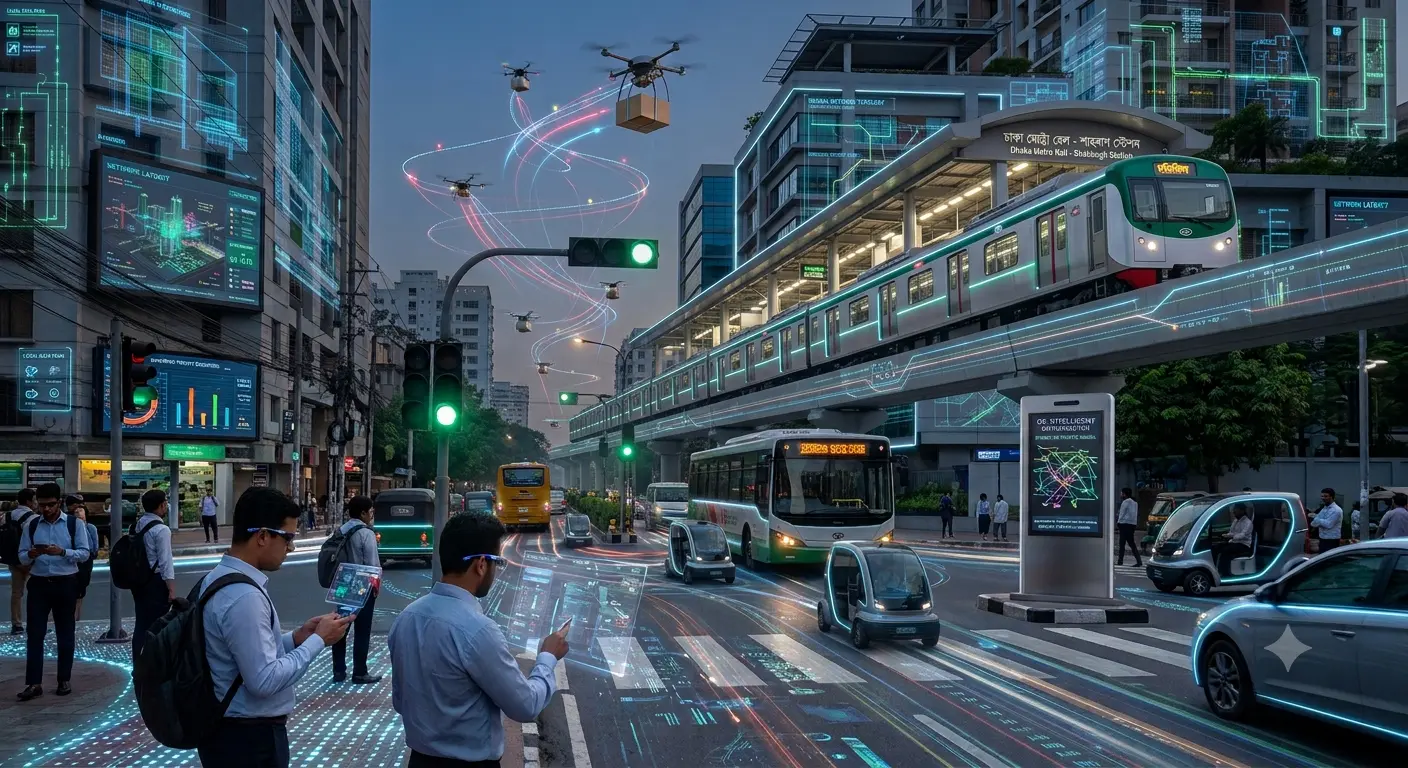
Imagine leaving your home on a Monday morning in 2032.
As you approach a busy intersection in Dhaka, the traffic light turns green ; not because its timer has run out, but because it has recognised an ambulance approaching from another road. Moments later, your phone alerts you that a package is arriving. Looking up, you see a drone quietly lowering a parcel onto a nearby rooftop. At home, your electricity system has already adjusted power consumption because it knows demand across the neighbourhood is rising.
It may sound like science fiction.
But pieces of that future are already taking shape.
Dhaka has begun testing artificial intelligence (AI)-powered traffic signals that can adjust timings according to traffic conditions. In the United States, China and several European countries, drones already deliver medicines, groceries and meals. Around the world, cities are becoming smarter, vehicles more connected and machines increasingly capable of making decisions without waiting for human instructions.
The challenge is that today's communication networks were never designed for a world like this.
Billions of sensors, robots, drones, cameras, vehicles and smart devices are coming online. They constantly exchange enormous amounts of data. Existing mobile networks—even 5G—will eventually struggle to keep up.
That is why researchers have already turned their attention to the next generation of wireless technology: 6G.
Although 5G is still expanding across many countries, the race towards 6G has already begun. International organisations such as the International Telecommunication Union (ITU) and the 3rd Generation Partnership Project (3GPP) are working on global standards, while major technology companies are investing billions of dollars in research. Commercial deployment is widely expected around 2030.
Unlike previous generations, however, 6G is not simply about making smartphones faster.
It is about creating networks that can think.
When networks become intelligent
Every generation of mobile technology has quietly changed the way we live.
The arrival of 3G made mobile internet practical. 4G transformed video streaming, social media and app-based services. Then came 5G, bringing faster cloud computing, smart factories and the rapid expansion of the Internet of Things (IoT).
6G aims to go one step further.
Researchers believe future 6G networks could eventually achieve data speeds of up to one terabit per second under ideal conditions. More importantly, delays in communication—known as latency—could become almost invisible.
That means a robot could respond almost instantly to commands from another city. A holographic meeting might feel as natural as talking face to face. Virtual and augmented reality could finally become seamless enough for everyday work, education and entertainment.
But speed is only part of the story.
Today's mobile networks simply carry information from one place to another. Future networks are expected to analyse information as it moves through them.
Instead of reacting after something happens, they may predict what is about to happen.
A city that understands itself
Picture Dhaka during evening rush hour.
Thousands of vehicles are trying to cross the city's busiest intersections. An accident blocks one road while heavy rain slows traffic elsewhere.
Today, traffic police, cameras and traffic signals mostly react to what they can already see.
A 6G-powered network could do something different.
It could gather information simultaneously from road sensors, connected cars, weather stations, surveillance cameras and navigation systems. Within seconds, artificial intelligence could analyse the situation and adjust traffic signals across multiple intersections.
An ambulance might automatically receive a clear route. Drivers could be redirected before congestion spreads. Public transport could receive priority without anyone manually changing the signals.
This idea is known as an AI-native network—a communication system where artificial intelligence is built into the network itself rather than added later as software.
Researchers are also developing a technology called Integrated Sensing and Communication (ISAC).
Simply put, the same radio waves that carry data could also detect movement, measure distance and identify nearby objects. In other words, future mobile networks may not only communicate—they may also "see" their surroundings.
Beyond the idea of a smart city
The phrase "smart city" has been used for years.
Yet many city services still work independently.
Traffic management, electricity distribution, emergency response, public transport and water systems often operate without sharing information.
Supporters of 6G believe those barriers could gradually disappear.
Traffic lights could communicate directly with buses and emergency vehicles. Electricity grids could automatically balance power demand across neighbourhoods. Firefighters responding to an emergency could instantly receive digital building layouts before arriving at the scene.
Even bridges, flyovers and buildings could monitor their own structural condition through embedded sensors, sending early warnings long before serious damage becomes visible.
Cities would no longer simply respond to problems.
They could begin anticipating them.
The age of billions of connected devices
The Internet of Things already connects billions of devices worldwide.
With 6G, that number could increase dramatically.
According to the ITU's long-term vision, future wireless networks may support between one million and one hundred million connected devices within a single square kilometre, depending on the application.
The early signs are already visible.
Companies such as Wing and Zipline use drones to deliver medicines and essential supplies. China's Meituan has expanded commercial drone food delivery in several cities.
As drone deliveries become more common, thousands of aircraft may eventually share the same skies.
Each drone will need to know where every other drone is, while constantly exchanging information about weather, speed, flight paths and possible obstacles.
That level of coordination demands communication that is almost instantaneous.
Researchers believe 6G could make it possible.
The same technology could support autonomous factories, precision agriculture, connected hospitals and millions of smart devices working together without interruption.
Healthcare without distance
Healthcare may become one of the biggest beneficiaries.
Imagine a patient in a remote village receiving a diagnosis from a specialist hundreds of kilometres away.
Medical scans could be transferred almost instantly. Wearable devices might continuously monitor heart rate, blood pressure or blood glucose levels and alert doctors before a medical emergency occurs.
Some researchers also believe that faster, more reliable communication could make remote robotic surgery safer and more precise than ever before.
Connecting places beyond the reach of towers
Unlike previous mobile generations, 6G is expected to combine terrestrial networks with satellites from the very beginning.
Instead of relying only on mobile towers, future networks may also use satellites, drones and high-altitude platforms to provide continuous coverage.
That could help connect remote villages, ships at sea, mountainous regions and disaster-affected areas where conventional infrastructure is difficult to build.
For developing countries, this could become an important tool for narrowing the digital divide.
Bangladesh's opportunity
Bangladesh may not see commercial 6G services immediately, but preparing early could make a significant difference.
AI-powered sensors could improve irrigation and fertiliser use in agriculture. Satellite-supported monitoring systems could strengthen flood forecasting, cyclone warnings and river erosion management. Smarter factories, ports and logistics networks could improve productivity and competitiveness.
To achieve that future, experts say Bangladesh will need sustained investment in fibre-optic infrastructure, cybersecurity, artificial intelligence research, spectrum planning and digital skills.
The road ahead
For all its promise, 6G still faces major challenges.
Researchers are exploring new high-frequency spectrum that can deliver extraordinary speeds but is technically difficult to use. Future AI-powered networks must also become more energy efficient despite handling vastly greater computing workloads.
Cybersecurity will become even more important as critical infrastructure becomes increasingly connected.
Privacy is another concern.
If communication networks can continuously sense the environment around them, governments, technology companies and regulators will face difficult questions about how that information should be collected, protected and used.
A quiet revolution
Every generation of wireless technology has changed society in ways few people expected.
Almost no one predicted that 4G would create today's app economy. Few imagined that 5G would accelerate cloud computing, smart manufacturing and connected devices as quickly as it has.
6G could prove even more transformative—not because it allows people to download films a little faster, but because it may quietly weave intelligence into the fabric of everyday life.
By the early 2030s, the most impressive feature of 6G may not be its speed.
It may be that we hardly notice it at all.
Traffic may flow more smoothly. Doctors may save lives more quickly. Farmers may receive better information. Drones may navigate safely overhead. Cities may quietly become more efficient.
And behind all of it, an invisible network may be making millions of decisions every second—without asking for our attention.
( The writer is a journalist and independent researcher)
