
Moody’s stable outlook signals renewed global confidence in Bangladesh’s economy amid reform momentum and persistent structural challenges
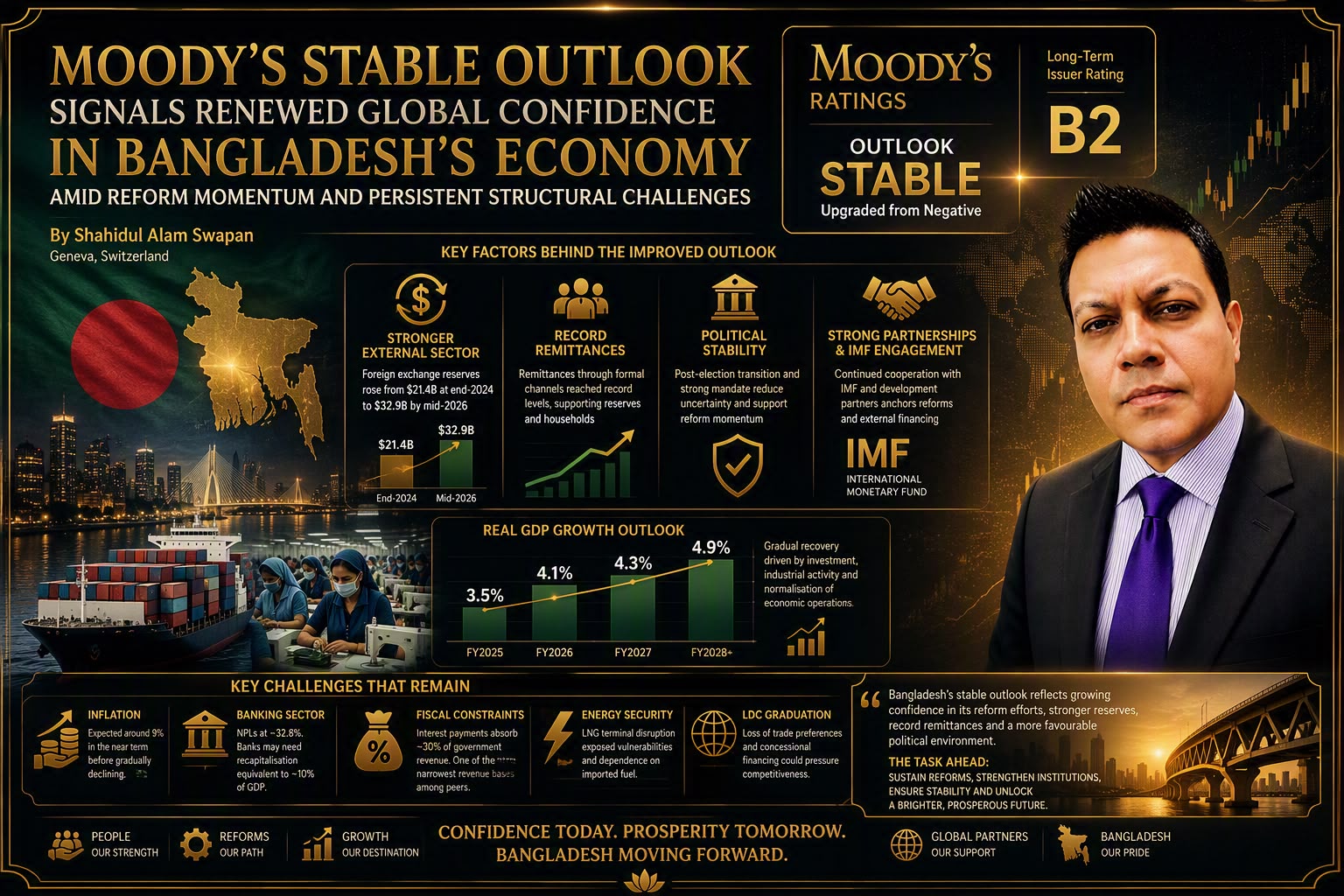
Bangladesh has received a significant endorsement from one of the world's leading credit rating agencies as Moody’s Ratings upgraded the country’s sovereign outlook from negative to stable while affirming its long-term issuer and senior unsecured ratings at B2. The decision marks an important milestone for the South Asian nation, reflecting growing confidence in its economic resilience, improving external financial position, and enhanced political stability following a period of considerable economic and financial pressures.
The outlook revision comes at a critical juncture for Bangladesh as the country seeks to consolidate macroeconomic stability, restore investor confidence, and maintain growth momentum amid a challenging global economic environment. Moody’s assessment suggests that the risks which previously justified a negative outlook have become more balanced, indicating that Bangladesh’s economic fundamentals have strengthened sufficiently to reduce the likelihood of further deterioration in its sovereign credit profile.
The upgrade is particularly noteworthy because sovereign outlooks serve as forward-looking indicators of a country's economic and financial trajectory. While Moody’s has maintained Bangladesh’s B2 rating, the change from negative to stable sends a strong signal to international investors, development partners, multilateral institutions, and global financial markets that the country's economic prospects are improving despite lingering vulnerabilities.
One of the most important factors behind Moody’s decision is the substantial improvement in Bangladesh’s external sector. Over the past two years, the country has successfully strengthened its foreign exchange reserves, easing concerns that had emerged during periods of reserve depletion and balance-of-payments pressure. According to Moody’s, foreign exchange reserves increased from approximately $21.4 billion at the end of 2024 to around $32.9 billion by the middle of 2026. This remarkable recovery has significantly enhanced Bangladesh’s ability to finance imports, service external obligations, and withstand global economic shocks.
The strengthening of reserves has been driven by a combination of policy reforms and favourable economic developments. Moody’s specifically highlighted the government's adoption of a more flexible exchange rate regime, the elimination of distortions in the foreign exchange market, and a sharp increase in remittances flowing through formal banking channels. These measures have contributed to restoring confidence in the foreign exchange market while increasing transparency and efficiency in currency transactions.
Among the most influential drivers of this positive trend has been the record level of remittance inflows from Bangladeshis living and working abroad. Remittances continue to serve as one of the country's most important sources of foreign exchange, providing critical support to both household incomes and national economic stability. The growing use of formal banking channels for transferring remittances has strengthened official foreign currency inflows and supported reserve accumulation, helping to offset rising import expenditures, particularly in the energy sector.
For millions of Bangladeshi families, remittance income remains a cornerstone of economic well-being. Beyond sustaining household consumption, these inflows support investments in education, health care, housing, and small businesses. At the national level, remittances provide a vital buffer against external vulnerabilities and contribute significantly to macroeconomic stability.
Moody’s also identified the reduction of political uncertainty as a major contributor to the improved outlook. The agency observed that the post-election transition and the government's strong mandate have lowered the risk of political instability disrupting economic reforms and policy implementation. Political stability plays an essential role in sovereign credit assessments because it enhances policy predictability, encourages investment, and creates favourable conditions for long-term economic planning.
The rating agency believes that the current political environment offers Bangladesh a valuable opportunity to pursue structural reforms aimed at improving governance, strengthening institutions, modernising public administration, and enhancing economic competitiveness. Sustained political stability could also help attract greater domestic and foreign investment, which will be crucial for supporting long-term growth.
An equally important factor supporting Bangladesh’s improved outlook is its continued engagement with international financial institutions, particularly the International Monetary Fund (IMF). Moody’s noted that cooperation with the IMF and other development partners remains a critical anchor for external financing and economic reform efforts. Although discussions are ongoing regarding a successor IMF programme, continued collaboration with international lenders is expected to play a key role in maintaining policy discipline and supporting macroeconomic stability.
Development partners have long been important contributors to Bangladesh’s economic development, providing concessional financing for infrastructure, social programmes, and institutional reforms. Continued access to such support helps reduce borrowing costs and strengthens investor confidence in the country's economic management.
Moody’s projections also point towards a gradual recovery in economic growth over the coming years. After slowing to 3.5 percent in fiscal year 2025, Bangladesh’s real GDP growth is expected to increase to 4.1 percent in fiscal year 2026, rise further to 4.3 percent in fiscal year 2027, and eventually reach around 4.9 percent from fiscal year 2028 onwards. This anticipated recovery is expected to be driven by improving investment conditions, expanding industrial activity, and the normalisation of economic operations following recent disruptions.
While these growth projections remain below the exceptionally high growth rates that Bangladesh achieved before global economic challenges emerged, they nevertheless indicate a gradual return to a more favourable growth trajectory. The country's large domestic market, robust manufacturing base, and extensive infrastructure development programmes continue to provide a solid foundation for future expansion.
Despite the positive developments, Moody’s made it clear that significant challenges remain. Inflation continues to be one of the most pressing economic issues facing Bangladesh. The agency expects inflation to remain around 9 percent in the near term before gradually declining. Persistent inflation erodes purchasing power, places pressure on household budgets, and increases operating costs for businesses. It also complicates economic policymaking by requiring authorities to balance growth objectives with price stability concerns.
However, the most serious concern identified by Moody’s relates to Bangladesh’s banking sector. Recent reforms and enhanced regulatory scrutiny have revealed deep-rooted weaknesses within the financial system. According to the agency, system-wide non-performing loans have reached approximately 32.8 percent, reflecting longstanding issues in lending practices, governance standards, risk management, and financial oversight.
The scale of the problem is considerable. Moody’s estimates that banks may require recapitalisation equivalent to roughly 10 percent of GDP in order to restore regulatory capital adequacy. Such a requirement would place substantial pressure on government finances, particularly at a time when fiscal space remains constrained. The possibility that the state may need to support struggling financial institutions represents one of the most significant risks to Bangladesh’s sovereign credit profile.
At the same time, Moody’s emphasised that liquidity conditions within the banking sector remain relatively stable. Deposits across the banking system increased by approximately 12 percent year-on-year through March 2026, suggesting that public confidence has not been fundamentally undermined. This distinction highlights that the sector's primary challenge lies in solvency rather than liquidity.
Fiscal constraints represent another important area of concern. Bangladesh continues to have one of the narrowest government revenue bases among comparable economies. Limited revenue collection restricts the government's fiscal flexibility and reduces its ability to respond effectively to economic shocks or finance long-term development priorities. Moody’s pointed out that interest payments now consume almost 30 percent of government revenue, a burden that limits resources available for public investment and social programmes.
Although government debt remains relatively moderate at around 40 percent of GDP, Moody’s expects debt levels to gradually increase over the medium term due to persistent budget deficits and the potential costs associated with supporting the banking sector. Strengthening tax administration and broadening the revenue base will therefore be essential if Bangladesh is to improve fiscal sustainability and create greater room for economic investment.
The agency also warned of vulnerabilities in the country's energy sector. A recent disruption at an LNG import terminal exposed weaknesses in Bangladesh’s energy infrastructure and highlighted the economy’s dependence on imported fuel. The disruption affected electricity generation, industrial production, and fertiliser manufacturing, underscoring the critical importance of energy security for sustained economic growth.
As Bangladesh progresses toward becoming a more industrialised economy, ensuring reliable and affordable energy supplies will be crucial. Investments in energy diversification, infrastructure resilience, and long-term supply security will be necessary to minimise future disruptions and support industrial competitiveness.
Looking ahead, Bangladesh faces another significant challenge as it prepares to graduate from Least Developed Country (LDC) status. While graduation reflects decades of remarkable economic and social progress, it also entails the gradual loss of certain trade preferences and concessional financing opportunities. Moody’s warned that these changes could place additional pressure on export competitiveness and external financing conditions.
Nevertheless, the agency expressed confidence that Bangladesh’s ready-made garment sector will remain a key driver of export earnings due to its strong competitive position in global markets. However, sustained structural reforms, productivity enhancements, technological upgrading, and market diversification will be essential to maintaining long-term growth momentum in a post-LDC environment.
Ultimately, Moody’s decision to upgrade Bangladesh’s outlook to stable represents an important international acknowledgment of the country’s recent economic achievements. It reflects growing confidence in the government's reform efforts, improved external stability, stronger foreign exchange reserves, record remittance inflows, and a more favourable political environment.
Yet the message from Moody’s is not one of complacency. Rather, it is a call for continued reforms. The country's future economic success will depend on its ability to address banking sector weaknesses, strengthen revenue mobilisation, manage inflation, ensure energy security, and navigate the challenges associated with LDC graduation. If Bangladesh can successfully undertake these reforms while maintaining macroeconomic stability, it has the potential to achieve stronger growth, attract greater investment, and secure further improvements in its sovereign credit standing in the years ahead.
(The writer is based in Geneva, Switzerland, and is a political analyst, private banking financial crime compliance specialist, columnist and poet. He writes on South Asian geopolitics, international affairs, global financial integrity and strategic affairs. Email: shahidul.alam@bluewin.ch)
