
From Marrakech City Hall to Morocco’s First Female Prime Minister
Fatima-Zahra Mansouri Makes History
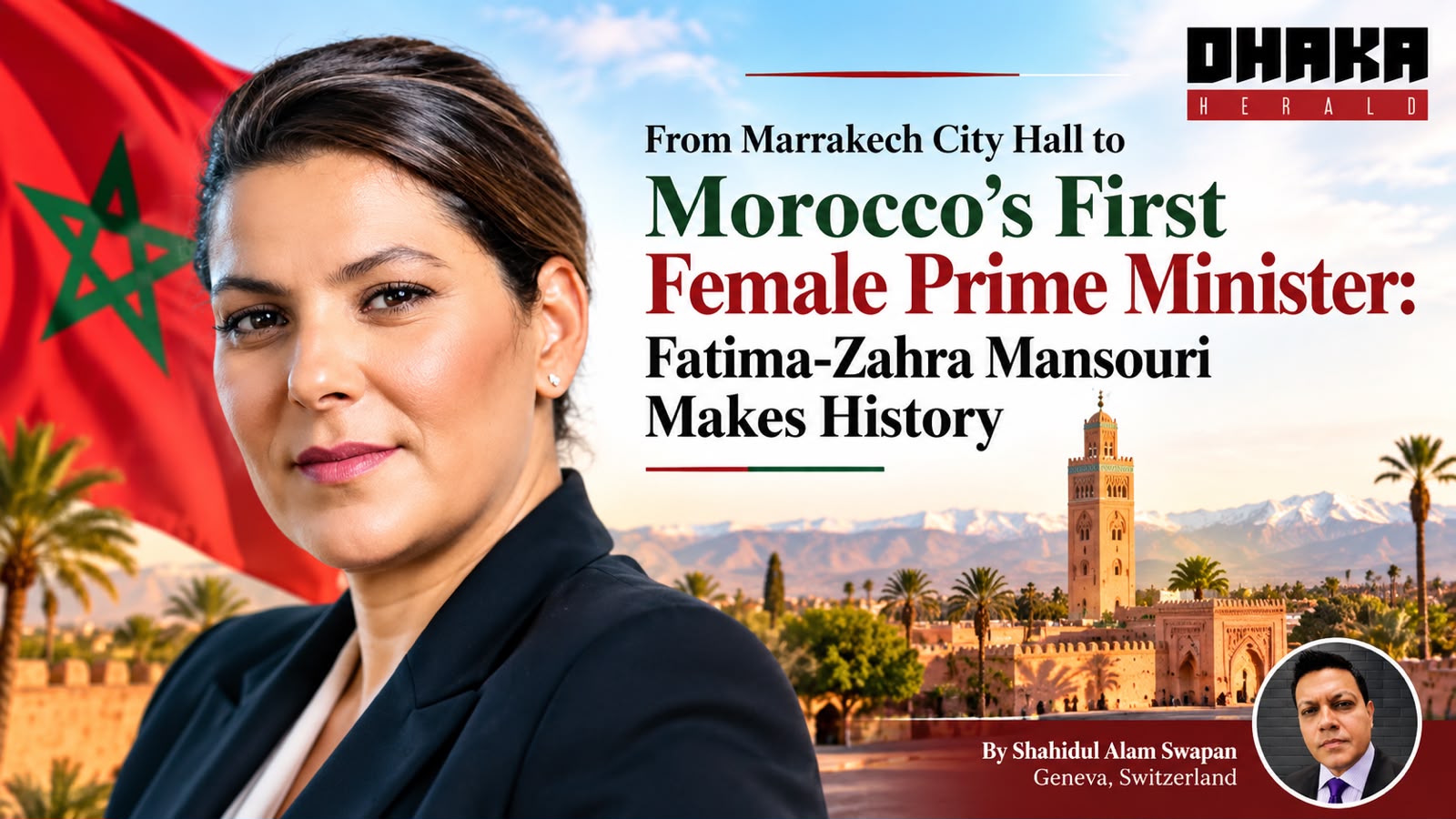
A political glass ceiling has been broken in North Africa.
For the first time in Morocco’s history, a woman is set to lead the government. Fatima-Zahra Mansouri, a lawyer, former minister, mayor of Marrakech and one of the country’s most prominent political figures, has been appointed head of government by King Mohammed VI and tasked with forming a new administration.
The appointment is historic. But Mansouri inherits a country facing demanding questions over jobs, living costs, public services, youth expectations and the enormous investment surrounding the 2030 FIFA World Cup. Her challenge is no longer reaching the top. It is delivering once she gets there.
From Marrakech to Rabat
Mansouri’s rise did not happen overnight. A lawyer by profession, she built much of her political reputation in Marrakech, one of Morocco’s most internationally recognised cities. Her experience spans municipal government, party politics and national administration. She has served as mayor of Marrakech and as minister responsible for national territorial planning, urban development, housing and city policy.
She is also a leading figure in the Authenticity and Modernity Party, known as PAM. Her years in Marrakech placed her close to many of the issues now confronting Morocco nationally: rapid urban expansion, housing, infrastructure, tourism and the challenge of ensuring that major development projects improve ordinary lives. Those challenges have now followed her from Marrakech to Rabat.
An Election That Changed History
Mansouri’s appointment followed Morocco’s September 23 parliamentary election, in which PAM emerged as the largest party with 97 seats in the 395-member House of Representatives. That result put her party in the leading position to form a government, but well short of a majority.
Her first test is therefore immediate: building a viable coalition. She will have to negotiate with other parties, reconcile competing interests and construct a parliamentary majority capable of supporting her programme. Breaking a glass ceiling makes history. Governing requires something more prosaic and more difficult: numbers, negotiation and compromise.
A Milestone for Women in the Arab World
Mansouri’s rise carries significance beyond Morocco. Women have made substantial advances in education, business and public administration across the Arab world, but their presence at the highest levels of executive power remains limited.
Tunisia’s Najla Bouden became the Arab world’s first female prime minister in 2021. Mansouri now adds another important chapter to women’s political leadership in North Africa. For young Moroccan women, the message is powerful: the office of head of government is no longer an exclusively male domain.
But the lasting significance of Mansouri’s premiership will depend on more than symbolism. It will be measured by the effectiveness of her government and whether Morocco’s political institutions continue opening space for women long after the novelty of this appointment has faded.
The Youth Question
Perhaps the most difficult domestic challenge is Morocco’s younger generation. Many young Moroccans are concerned less with political symbolism than with practical questions: Can they find decent jobs? Can they afford housing? Does education offer a path to opportunity? Can they build a future without leaving the country?
Morocco has made substantial economic and infrastructural progress, establishing itself as a manufacturing, tourism and investment hub linking Europe and Africa. Its automotive, aerospace, renewable energy and logistics sectors have expanded significantly. Yet national economic ambition does not automatically translate into individual opportunity.
That gap between impressive development projects and everyday economic experience could become one of Mansouri’s defining political tests.
The $20 Billion World Cup Test
Then comes 2030. Morocco will co-host the FIFA World Cup with Spain and Portugal, placing the kingdom at the centre of one of the world’s largest sporting events.
For Morocco, this is more than football. It is an opportunity to accelerate infrastructure development, attract investment and present itself as a modern economic hub connecting Africa, Europe and the Arab world. Around $20 billion in investment is associated with preparations, including stadiums, transport networks and urban infrastructure.
The opportunity is considerable. So is the political sensitivity. Citizens watching billions flow into stadiums, airports, railways and urban redevelopment will inevitably ask whether similar urgency is being applied to hospitals, schools, employment and affordable housing.
That question will be especially relevant to Mansouri because urban development and housing have been central to her ministerial career. The real legacy of 2030 will therefore be determined after the crowds leave: whether World Cup investment produces infrastructure and economic opportunities that continue benefiting Moroccans.
Governing Alongside the Monarchy
Mansouri will operate within Morocco’s distinctive political system. The country is a constitutional monarchy in which the elected government exercises significant authority while King Mohammed VI retains substantial constitutional and political powers.
Under reforms introduced in 2011, the king appoints the head of government from the party that finishes first in parliamentary elections. Mansouri’s appointment follows that framework.
Her effectiveness will consequently depend on managing several centres of influence simultaneously: the royal palace, coalition partners, parliament, state institutions and public expectations. This balancing act may prove as important as any individual policy.
Morocco’s International Ambitions
The new government also inherits a country seeking a larger international role. Morocco has positioned itself as a bridge between Europe and Africa, expanded its economic relationships across sub-Saharan Africa and maintained important commercial and security ties with Europe and the United States.
It has invested heavily in renewable energy, transport and industrial infrastructure while developing as a manufacturing and logistics base close to European markets. Western Sahara remains central to Moroccan foreign policy and continues to shape important diplomatic relationships.
For Mansouri, domestic and foreign policy will therefore intersect repeatedly. Investment, migration, African diplomacy, European relations and regional security all have consequences at home. The political challenge is ensuring that Morocco’s growing international profile produces benefits citizens can see and feel.
Beyond the Symbolism
Historic appointments inevitably generate expectations that extend beyond one individual. Mansouri will face scrutiny not only because she leads the government but because she is the first woman to do so. That can make both success and failure appear larger than they otherwise would.
The more consequential test, however, is straightforward: performance. Can her government build a stable coalition, expand economic opportunity, improve public services and manage the World Cup investment boom without widening social disparities? Those are the questions that will ultimately define her premiership.
History Made, Governing Begins
Fatima-Zahra Mansouri’s journey from Marrakech city politics to the head of Morocco’s government marks a significant moment for the kingdom and for women’s political leadership in North Africa. But the celebration will be brief.
She now has to build a government, create jobs, respond to younger Moroccans demanding opportunity and ensure that the billions being invested ahead of 2030 leave something more durable than stadiums and photographs.
Mansouri has already made history by reaching the office. *What matters now is what she does with it.
(Shahidul Alam Swapan is based in Geneva, Switzerland. He is a private banking financial crime compliance specialist, columnist and poet, and writes on geopolitics, international affairs, global financial integrity and strategic issues. shahidul.alam@bluewin.ch)
