
National Roundtable Stresses Climate Resilience and Water Security via Padma Barrage
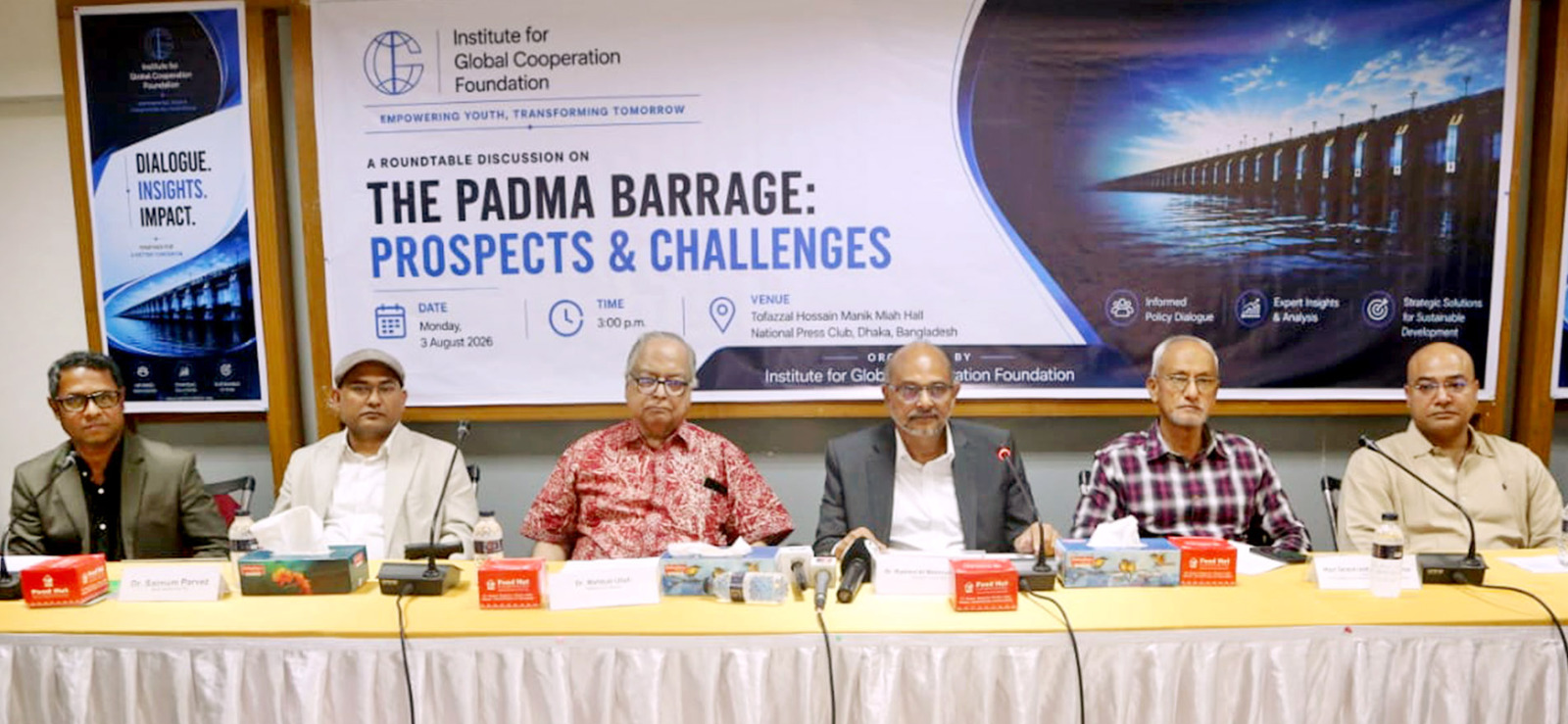
Policymakers, academics, and development experts on Monday called for information-based planning, coordinated execution, and strict cost controls to ensure the long-term success of the newly approved Padma Barrage Project.
Speaking at a roundtable titled "Padma Barrage: Opportunities and Challenges," speakers underscored the initiative as a national lifeline to tackle water insecurity, falling agricultural yields, rising salinity, and escalating climate vulnerabilities in Bangladesh’s southwestern region.
The discussion, organised by the Institute for Global Cooperation Foundation (IGCF), was held at the Tofazzal Hossain Manik Mia Hall of the National Press Club.
Policymakers, economists, engineers, academics, media personalities and development experts participated in the roundtable discussion. The discussion exchanged views on various aspects of the Padma Barrage Project's potential economic, social, environmental and climate impacts, water management, agricultural productivity, food security and sustainable development.
Prime Minister's Finance and Planning Advisor Dr. Rashed Al Mahmud Titumir said, "Bangladesh's fundamental problem is 'Too much water or Too little water'. But in reality, the only breakthrough in this regard was the Ganges Water Sharing Agreement in 1977. After that, various plans were taken but they were not implemented in the right way. Currently, under the direction of our Prime Minister, the design of the barrage has been changed keeping in mind the aspirations of the people. If the construction of the Padma Barrage Project is completed, an additional growth of zero.5 percent to one percent will be added to the Gross Domestic Product (GDP)."
Special Assistant to the Prime Minister (Environment, Forest and Climate Change) Dr. Saimum Parvez said, “There was a mega project in our election manifesto, which is this Padma Barrage. We will take action on the Padma Barrage very soon. In this case, we will apply the ‘Bangladesh first’ formula. We will not accept any other country’s surveillance or monitoring. The government will do whatever needs to be done to deal with this water problem and disaster for our people.”
Major General (Retd.) Fazle Elahi Akbar, Chairman, FSDS (The Foundation for Strategic and Development Studies) said, “The mega project that China started in 2025 upstream of the Brahmaputra is scheduled to be completed in 2030 and plans to generate 65,000 MW of electricity through it. It may have a significant impact on regional water security and geopolitics in the future. It is also important to ensure cost control and efficient management in the implementation of the Tk 34,497 crore project.”
The event was moderated by Dr. Bulbul Siddiqui, Professor of Political Science and Sociology at North South University. He said, “The discussion on the Padma Barrage started in the 1960s, considering the country’s four divisions, 19 districts, and 70 million people. The Bangladesh-India Ganga Water Sharing Treaty and the Padma Barrage are interrelated. One of our main problems is not being able to store enough water during the dry season. Moreover, we observe that despite the presence of water in the Padma, water does not reach the tributaries. Our aim is to help the government in policy making by discussing these issues in mind so that poor designs and old infrastructure can be repaired.”
IGCF Chairman Mahmudur Rahman Shawon said, “The purpose of today’s discussion is to bring together the knowledge, experience and critical observations of experts from various fields so that the project’s potential as well as its technical, environmental, economic, social and diplomatic risks can be clearly identified. On May 13, ECNEC approved the first phase of the Padma Barrage at a cost of Tk 34,497 crore from its own funds. The Padma Barrage is not just a major infrastructure project for Bangladesh; it also involves issues of water security, agriculture, food production, river flow, sediment management, Sundarbans, biodiversity, regional water diplomacy and huge government investment.”
The speakers participating in the discussion mentioned the need for effective use of the country’s water resources, water conservation during the dry season, restoration of the flow of rivers and tributaries, increasing agricultural production, controlling salinity and addressing the impacts of climate change. They emphasized the importance of a scientific and data-based assessment of the Padma Barrage project, taking into account both the potential benefits and challenges.
The roundtable meeting was also attended by National Press Club General Secretary Ayub Bhuiyan, Dhaka Central University Vice Chancellor Dr. Nurul Islam, National Professor Dr. Mahbub Ullah, North South University Vice Chancellor Professor Dr. Abdul Hannan Chowdhury, North South University Civil and Environmental Engineering Department Professor Dr. Md. Sirajul Islam, Economics Department Assistant Professor Dr. Md. Javed Hossain, Dhaka Stream Editor Iftekhar Mahmud, Georgia State University Doctoral Fellow and Geopolitical Analyst Asif Bin Ali, Rancon Infrastructure and Engineering Limited COO Subail Bin Alam and many others.
At the end of the discussion, the participants emphasized the need to continue such policy dialogues to ensure the country's long-term water security, agricultural productivity, environmental balance and sustainable development.
