
Bangladesh’s investment warning
Why multinational companies are reassessing the market
Bangladesh needs foreign investment more than ever. As the economy struggles to sustain growth, attract dollars and create jobs, policymakers are under increasing pressure to convince international companies that the country remains a reliable place to do business.
Yet a series of high-profile corporate exits and asset sales has raised uncomfortable questions about Bangladesh’s investment climate.
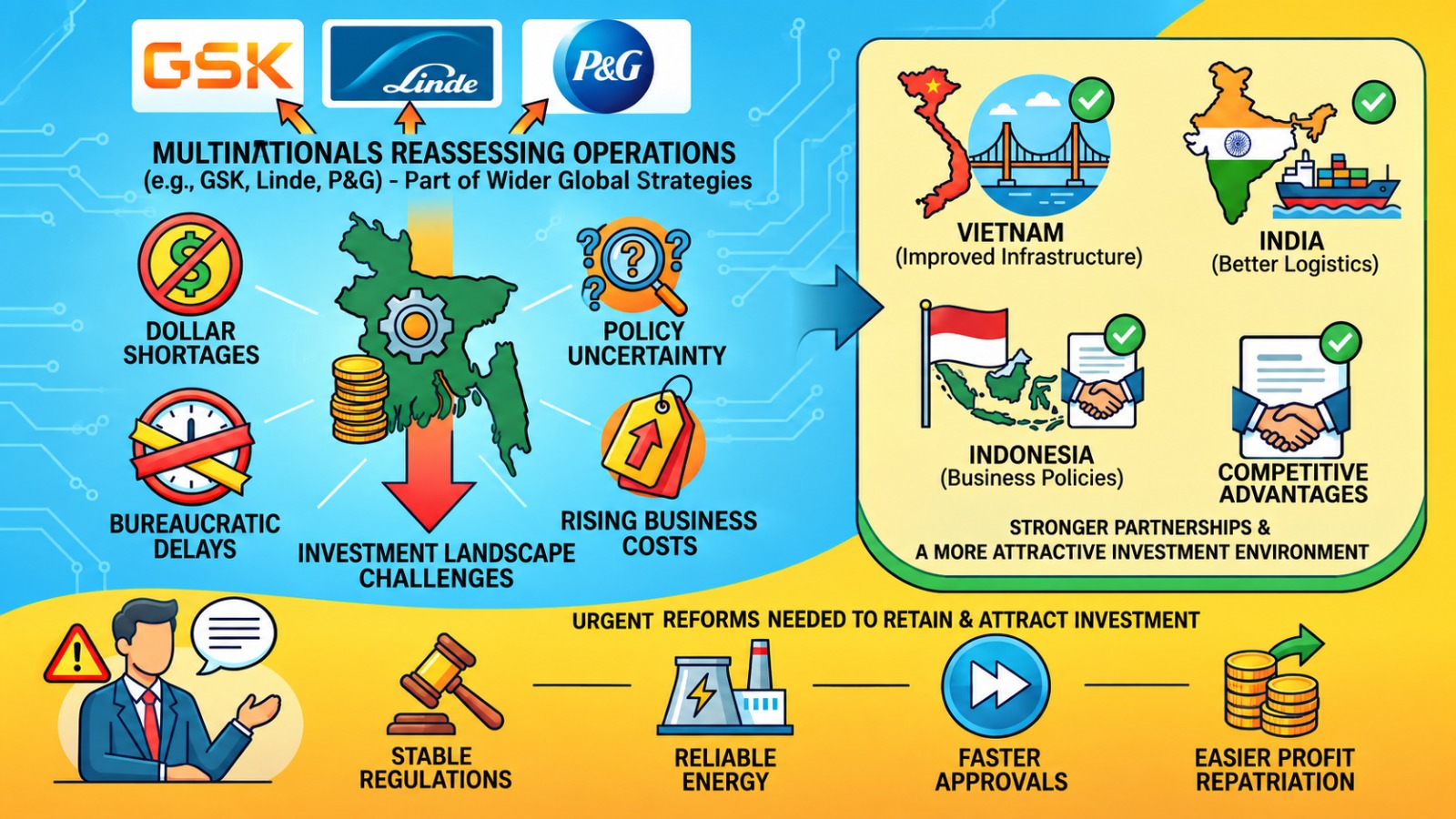
The departures do not necessarily mean that multinational companies are leaving solely because of conditions in Bangladesh. Global corporations routinely restructure their businesses, sell non-core assets and redirect capital to more profitable markets. But when such decisions coincide with foreign-exchange shortages, regulatory uncertainty, bureaucratic delays and rising operating costs, they can become a warning signal for potential investors.
GlaxoSmithKline, or GSK, offers one example. The British pharmaceutical company decided in 2018 to close its pharmaceutical manufacturing operations in Bangladesh after decades in the country. In 2020, Unilever acquired GSK’s consumer healthcare business in Bangladesh in a deal worth about Tk2,020 crore, effectively ending GSK’s direct presence in the market.
Linde Bangladesh provides another example. In 2024, the company sold its welding-electrode business to ESAB, transferring a significant part of its manufacturing operation. The transaction was approved by shareholders in June and completed soon afterwards.
Neither transaction, by itself, proves that Bangladesh has become hostile to foreign investors. But together with other corporate retrenchments, they raise a broader question: is Bangladesh sufficiently competitive to persuade global companies to invest more rather than move capital elsewhere?
For foreign investors, the size of Bangladesh’s consumer market and relatively low labour costs are no longer enough. Companies also need predictable taxation, reliable energy supplies, efficient ports, functioning logistics and the ability to move profits and capital across borders without prolonged administrative obstacles.
Policy uncertainty can be particularly damaging. When tax, customs, VAT or regulatory rules change frequently, companies struggle to make reliable five- or 10-year investment plans. Delays in approvals for land, utilities, environmental clearances and customs can further increase the cost of doing business.
The much-publicised one-stop service for investors has also faced criticism over its effectiveness. A service intended to simplify investment can lose its purpose if companies still have to deal separately with numerous government agencies.
Foreign-exchange shortages have added another layer of uncertainty. Multinational companies expect to repatriate legitimate profits and, where necessary, investment capital. Restrictions or delays can undermine confidence even when the underlying business remains profitable.
The United Nations Conference on Trade and Development has highlighted foreign-exchange constraints, payment delays and import restrictions as factors that have increased operating difficulties for investors in Bangladesh. The country’s foreign direct investment inflows have also remained modest compared with the size of its economy.
Bangladesh is not competing for investment in isolation. Vietnam, India and Indonesia are aggressively positioning themselves as manufacturing and supply-chain destinations. Their advantages include improving infrastructure, expanding logistics networks and increasingly investor-focused policies.
This matters particularly for Bangladesh’s garment industry. International retailers may not directly own factories, but they can shift sourcing and production when costs, delivery times or political and logistical risks rise.
The central issue, therefore, is not simply why one multinational company leaves. It is whether companies already operating in Bangladesh want to expand, and whether those watching from abroad see the country as a place where they can safely commit capital for decades.
Bangladesh still has enormous advantages: a large domestic market, an experienced manufacturing workforce and a strategically important location. But those advantages cannot compensate indefinitely for uncertainty.
The message for policymakers is straightforward. Attracting foreign investment requires more than announcing new projects or offering incentives. Investors need stable rules, efficient institutions, reliable infrastructure and confidence that their money can move in and out of the country.
In the global competition for capital, keeping the door open is no longer enough. Bangladesh must give investors a reason to walk through it—and an even stronger reason to stay.
