
Bangladesh’s banking crisis
How political influence and family control hollowed out the banks
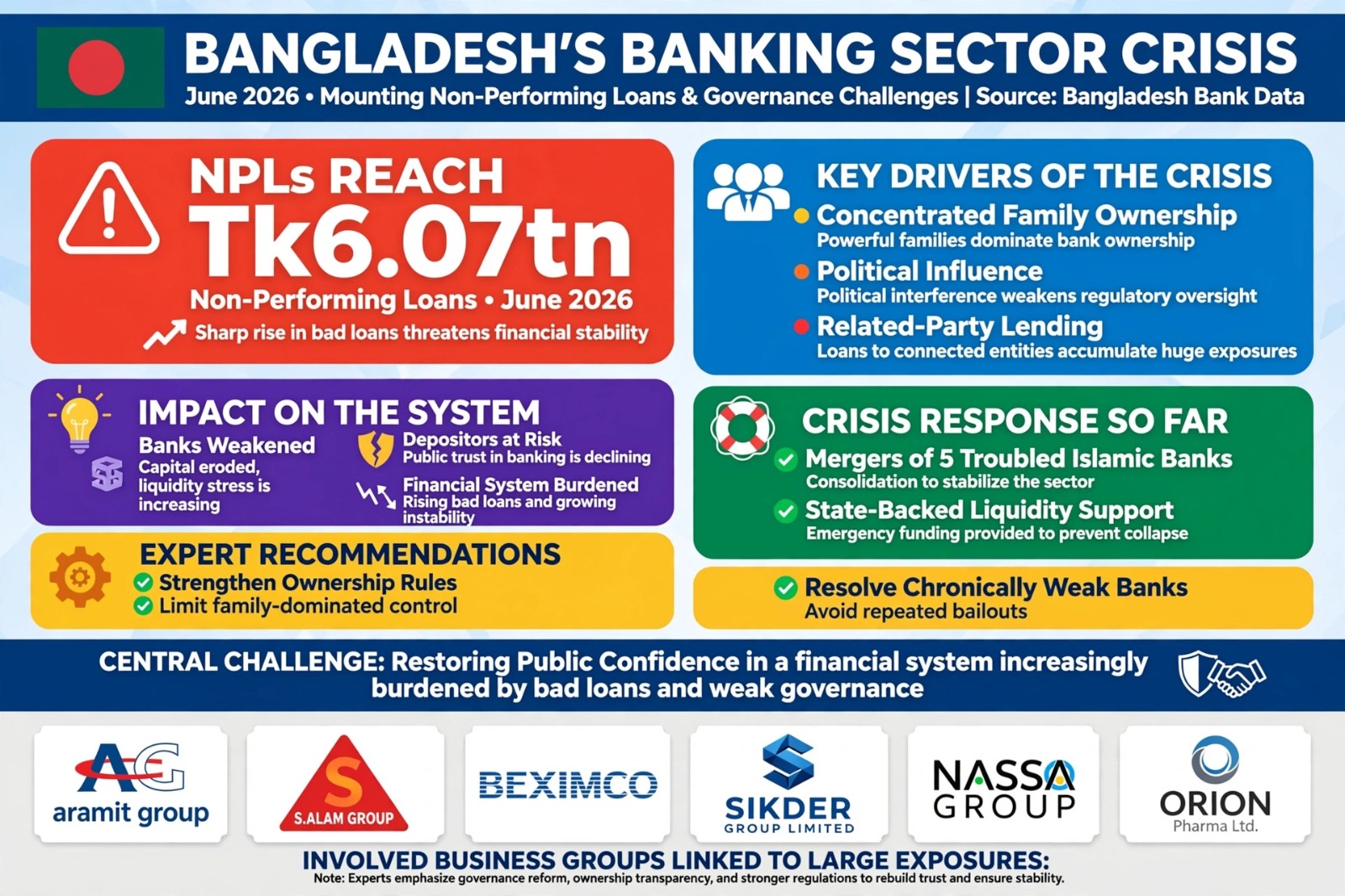
Bangladesh’s banking sector is facing a crisis of confidence. Official data show a banking system under severe pressure, with non-performing loans rising sharply and several banks requiring state support. At the heart of the problem is a system in which political connections, concentrated ownership and weak governance have allowed powerful business groups to gain disproportionate influence over lenders.
Non-performing loans reached Tk6.07tn in June 2026, accounting for more than 32% of total loans, according to Bangladesh Bank data cited in the discussion. The scale of the problem has raised questions about whether banks are still functioning primarily as financial institutions – or as sources of cheap credit for politically connected business interests.
The crisis has been building for years. In 2013, despite concerns that Bangladesh already had enough banks, nine new private banks received licences. Several subsequently encountered serious financial difficulties. Farmers Bank, for example, collapsed into a prolonged crisis before being renamed Padma Bank.
A more consequential change came in 2017, when the Bank Company Act was amended to increase the number of directors from a single family from two to four and extend their tenure from six to nine years. Critics warned that the changes could strengthen family control over private banks.
That concern has since become central to the debate over banking-sector reform.
Bangladesh Bank has identified several major business groups whose companies accumulated substantial exposure to banks. The groups named in official assessments include S Alam, Beximco, Sikder, Nassa, Orion and the Aramit group.
The S Alam case is particularly striking. Bangladesh Bank assessments have put the group’s borrowing from several banks at tens of thousands of crores of taka. Islamic Bank Bangladesh, once regarded as one of the country’s largest private lenders, became deeply exposed to companies linked to the group.
The underlying problem is known internationally as related-party lending: banks lending to companies connected to their owners or controlling interests. It creates an obvious conflict. A bank owner assessing a loan application from his own business has little incentive to apply the same scrutiny used for an unrelated borrower. Once such loans become distressed, recovery can become even more difficult.
The consequences extend beyond shareholders and corporate borrowers. They affect ordinary depositors, whose money ultimately stands behind the banking system.
Bangladesh has already begun consolidating some troubled lenders. Five weak Islamic banks – EXIM Bank, First Security Islami Bank, Global Islami Bank, Social Islami Bank and Union Bank – have been merged into Sammilito Islami Bank. The government has authorised substantial capital for the new institution, while Bangladesh Bank has provided liquidity support to help meet deposit withdrawals.
The broader question is whether rescue measures can restore confidence without allowing the people responsible for failed banks to regain control.
International experience offers some lessons. India has imposed restrictions on the ability of industrial business groups to control banks and has strengthened insolvency mechanisms. The United States has historically maintained strict barriers between banking and commercial business, although those rules have evolved over time. China has taken an even harsher approach to financial misconduct, including criminal prosecution and severe punishment in major corruption cases.
Bangladesh does not need to copy any one of these systems. But it does need to confront the central conflict: banks cannot safely serve the public interest when their ownership and lending decisions are dominated by concentrated private interests.
Three reforms are therefore critical.
First, ownership rules must prevent business groups from exercising excessive control over banks and related-party lending must face genuinely independent scrutiny.
Second, family control must be reduced. Board representation and tenure should be structured to prevent a small group of shareholders from dominating institutions for decades.
Third, weak banks should be merged or resolved rather than repeatedly kept alive with public money.
The immediate priority is to protect depositors. But the long-term task is harder: rebuilding a banking culture in which political connections and family influence no longer determine who gets credit.
A banking system may contain dozens of licensed institutions. But if depositors cannot trust that their money is being managed independently, the number of banks becomes almost irrelevant.
The real measure of a banking system is not how many banks exist. It is whether people believe their money is safe.
