
Taka strengthens against rupee, offering relief to Bangladeshis travelling to India
For Bangladeshis travelling to India for medical treatment, education, tourism or shopping, the exchange rate has brought an unexpected measure of relief.
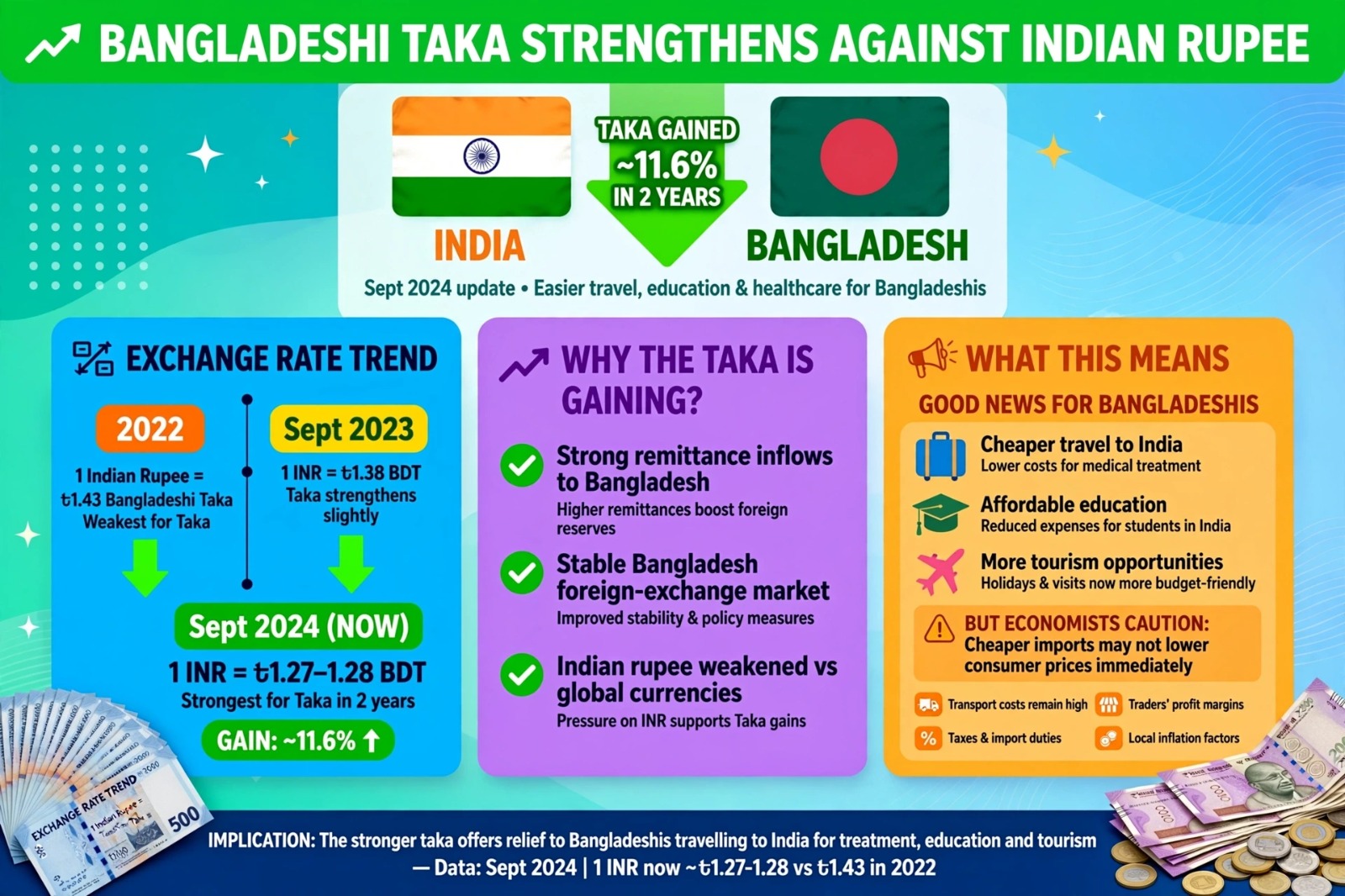
The Bangladeshi taka has strengthened significantly against the Indian rupee over the past two years. In September, Tk1 was buying about 0.78 Indian rupees, putting the value of one rupee at roughly Tk1.27-1.28. A year earlier, one rupee cost about Tk1.38, while in 2022 it was around Tk1.43.
That means the taka has gained about 11.6% against the rupee over two years, with most of the improvement coming during the past year.
The change is particularly significant for Bangladeshis who regularly cross the border for healthcare. India remains a major destination for Bangladeshi patients seeking treatment in cities including Kolkata, Chennai, Vellore and Mumbai.
Consider a family with a medical bill of 200,000 rupees. At an exchange rate of Tk1.40 per rupee, the bill would have cost about Tk280,000. At Tk1.27, the same bill costs roughly Tk254,000 – a saving of about Tk26,000.
For middle-income families already struggling with the cost of overseas treatment, the difference is not insignificant.
Tourists are also benefiting. Hotel bills, meals, transport and shopping in destinations such as Kolkata, Darjeeling, Kashmir and Goa become cheaper when measured in taka. For students enrolled at Indian universities, the stronger taka can also reduce the local-currency cost of tuition, accommodation and everyday expenses.
But the recent movement in the exchange rate should not be interpreted simply as a story of a suddenly stronger Bangladeshi economy.
Economists point to another important factor: weakness in the Indian rupee. The rupee has faced pressure against the US dollar, while Bangladesh's foreign-exchange market has become relatively more stable.
Bangladesh has also seen strong growth in remittances, helping improve the supply of foreign currency and supporting the taka. The combination of a more stable taka and a weaker rupee has therefore shifted the bilateral exchange rate in Bangladesh's favour.
The development could also benefit some Bangladeshi importers. Bangladesh imports a range of products and industrial inputs from India, including cotton, yarn, raw materials and food products. Where transactions are settled directly in rupees, a favourable exchange rate can reduce import costs.
But cheaper foreign currency does not automatically translate into cheaper goods in Bangladeshi shops.
The Centre for Policy Dialogue (CPD) fellow Dr Fahmida Khatun has pointed out that consumer prices depend on several factors beyond the exchange rate, including transport costs, duties, taxes and traders' margins. Any benefit from a stronger taka may therefore be absorbed partly along the supply chain rather than passed fully on to consumers.
There is another side to the equation. A stronger taka can make Bangladeshi goods relatively more expensive in India, potentially putting pressure on exporters competing in the Indian market.
For now, however, the exchange-rate movement is providing a welcome cushion for Bangladeshis who spend money in India. Patients and their families are likely to feel the benefit most directly, followed by tourists, students and some importers.
The bigger question is whether the trend can last.
The bilateral exchange rate will depend not only on the performance of the two currencies but also on global dollar movements, remittance flows, foreign-exchange reserves and the wider health of Bangladesh's economy.
For those heading to India today, the arithmetic is simple: the same rupee costs fewer taka than it did two years ago. Whether that relief becomes a lasting economic advantage will depend on how long the underlying stability survives.
