
Bangladesh growth forecast clouds over factory closures and record borrowing
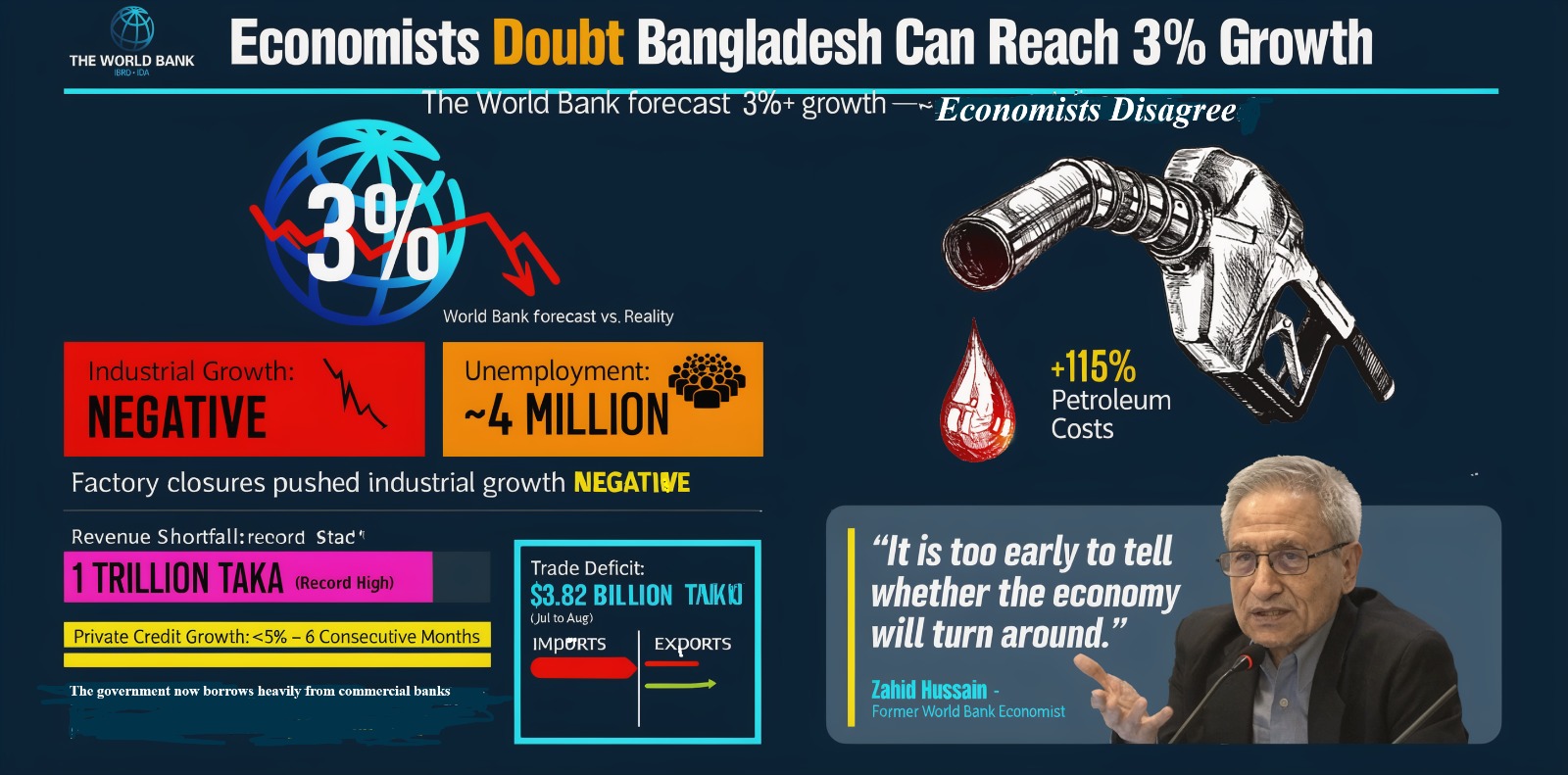
The World Bank expects growth above 3% this fiscal year, but economists doubt the economy can reach it as unemployment nears 4 million and private credit stalls.
The World Bank has forecast that Bangladesh's economy will grow by more than 3% this fiscal year. Economists fear the figure is out of reach.
High interest rates, an energy crisis and long-standing infrastructure problems have pushed industrial output into negative growth. Factories keep closing, and the total number of unemployed has reached roughly 4 million, counting old and new job losses. Incomes have stagnated while costs rise, and inflation refuses to fall. Poverty and extreme poverty have grown.
"How will revenue rise when industry shrinks?" asked Abdul Majid, a former chairman of the National Board of Revenue. Instability in the Middle East shows no sign of easing, he said, so business costs will not fall. "Growth will slow – that is natural," he told the daily Khabarer Kagoj. "We cannot guarantee that overall growth will pass 3%."
A widening revenue hole
Last fiscal year, revenue collection fell short by a record 1 trillion taka. In the first three months of the current year, the gap has already passed 300bn taka. Officials struggle to collect taxes while Middle East turmoil keeps investment sluggish.
Government leans on banks
The state has turned to the banking system to fill the gap. In the first two months of the fiscal year, its net bank borrowing rose by Tk 128.72bn . Total government borrowing from banks stood at Tk 6.98 trillion at the end of August.
The government cut its borrowing from the central bank by Tk 37.29bn , to Tk 903.23bn . Borrowing from commercial banks rose by 166.01bn taka, to 6.08 trillion taka.
The budget sets a bank-borrowing target of Tk 1.12 trillion this year. Last year the government borrowed Tk1.35 trillion against a target of Tk 1.18 trillion, overshooting it.
Mustafa K Mujeri, a former chief economist at Bangladesh Bank, said weak revenue drives this dependence. Heavy lending to the state leaves less room for private credit, he said, which makes growth above 3% uncertain.
Private lending stays low
Private-sector credit growth has stayed below 5% for six straight months. It stood at 4.72% in March and 4.75% in August. Industry insiders say demand for loans is weak because nobody is starting new businesses, and factories use only part of their capacity. Domestic consumption has been sluggish for years. Energy shortages and high inflation keep the policy rate high, which stops banks from cutting lending rates.
Fahmida Khatun, a distinguished fellow at the Centre for Policy Dialogue, said businesses still lack confidence despite the arrival of an elected government. Old infrastructure problems have returned, she said, and energy troubles push costs higher. Industrial growth has already turned negative.
Imports have risen faster than exports. In July and August, Bangladesh spent $12.2bn on imports against $8.38bn in export earnings, leaving a trade deficit of $3.82bn. A year earlier the deficit stood at $2.96bn.
The overall balance of payments recorded a $694m deficit, and the financial account showed a $1.14bn deficit, nearly five times last year's. Rising remittances kept the current account in surplus.
Zahid Hussain, a former lead economist at the World Bank's Dhaka office, said petroleum import costs have jumped more than 115%, the main driver of the higher import bill. Spending on capital machinery has not risen. "We cannot yet say how far the economy will break from the present trend," he said.
